
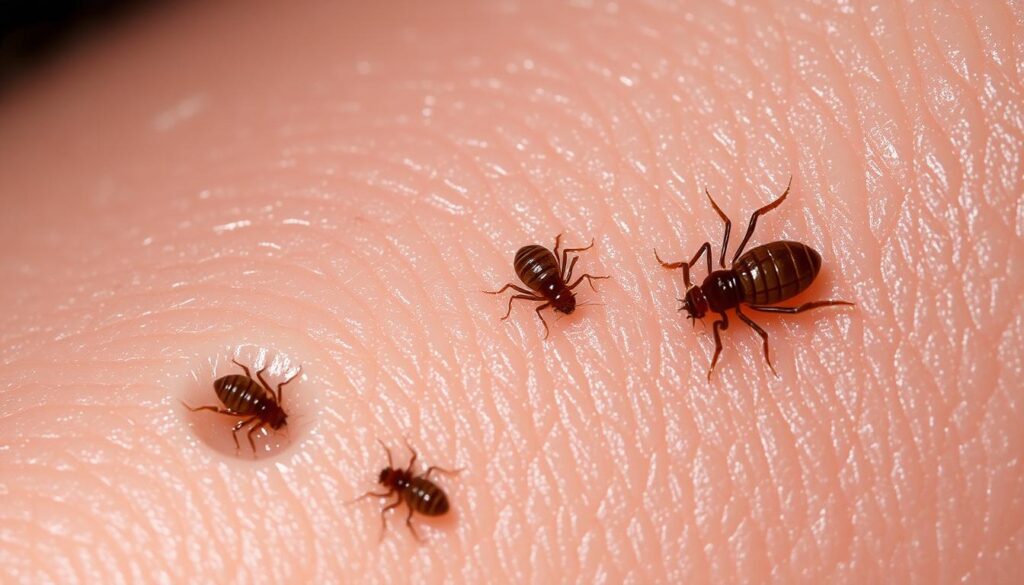
Scabies is a tricky skin problem that can mess up your daily routine. Tiny mites burrow into your skin, causing intense itching1. This contagious disease spreads quickly through close contact if not treated1.
Knowing about scabies helps catch it early. The rash can show up in many places, like between fingers, on the waist, and chest1. While it seems scary, modern treatments can fix it fast.
Scabies hits millions worldwide each year, making it a big health issue. But don’t worry! With the right medical help, you can beat these pesky mites1.
Key Takeaways
- Scabies is a highly contagious skin condition caused by microscopic mites
- Treatment typically involves prescription medications applied directly to the skin
- The condition can affect people of all ages and backgrounds
- Early detection and treatment are critical to prevent spread
- One treatment is usually sufficient to kill scabies mites2
What is Scabies and How Does It Spread?
Scabies is a tiny skin condition caused by the microscopic Sarcoptes scabiei mite. These tiny parasites burrow into human skin, creating an uncomfortable and contagious infestation3.
Understanding the Tiny Invaders
The Sarcoptes scabiei mite spreads scabies through prolonged skin-to-skin contact. Transmission usually requires about 15-20 minutes of close personal interaction4. These creatures can quickly spread in places with close human contact.
Common Transmission Routes
- Direct skin-to-skin contact with an infected person4
- Sharing personal items like clothing or bedding
- Close physical interactions in crowded settings
High-Risk Environments
Some places increase the chance of scabies transmission4:
| Environment | Transmission Risk |
|---|---|
| Nursing Homes | High |
| Prisons | High |
| Childcare Facilities | Moderate to High |
Scabies mites typically survive only 48-72 hours without a human host. Unlike common misconceptions, pets cannot spread human scabies, though they might carry different mite varieties3.
“Knowledge is the first step in preventing scabies transmission” – Public Health Expert
Knowing how scabies spreads helps you protect yourself and others. By staying informed, you can prevent this persistent skin condition.
Symptoms of Scabies You Should Recognize
Scabies is a skin condition with distinct, uncomfortable symptoms. Knowing these signs helps you spot and tackle the problem quickly.
Early Signs and Symptoms
The first scabies warning signs include intense itching, worse at night. You might see a skin rash with tiny red bumps in specific patterns.
Microscopic mites create threadlike tracks on your skin. These tracks are a clear sign of infestation5.
- Threadlike tracks on skin
- Tiny red bumps
- Intense nighttime itching
Common Affected Areas
Scabies targets body regions where skin folds or areas with close contact occur. These typically include:
- Between fingers
- Wrist areas
- Elbows
- Armpits
- Waistline
Severe Symptoms and Complications
Sometimes, scabies can become crusted scabies, which is extremely contagious5. The intense itching can disrupt sleep and lead to skin infections.
Scabies doesn’t discriminate – anyone can contract it, though some groups are more susceptible6.
| Symptom | Characteristics |
|---|---|
| Itching | Worst at night, can persist for weeks |
| Rash | Red bumps, may appear 6-8 weeks after infection |
| Transmission | Requires only 20 minutes of close contact |
The Itch Factor: Understanding Intense Itching
Scabies causes profound itching due to an allergic reaction to mites, eggs, and waste. This isn’t just annoying – it can greatly affect your daily life and sleep.
While scabies is uncomfortable, it’s treatable. Spotting symptoms early is key to managing it effectively.
Treatment Options for Scabies
Scabies demands targeted medical intervention. Understanding treatment options is vital when these mites invade your skin. Experts suggest specific methods to effectively eliminate the infestation.
Scabies treatment uses prescription medications to kill mites and eggs. Your doctor will suggest the best approach for your condition.
Topical Treatments: First Line of Defense
Permethrin cream is the main topical treatment for scabies. The FDA approves this 5% cream for people 2 months and older7.
You’ll need two applications about a week apart to fully eliminate the mites7.
- Permethrin cream 5%
- Spinosad topical suspension 0.9%
- Sulfur ointment 5-10%
Oral Medications: When Topical Treatments Aren’t Enough
For severe cases, doctors might prescribe ivermectin, an oral medication. It’s as effective as topical permethrin7.
This approach works well for widespread infestations. It’s also useful when topical treatments don’t fully solve the problem.
| Medication | Type | Recommended Use |
|---|---|---|
| Permethrin | Topical cream | First-line treatment |
| Ivermectin | Oral tablet | Severe or resistant cases |
| Spinosad | Topical suspension | Alternative treatment |
Home Care and Additional Considerations
Home remedies can’t replace medical treatment. However, you can help by washing bedding, clothes, and towels in hot water.
Preventing reinfestation is key to successful treatment.
Remember: Treat all household members simultaneously to prevent the spread of scabies.
Always talk to a doctor about the best treatment for you. Proper medical care ensures complete elimination of scabies mites.
Prevention Tips to Protect Yourself from Scabies
Scabies is a contagious disease that requires a proactive approach to personal hygiene. Understanding how it spreads is key to protecting yourself and others. People in close-contact settings like dorms and nursing homes are at higher risk8.
Your main defense is strict personal hygiene. Wash all clothing, bedding, and towels in hot water to kill mites8. Seal items you can’t wash in plastic bags for about a week8.
Treat everyone in your household, even without symptoms, to stop the spread8. Avoid close contact with infected people, as scabies spreads through skin-to-skin interactions8.
People can be infectious for up to two months before showing symptoms9. If you think you’ve been exposed, see a doctor right away9.
Stay alert in community settings by practicing good hygiene. Quick detection and thorough treatment are vital for managing scabies outbreaks10.
FAQ
What exactly are scabies?
Scabies is a contagious skin condition caused by tiny Sarcoptes scabiei mites. These microscopic parasites burrow into your skin and lay eggs. They trigger an intense allergic reaction, causing extreme itching and a distinctive rash.
How do scabies spread?
Scabies spreads through prolonged skin-to-skin contact, usually lasting about 15-20 minutes. They can also transmit through shared clothing, bedding, or towels. Mites can survive up to 72 hours without a human host.
What are the primary symptoms of scabies?
The main symptoms include intense itching, especially at night. A pimple-like rash and thin, wavy lines on the skin are also common.
Affected areas often include fingers, wrists, elbows, armpits, waist, and genital regions.
How are scabies treated?
Treatment typically involves prescription medications like permethrin cream or oral ivermectin. These are applied from neck to toes for 8-14 hours.
All household members and close contacts should be treated at the same time. This helps prevent reinfestation.
Can pets spread human scabies?
No, pets do not spread human scabies. They can carry different mites that might cause temporary itching. However, the Sarcoptes scabiei mite that affects humans isn’t transmitted by animals.
How long does scabies treatment take to work?
Treatment can kill mites quickly, but symptoms may persist for weeks. The intense itching is due to an allergic reaction.
Itching can continue even after mites are eliminated. Antihistamines might help manage the itching.
What are the best prevention strategies?
Maintain good personal hygiene and avoid close contact with infected individuals. Wash potentially contaminated items in hot water.
Don’t share personal items like clothing or bedding. Prompt treatment of infected individuals is crucial.
Are there any serious complications of scabies?
Severe cases can lead to crusted (Norwegian) scabies, which is highly contagious. Excessive scratching can cause secondary bacterial skin infections.
Early detection and treatment are essential to prevent these complications.
Source Links
- Scabies – Symptoms and causes – https://www.mayoclinic.org/diseases-conditions/scabies/symptoms-causes/syc-20377378
- What Is Scabies? – https://my.clevelandclinic.org/health/diseases/4567-scabies
- Scabies – https://www.who.int/news-room/fact-sheets/detail/scabies
- About Scabies – https://www.cdc.gov/scabies/about/index.html
- Scabies – https://www.healthdirect.gov.au/scabies
- Scabies – https://www.nhs.uk/conditions/scabies/
- Clinical Care of Scabies – https://www.cdc.gov/scabies/hcp/clinical-care/index.html
- How to Prevent Scabies – https://www.verywellhealth.com/scabies-prevention-4161244
- Scabies – including symptoms treatment and prevention | SA Health – https://www.sahealth.sa.gov.au/wps/wcm/connect/public content/sa health internet/conditions/bites stings and pests/scabies – including symptoms treatment and prevention
- Scabies control guidelines – https://www.health.vic.gov.au/infectious-diseases/scabies-control-guidelines

