
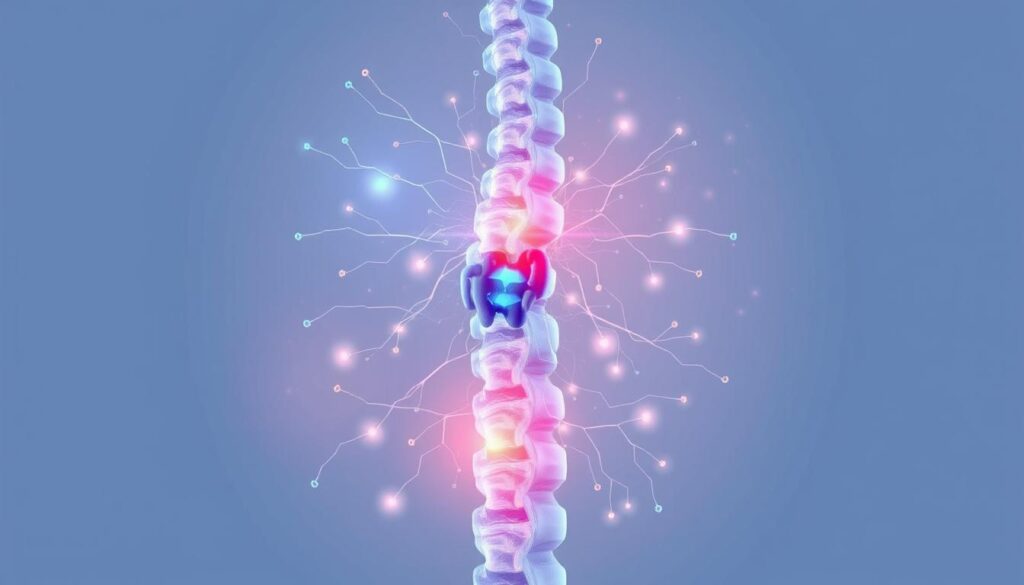
Spinal cord injuries can drastically change your life. They affect how your body responds and works. These complex events impact millions worldwide, with some groups more at risk1.
Men aged 16-30 face the highest risk. They make up about 80% of traumatic spinal cord injuries in the U.S1. Grasping Spinal Injury Reflex Control is vital for recovery.
Car crashes are the main cause of these injuries. This is especially true for people under 652. Spinal cord damage can lead to changes in movement and feeling2.
Other causes include falls, sports, and violence1. Alcohol plays a role in about 25% of these incidents1. This highlights the need for responsible behavior.
Key Takeaways
- Spinal cord injuries can profoundly impact neurological function
- Men aged 16-30 are most susceptible to spinal cord injuries
- Motor vehicle accidents are a leading cause of spinal cord damage
- Rehabilitation and understanding reflex control are critical
- Prevention and awareness can reduce injury risks
What is Spinal Injury Reflex Control?
Spinal injury reflex control is crucial for nervous system responses after spinal cord injuries. It greatly affects recovery and daily functioning. Your body’s ability to manage reflex responses plays a key role3.
The nervous system controls many bodily functions. Spinal cord injuries can disrupt communication between the brain and body. This leads to unique challenges in Autonomic Dysreflexia Management.
Understanding Reflex Mechanisms
Spinal cord injuries can change how your body responds to stimuli. Key aspects of reflex control include:
- Motor function regulation
- Sensory perception modification
- Autonomic nervous system responses
Clinical Insights into Reflex Responses
Recent research has revealed new insights into spinal reflexes. Dr. Aiko Thompson’s study showed targeted training could improve reflex control4.
Six out of nine participants in a special training group saw great improvements. They experienced a 59% increase in walking speed4.
“Reflex training offers promising potential for enhancing mobility and daily functioning after spinal cord injuries.”
Neuropathic Pain Treatment Considerations
People with spinal cord injuries often face unique neurological challenges. Some develop neurogenic pain that needs special Neuropathic Pain Treatment approaches3.
Treatment options may include:
- Medication management
- Electrical stimulation techniques
- Targeted physical therapy
- Surgical interventions
Grasping these complex reflex mechanisms helps create better rehabilitation strategies. This knowledge aids those adapting to life after a spinal cord injury3.
Types of Reflex Responses in Spinal Injuries
Spinal cord injuries can drastically change the body’s reflex mechanisms. These changes affect rehabilitation for bladder, bowel, and respiratory function. Understanding these responses is key to developing effective strategies.
The nervous system uses reflex responses to protect and maintain bodily functions. These reflexes work through complex neural pathways. Spinal injuries can significantly impact these pathways.
Withdrawal Reflex
The withdrawal reflex is a crucial protective mechanism in the human body. It causes immediate muscle contraction when you experience a potentially harmful stimulus. This reflex removes the affected body part from danger5.
For people with spinal cord injuries, this reflex can be compromised. This change can affect overall motor control in various ways.
- Protects against potential physical harm
- Involves rapid neural communication
- Can be impacted by spinal cord damage
Stretch Reflex
Monosynaptic reflexes are crucial for muscle function. These reflexes use two key neurons: a sensory neuron and a motor neuron. Both are located in the spinal ganglion5.
Important stretch reflexes include:
- Biceps brachii reflex
- Triceps brachii reflex
- Quadriceps femoris reflex
Crossed Extensor Reflex
This complex reflex coordinates responses across multiple muscle groups. When one side of the body feels a stimulus, the other side adjusts. This adjustment maintains balance and protects against potential injury5.
“Reflexes are the body’s rapid response system, operating faster than conscious thought.” – Neurological Research Team
Spinal shock can greatly affect these reflex responses. It typically lasts 4 to 12 weeks. During this time, reflex activities may change dramatically6.
Understanding these changes is crucial for rehabilitation. It helps develop better approaches for restoring bladder and bowel function. It also aids in respiratory muscle training.
Impact of Spinal Injuries on Reflex Control
Spinal cord injuries disrupt critical neurological systems and bodily functions. These complex challenges require effective rehabilitation strategies. Understanding these impacts is key to developing proper treatment7.
Trauma to the central nervous system can cause severe complications. These range from motor dysfunction to sensory impairments. Patients face significant challenges due to these issues7.
Understanding Impairment Levels
Spinal cord injuries show different severity levels. These levels greatly influence patient outcomes:
- Complete transection resulting in total loss of neural connectivity7
- Partial injuries leaving potential for neural recovery
- Variations in sympathetic nervous system disruption7
Rehabilitation Techniques for Reflex Enhancement
Functional Electrical Stimulation Therapy offers promising interventions for patients. This technique targets neuroplasticity to help regain crucial motor functions. It’s an innovative approach to spinal cord injury rehabilitation8.
Rehabilitation is not about perfection, but progressive improvement in neural pathway restoration.
The recovery process involves carefully monitored strategies. These include:
- Targeted electrical stimulation
- Progressive reflex conditioning
- Personalized neural retraining protocols
Successful rehabilitation depends on understanding individual neural response patterns and implementing precise intervention techniques.
Future Directions in Spinal Injury Research
Neurological recovery is a key focus in spinal cord injury treatment. Research is expanding our knowledge of neural regeneration and functional restoration. Advanced tech is reshaping rehab strategies, bringing hope to patients with complex spinal injuries9.
Advances in Neurorehabilitation
Functional Electrical Stimulation Therapy is a groundbreaking approach to neural rehab. It targets specific nervous system pathways, potentially restoring movement. Stem cell therapy and biomaterial transplantation are entering clinical trials9.
These innovative techniques show remarkable potential for rebuilding neural circuits. They offer new hope for patients with spinal cord injuries.
Promising Therapies and Innovations
New research explores tech that regulates neural cell growth. Electricity, magnetism, and ultrasound show promise in neural regeneration9. Scientists are creating advanced treatments to boost neurological recovery10.
Knowing about these developments is vital. Future rehab methods will target specific neural pathways. The outlook for spinal injury treatment is becoming more positive11.
FAQ
What is a Spinal Cord Injury (SCI)?
A spinal cord injury damages nerves that send signals to and from the brain. It can cause changes in feeling, movement, and body functions below the injury site. The injury may be complete or incomplete, depending on its extent and location.
How are Spinal Cord Injuries Classified?
The ASIA Impairment Scale (AIS) classifies spinal cord injuries. It measures the severity based on anal sensation and muscle control. The scale helps doctors understand nerve damage and recovery potential.
What Are the Main Types of Reflex Responses in Spinal Injuries?
The main reflex responses are the spinal stretch reflex (SSR) and the H-reflex. These use a two-neuron pathway in the spinal cord. In SCI patients, these reflexes can be abnormal.
Abnormal reflexes can lead to spasticity, foot drop, and reduced muscle control.
What Complications Can Result from a Spinal Cord Injury?
Spinal cord injuries can cause many complications. These may include breathing problems, pneumonia, and circulatory issues. Other potential problems are muscle stiffness, autonomic dysreflexia, pressure sores, and chronic pain.
What Rehabilitation Techniques Are Used for Spinal Cord Injuries?
Rehabilitation focuses on improving reflex control and overall function. One promising approach is the Spinal Cord Reflex Neurorehabilitation Training Device. It uses operant conditioning to target reflex pathway plasticity.
This method can improve locomotion, reduce spasticity, and increase walking speed. It may also decrease dependence on assistive devices.
Can Spinal Cord Injury Patients Improve Their Mobility?
Yes, patients can improve mobility through advanced rehabilitation techniques. These include functional electrical stimulation therapy and specialized reflex training devices. These methods aim to restore some motor function and improve muscle control.
They enhance overall mobility by targeting specific neural pathways and promoting neurological recovery.
What Are the Future Directions in Spinal Injury Research?
Current research focuses on developing advanced neurorehabilitation techniques. One example is the H-Reflex Device, which modifies nervous system pathways through operant conditioning. Researchers aim to create therapies for home use with remote therapist oversight.
These new treatments could help patients with various neurological conditions improve their quality of life.
How Does the Spinal Cord Protect Itself?
The spinal cord has three layers of tissue and cerebrospinal fluid for protection. It’s housed within the vertebrae. The cord consists of gray matter (nerve cells) and white matter (nerve fiber bundles).
These components work together to transmit signals between the brain and the body.
Source Links
- Spinal cord injury – Symptoms and causes – https://www.mayoclinic.org/diseases-conditions/spinal-cord-injury/symptoms-causes/syc-20377890
- Understanding Effects On Your Body After SCI – https://msktc.org/sci/factsheets/understanding-spinal-cord-injury-part-1-body-and-after-injury
- Spinal Cord Injury – https://www.ninds.nih.gov/health-information/disorders/spinal-cord-injury
- Reflex control could improve walking after incomplete spinal injuries – https://www.nih.gov/news-events/news-releases/reflex-control-could-improve-walking-after-incomplete-spinal-injuries
- Spinal reflex – https://www.kenhub.com/en/library/anatomy/spinal-reflex
- Revisit Spinal Shock: Pattern of Reflex Evolution during Spinal Shock – https://pmc.ncbi.nlm.nih.gov/articles/PMC6218357/
- Frontiers | Consequences of spinal cord injury on the sympathetic nervous system – https://www.frontiersin.org/journals/cellular-neuroscience/articles/10.3389/fncel.2023.999253/full
- Spinal shock revisited: a four-phase model – Spinal Cord – https://www.nature.com/articles/3101603
- Spinal cord injury: molecular mechanisms and therapeutic interventions – Signal Transduction and Targeted Therapy – https://www.nature.com/articles/s41392-023-01477-6
- Spinal cord injury: Present and future therapeutic devices and prostheses – https://pmc.ncbi.nlm.nih.gov/articles/PMC2390875/
- The past, present, and future of traumatic spinal cord injury therapies: a review – https://pmc.ncbi.nlm.nih.gov/articles/PMC9134839/

