
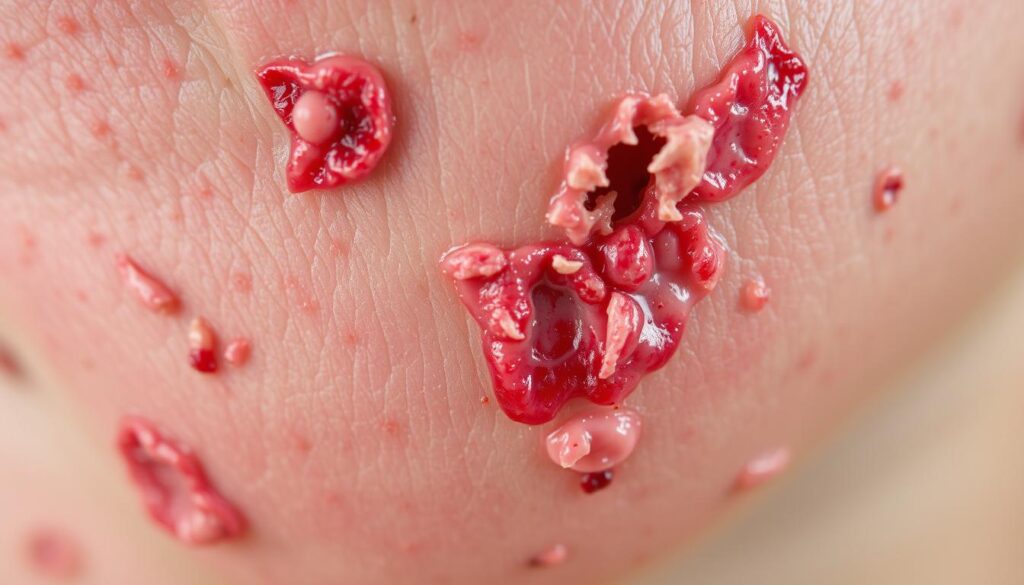
Toxic Epidermal Necrolysis (TEN) is a rare but severe skin condition. It can cause extensive damage to your body’s largest organ. TEN typically affects people over 40, with women being more susceptible1.
Drug reactions cause 80% to 95% of TEN cases1. The condition usually impacts oral, eye, and genital regions. Certain genetic factors and high-risk groups increase the chances of developing TEN1.
TEN is a serious medical emergency with mortality rates of 20% to 50%12. Immediate medical attention is crucial. HIV-positive individuals have a 1000 times higher risk of developing TEN1.
Key Takeaways
- TEN is a rare, severe skin reaction affecting 1-2 people per million annually
- Drug reactions are the primary cause of TEN
- Individuals over 40 are most commonly affected
- High mortality rates range between 20% and 50%
- HIV-positive patients have significantly increased risk
What is TEN (Toxic Epidermal Necrolysis)
Toxic Epidermal Necrolysis (TEN) is a rare, life-threatening skin disorder. It severely damages skin and mucous membranes. TEN can drastically change your health in many ways3.
Medical Definition and Classification
TEN causes a severe skin rash affecting over 30% of your body. It leads to widespread skin detachment and mucosal erosions. The condition usually appears within one to four weeks after taking certain medications3.
- Rare occurrence: 0.4 to 1.2 cases per million people annually4
- High mortality rate: 25% to 35% of diagnosed patients4
- Most frequently triggered by medications
Relationship to Stevens-Johnson Syndrome
Stevens-Johnson syndrome and TEN are closely related skin conditions. TEN is the more severe form. Stevens-Johnson affects less than 10% of body surface. TEN impacts over 30% of skin area4.
| Condition | Body Surface Affected | Severity |
|---|---|---|
| Stevens-Johnson Syndrome | < 10% | Moderate |
| TEN | > 30% | Severe |
Impact on Body Systems
TEN can harm multiple body systems, causing complex health issues. Possible problems include blood infections, lung damage, and vision loss. It can also lead to permanent skin damage3.
Genetic factors and specific HLA types may increase your risk for TEN4.
Early recognition and prompt medical intervention are crucial for managing TEN and improving potential outcomes.
Common Causes and Risk Factors of Severe Skin Reactions
Toxic Epidermal Necrolysis (TEN) stems from medication triggers and genetic factors. Knowing these causes helps spot risks early. Prompt medical help is crucial for this condition.
Specific medications and health issues can trigger severe skin reactions. People with weak immune systems are at higher risk. These reactions can be dangerous for them5.
Key Risk Factors
- HIV infection dramatically increases susceptibility to severe skin reactions6
- Genetic variations in the HLA-B gene play a crucial role in immunological reaction potential5
- Certain medications pose higher risks of triggering skin disorders
Medication Triggers
| Medication Category | Risk Level |
|---|---|
| Antibiotics | High Risk |
| Epilepsy Drugs | Moderate Risk |
| Sulfa Drugs | High Risk |
| Allopurinol | Significant Risk |
Symptoms usually start 1-4 weeks after taking a new medicine. HIV-positive people are 100 times more likely to have these reactions6.
“Understanding your personal risk factors can be a critical step in preventing severe skin reactions.” – Dermatology Research Institute
Your genes play a big role in your risk level. The U.S. FDA suggests genetic tests for Asian and South Asian people before certain treatments6.
Important Considerations
- Consult healthcare providers about potential medication risks
- Be aware of your genetic predispositions
- Monitor any unusual skin reactions immediately
These skin reactions are rare but can be deadly. Stevens-Johnson syndrome can be fatal in 10% of cases5. Toxic epidermal necrolysis is even more dangerous.
It can be fatal in up to 50% of cases5. Early detection and treatment are key to survival.
Recognizing Symptoms and Diagnostic Approaches
Toxic Epidermal Necrolysis (TEN) is a serious condition that needs immediate medical attention. Recognizing early signs is crucial for patient survival. Quick action can prevent life-threatening complications.
Early Warning Signs of Skin Reactions
TEN symptoms appear rapidly, starting with intense skin pain and a spreading rash. You may notice blistering and early skin detachment. These signs can progress quickly.
Patients often experience high fever, severe skin pain, and a reddish or purplish rash. Initial skin sensitivity is also common.
- High fever
- Severe skin pain
- Reddish or purplish rash
- Initial skin sensitivity
Progressive Symptoms Development
As TEN worsens, symptoms become more severe. Peeling skin and mucosal erosions can develop dramatically, often covering large body areas7.
The condition typically progresses rapidly. Symptoms can evolve within just three days7.
Clinical Assessment Methods
Diagnosing TEN requires a comprehensive clinical approach. Doctors use the SCORTEN system to assess disease severity. This system helps predict potential mortality risks8.
| Diagnostic Criteria | Assessment Method |
|---|---|
| Physical Examination | Evaluate skin and mucosal involvement |
| Skin Biopsy | Confirm TEN diagnosis |
| SCORTEN Scoring | Predict mortality risk |
Early recognition and prompt medical intervention are critical for improving patient outcomes.
TEN mortality rates can range from 14.8% to 48%. This highlights the need for immediate, specialized medical care8.
Conclusion
Toxic Epidermal Necrolysis (TEN) demands a thorough medical approach. Treatment focuses on critical supportive care strategies that impact recovery. TEN’s complexity requires careful medical intervention, with mortality rates of 25-35% for severe cases9.
Long-term management is vital for TEN patients. Systemic corticosteroids may help control inflammatory responses. Specialized wound care, like Nanocrystalline silver dressings, can boost healing.
Recovery time varies from 12 to 65 days, averaging 23 days9. Prevention is crucial, especially for those with previous drug reaction histories.
Your medical team will address potential complications affecting skin, eyes, and mental health. TEN is rare, with 1-2 cases per million people annually10.
Work closely with healthcare experts and stay vigilant about medications to manage this condition effectively. Quick detection, fast action, and tailored treatment plans are crucial for TEN recovery.
Stay informed, follow medical advice, and put your health first throughout your healing journey.
FAQ
What is Toxic Epidermal Necrolysis (TEN)?
TEN is a rare, life-threatening skin condition. It causes widespread blistering and skin peeling, affecting over 30% of your body. TEN is the most severe form of Stevens-Johnson syndrome and needs immediate medical care.
This condition can cause intense skin pain and affect mucous membranes. It may also impact multiple body systems, making it very serious.
What typically causes TEN?
TEN is mainly caused by bad reactions to medicines. Symptoms usually show up 1-4 weeks after starting a new drug. Common triggers include antibiotics, epilepsy drugs, sulfa drugs, and allopurinol.
Your risk is higher if you have HIV, a weak immune system, or cancer. A personal or family history of similar skin reactions also increases risk.
What are the early warning signs of TEN?
Early signs of TEN include widespread skin pain, fever, and a spreading rash. As it worsens, large areas of skin may blister and peel off.
You might get sores on mucous membranes like your mouth, eyes, and genitals. Internal organs can also be affected. If you notice these symptoms, get medical help right away.
How is TEN diagnosed?
Doctors diagnose TEN based on how it looks and a skin biopsy. They use the SCORTEN system to check how bad it is.
The diagnosis looks at how much skin is affected and what symptoms you have. Doctors also consider which medicines might have triggered it.
What is the treatment for TEN?
Treatment focuses on supportive care. This includes managing pain, caring for wounds, replacing fluids, and providing nutrition. Some patients may benefit from steroids or other immune-changing therapies.
Long-term care involves dealing with possible problems like eye issues, skin damage, and mental health impacts.
What is the mortality rate for TEN?
The death rate for TEN is about 25%. However, early detection and quick medical help can greatly improve outcomes. Treatment in a special hospital is crucial for managing this severe condition.
Can TEN be prevented?
Prevention is key for those who’ve had TEN before. Avoid medicines that caused the reaction before. Wear medical alert ID and talk to doctors before taking new drugs.
Genetic testing may help find potential risk factors.
How long does recovery from TEN take?
Recovery can take weeks to months. The time depends on how severe the condition is and how well you heal.
Ongoing medical check-ups and supportive care are crucial during recovery.
Source Links
- Toxic epidermal necrolysis – https://en.wikipedia.org/wiki/Toxic_epidermal_necrolysis
- Toxic epidermal necrolysis and Stevens-Johnson syndrome – Orphanet Journal of Rare Diseases – https://ojrd.biomedcentral.com/articles/10.1186/1750-1172-5-39
- TEN – Symptoms and causes – https://www.mayoclinic.org/diseases-conditions/toxic-epidermal-necrolysis/symptoms-causes/syc-20491903
- Toxic Epidermal Necrolysis (TEN): Background, Pathophysiology, Etiology – https://emedicine.medscape.com/article/229698-overview
- Stevens-Johnson syndrome/toxic epidermal necrolysis: MedlinePlus Genetics – https://medlineplus.gov/genetics/condition/stevens-johnson-syndrome-toxic-epidermal-necrolysis/
- Stevens-Johnson syndrome-Stevens-Johnson syndrome – Symptoms & causes – Mayo Clinic – https://www.mayoclinic.org/diseases-conditions/stevens-johnson-syndrome/symptoms-causes/syc-20355936
- Toxic Epidermal Necrolysis | Loma Linda University Health – https://lluh.org/conditions/toxic-epidermal-necrolysis
- Stevens–Johnson Syndrome and Toxic Epidermal Necrolysis: A Review of Diagnosis and Management – https://pmc.ncbi.nlm.nih.gov/articles/PMC8472007/
- Toxic epidermal necrolysis – management issues and treatment options – https://pmc.ncbi.nlm.nih.gov/articles/PMC3415942/
- Stevens-Johnson Syndrome/Toxic epidermal necrolysis complicated with fulminant type 1 diabetes mellitus: a case report and literature review – BMC Endocrine Disorders – https://bmcendocrdisord.biomedcentral.com/articles/10.1186/s12902-024-01683-5

