
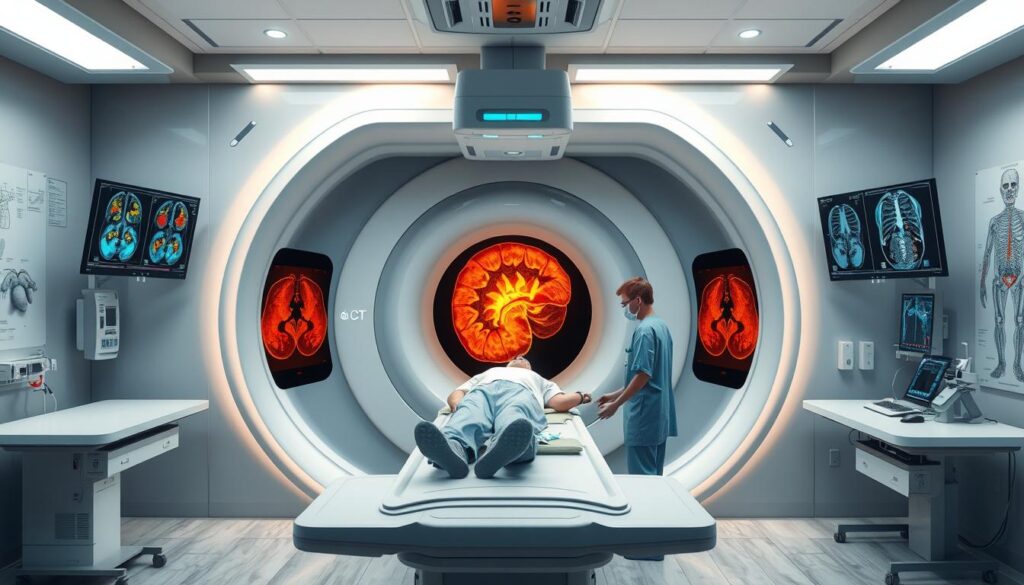
A CT urogram is a high-tech scan that explores your urinary tract. It provides detailed views of any abnormalities affecting your health1. Your doctor may suggest this scan if you have urine pain or blood in your urine1.
Radiologists take multiple images during a CT urogram to diagnose various conditions. The scan detects kidney stones, bladder issues, infections, and possible tumors1. Doctors use this method to understand complex urinary system problems accurately2.
Your CT urogram involves three key stages. These include a non-contrast scan, a contrast-enhanced scan, and a final drainage scan1. The process is usually painless and lasts about 90 minutes1.
Technologists carefully prepare and perform each stage. This ensures they gather all the necessary diagnostic information2.
Key Takeaways
- CT urograms provide comprehensive imaging of the urinary tract
- The procedure helps diagnose various urological conditions
- Multiple scan stages ensure detailed medical insights
- Typically painless and takes around 90 minutes
- Helps detect kidney stones, infections, and potential tumors
What is a CT Urogram and Its Medical Purpose
CT urography is an advanced imaging technique for your urinary system. It provides detailed views of kidneys, ureters, and bladder. This helps doctors detect and evaluate urinary tract conditions quickly3.
Using cutting-edge technology, CT urography offers exceptional precision. It allows healthcare professionals to examine the urinary system thoroughly.
How CT Urography Technology Works
CT urography creates 3D images of your urinary system. A special contrast medium is injected to enhance visibility4. The scanning process involves lying on an exam table.
You’ll receive an intravenous X-ray dye injection. Then, a detailed scan captures multiple image angles.
- Lying on an exam table
- Receiving an intravenous X-ray dye injection
- Undergoing a detailed scan that captures multiple image angles
Common Reasons for Getting a CT Urogram
Doctors recommend CT urography for various medical conditions. You might need this if you have persistent side or back pain.
Other reasons include blood in your urine or suspected kidney stones. It’s also used for potential bladder cancer detection.
- Persistent pain in the side or back
- Blood in your urine
- Suspected kidney stones
- Potential bladder cancer detection
“CT urography provides unparalleled visualization of the urinary tract, helping doctors diagnose complex conditions with remarkable accuracy.” – Radiology Specialist
Benefits of Contrast-Enhanced Imaging
Contrast-enhanced CT offers significant advantages in medical diagnostics. It helps identify kidney stones, tumors, and structural abnormalities clearly3. Radiologists can distinguish between different tissue types more effectively.
The CT urogram procedure typically takes 10 to 30 minutes. Each scan captures detailed images in seconds5.
While the procedure involves minimal discomfort, discuss any concerns with your healthcare provider. It’s crucial to share your medical conditions beforehand3.
Preparing for Your CT Urogram Procedure
Proper preparation is crucial for accurate CT urogram imaging. Your radiology team will provide specific instructions for this contrast-enhanced CT exam6. Follow their guidance carefully to ensure the best results.
- Inform your healthcare provider about all allergies, especially to iodine or contrast dye
- Discuss current medications and medical conditions
- Complete any required blood tests
- Wear comfortable, loose-fitting clothing6
“Proper preparation is key to a successful imaging procedure”
If you’re allergic to contrast dye, your doctor may suggest taking steroids and antihistamines beforehand6. You’ll likely be asked to drink water and avoid urinating to expand your bladder for better imaging6.
Before the scan, remove metal objects like jewelry. You might need to change into a hospital gown. The CT urogram usually takes 5-10 minutes2.
When the contrast dye is injected, you may feel warm or taste metal. Women should tell their doctor if they might be pregnant6. The technologist will guide you through each step.
Conclusion
CT Urograms offer vital insights into urinary tract health. These advanced scans help doctors spot abnormalities with great accuracy7. Your experience is designed to be thorough and patient-centered8.
Radiologists use cutting-edge tech to capture detailed urinary system images. The scan usually takes 30 to 60 minutes8. Special methods like the split bolus technique reduce radiation while maintaining high-quality results7.
Your safety is a top priority during these exams. CT equipment is designed to minimize radiation risks8. Your doctor will explain each step, ensuring you’re comfortable throughout the process9.
CT Urograms are key in identifying potential health issues. They allow for early detection of various medical conditions. Trust your medical team and the advanced technology supporting your care.
These scans provide detailed views of your urinary tract. This enables prompt intervention when needed. Your healthcare journey is backed by expertise and state-of-the-art imaging.
FAQ
What exactly is a CT urogram?
A CT urogram is an advanced imaging exam for your urinary tract. It uses X-rays to create detailed images of your kidneys, bladder, and ureters. This test helps doctors diagnose conditions like kidney stones, tumors, and structural issues.
How long does a CT urogram procedure take?
The entire CT urogram exam usually lasts about an hour. The actual scanning time ranges from 10 to 30 minutes. You’ll lie on a table while the CT machine takes X-ray images.
Will I need to do anything special to prepare for the CT urogram?
Tell your doctor about any allergies, especially to iodine or contrast dye. You might need to drink water before the exam. Wear comfy clothes and take off metal items like jewelry.
Your doctor may also order blood tests. This ensures it’s safe to use contrast dye during the procedure.
Does the CT urogram involve radiation?
Yes, the CT urogram uses X-ray technology, which involves radiation. However, doctors carefully control radiation levels to keep patients safe. The benefits of diagnosis usually outweigh the small risks of radiation exposure.
What happens during the contrast dye injection?
An iodine-based contrast medium is injected into your vein. You might feel warmth, flushing, or taste metal in your mouth. This dye helps highlight your urinary system for clearer images.
Are there any side effects from the CT urogram?
Most patients handle the procedure well. Some might have mild allergic reactions to the contrast dye. You could feel temporary warmth or flushing.
Rarely, kidney-related complications can occur. Always talk to your doctor about your medical history and concerns beforehand.
When will I receive my CT urogram results?
CT urogram results are usually ready within 1-2 weeks after the procedure. A radiologist will study the images and write a report. Your doctor will then discuss the findings with you.
Can I resume normal activities after the CT urogram?
In most cases, you can go back to your normal activities right after the CT urogram. If you notice any unusual symptoms, contact your doctor right away.
Source Links
- What is a CT urogram? Procedure, uses, risks, and results – https://www.medicalnewstoday.com/articles/ct-urogram
- CT Urogram | Jackson Hospital – https://www.jackson-hospital.com/medical-services/radiology-x-ray/ct-scan/ct-urogram/
- Computerized tomography (CT) urogram – Mayo Clinic – https://www.mayoclinic.org/tests-procedures/ct-urogram/about/pac-20393602
- CT urogram – https://www.cancerresearchuk.org/about-cancer/tests-and-scans/ct-urogram
- CT Urogram: Purpose, Procedure, Risks & Results – https://my.clevelandclinic.org/health/diagnostics/24186-ct-urogram
- Urography – https://www.radiologyinfo.org/en/info/urography
- Computed Tomography Urography: State of the Art and Beyond – https://www.mdpi.com/2379-139X/9/3/75
- What is the difference between a CT Scan And a CT Urogram – https://aqmdi.com/what-is-the-difference-between-a-ct-scan-and-a-ct-urogram/
- Image quality and pathology assessment in CT Urography: when is the low-dose series sufficient? – BMC Medical Imaging – https://bmcmedimaging.biomedcentral.com/articles/10.1186/s12880-019-0363-z

