
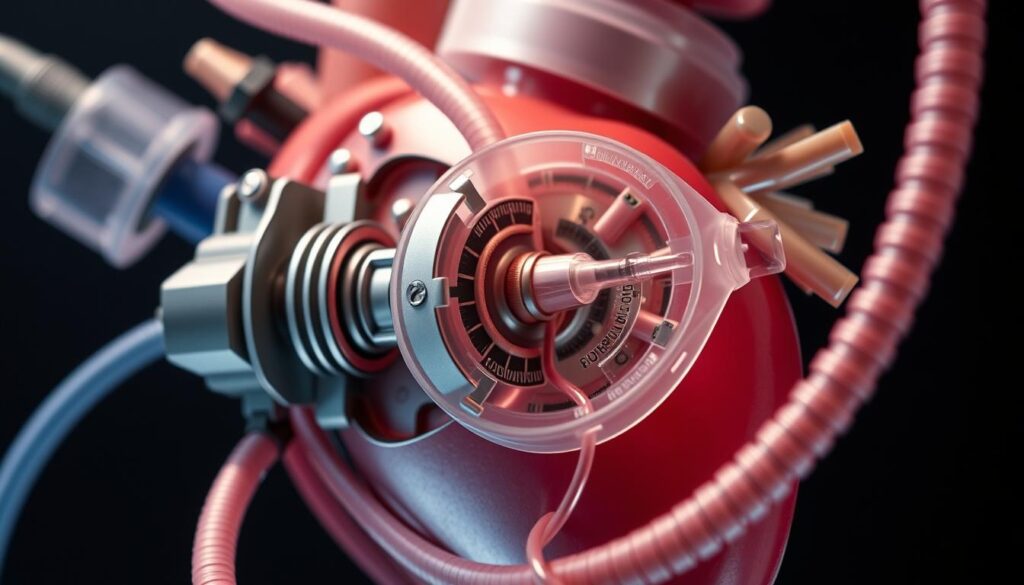
A Ventricular Assist Device (VAD) is a lifesaving cardiac implant for hearts struggling to pump blood. It provides mechanical support, ensuring continuous blood flow throughout the body1. Left ventricular assist devices are often placed in the left lower heart chamber to help critical cardiac conditions1.
VADs are crucial for patients facing severe heart failure. These mechanical pumps maintain constant blood flow from the heart to vital organs1. LVAD implantation requires open-heart surgery and carries risks, but it can transform lives of those with severe heart issues1.
VAD treatment serves multiple purposes in cardiac care. It can bridge patients to heart transplant or act as destination therapy for transplant-ineligible individuals2. Sometimes, it supports potential heart recovery.
Medical experts carefully assess each patient’s unique cardiac condition. This evaluation helps determine the most suitable approach for VAD treatment.
Key Takeaways
- VADs provide critical mechanical circulatory support for heart failure patients
- Open-heart surgery is typically required for LVAD implantation
- Devices can be temporary or permanent depending on patient needs
- Continuous blood flow is maintained through advanced cardiac technology
- Multiple types of VADs exist to address different heart conditions
What is a Ventricular Assist Device (VAD) and How Does It Work?
A ventricular assist device (VAD) supports heart function in severe heart failure patients3. These devices have transformed cardiac care in recent years. They offer hope to those with advanced heart conditions.
Types of Ventricular Assist Devices
Doctors use different VADs for specific heart issues:
- Left Ventricular Assist Device (LVAD): Supports the left side of the heart3
- Right Ventricular Assist Device (RVAD): Supports the right side of the heart3
- Biventricular Assist Device (BiVAD): Provides support to both heart ventricles
- Durable VAD: Designed for long-term use
Components and Functionality
A typical VAD has several key parts. The internal pump weighs about 1 to 2 pounds4. It’s carefully implanted to help the heart work better.
The surgery to put in a VAD usually takes 4 to 6 hours4.
Common Uses and Applications
VADs serve important medical needs:
- Bridge to Transplant (BTT): Helping patients waiting for heart transplants3
- Destination Therapy: Long-term heart support, with patients living over 8 years on the device3
- Bridge to Recovery: Short-term heart help
VADs have transformed cardiac care, offering new hope for patients with advanced heart failure.
Note: VADs can improve patient health but may cause blood clots, infections, or surgery problems4.
Benefits and Candidacy for VAD Treatment
Ventricular assist devices (VADs) can change your heart failure treatment journey. These cardiac implants offer hope for severe heart conditions. VADs provide a crucial bridge to transplant or long-term therapy5.
VAD candidacy requires a thorough evaluation process. It looks at several key factors.
- Severity of heart failure
- Overall health conditions
- Heart chamber function
- Ability to manage blood thinners
- Personal support system
VAD treatment offers major benefits. Patients often see better quality of life. Some treatments can even extend life expectancy5.
New VAD technologies bring great advantages. These include smaller pumps and wearable support systems.
- Smaller, more advanced pumps
- Wearable support systems
- Reduced medication requirements
- Enhanced long-term outcomes
VADs represent a beacon of hope for those battling advanced heart failure, transforming what was once a dire prognosis into a manageable condition.
| VAD Treatment Characteristics | Details |
|---|---|
| Surgical Duration | 4-8 hours5 |
| Hospital Recovery | 2-4 weeks5 |
| Primary Purpose | Destination therapy or bridge to transplant |
Careful patient selection and comprehensive medical assessment are key. They ensure VAD treatment fits each person’s unique needs6.
Conclusion
Ventricular Assist Devices (VADs) have revolutionized heart failure treatment. These mechanical supports offer new hope for patients with severe cardiac issues. Six million Americans battle heart failure, with 600,000 new cases yearly7.
For advanced conditions, a durable VAD can be life-changing8. Innovative VAD technologies have greatly improved patient outcomes. Left Ventricular Assist Devices (LVADs) now support patients with complex heart conditions9.
Clinical trials show impressive survival rates with these devices. Patients experience up to a 48% reduction in mortality risk7. The HeartMate II device boasts a 58% two-year survival rate7.
Choosing a VAD requires careful thought and ongoing medical care. Despite challenges, the potential for a better life is huge. Modern VADs are smaller, more reliable, and extend lifespans beyond traditional treatments9.
As medical tech advances, these devices shine as beacons of hope. They offer new possibilities for those facing advanced heart failure. Learn more about heart failure treatment advances and how they can help you.
FAQ
What is a Ventricular Assist Device (VAD)?
A VAD is a mechanical pump that helps your heart circulate blood. It’s implanted to support weakened hearts or treat heart failure. This device assists when your heart can’t pump blood effectively on its own.
What are the different types of VADs?
There are three main types of VADs: LVADs, RVADs, and BiVADs. LVADs are the most common, supporting the left ventricle. RVADs help the right side of the heart. BiVADs provide support to both ventricles.
How is a VAD implanted?
VAD implantation requires open-heart surgery. The device has an internal pump connected to an external controller. Your surgeon places the pump in the heart chamber and connects it to the aorta.
Who is a candidate for VAD treatment?
Candidates include patients awaiting heart transplants and those needing long-term support. People with potentially reversible heart failure may also qualify. The evaluation involves comprehensive medical tests like blood work and cardiac catheterization.
What are the main uses of a VAD?
VADs serve three primary purposes. They can be a bridge to transplant or recovery. They’re also used as destination therapy for those ineligible for heart transplants.
What daily maintenance is required for a VAD?
VAD maintenance involves daily self-tests and regular dressing changes. You’ll need to take blood thinners and follow specific guidelines. Your medical team will provide detailed instructions on proper care.
What are the potential risks of VAD treatment?
VAD treatment carries risks like bleeding, infection, and device malfunction. However, for many patients, the benefits often outweigh these risks. Improved quality of life and increased survival rates are significant advantages.
How does a VAD improve quality of life?
A VAD can significantly enhance your life by providing consistent blood circulation. It reduces heart failure symptoms and may improve organ function. Many patients experience increased energy and fewer hospital visits.
Can I live a normal life with a VAD?
With some lifestyle adjustments, many VAD patients enjoy an active life. You’ll work closely with your medical team to manage the device. Adapting to your new medical support system is crucial for a fulfilling life.
Source Links
- Ventricular assist device (VAD) – Mayo Clinic – https://www.mayoclinic.org/tests-procedures/ventricular-assist-device/about/pac-20384529
- Ventricular Assist Device (VAD) – https://www.templehealth.org/services/treatments/ventricular-assist-device
- LVADs and VADs | Frankel Cardiovascular Center – https://www.umcvc.org/conditions-treatments/lvads-and-other-ventricular-assist-devices-vads
- Ventricular assist device: MedlinePlus Medical Encyclopedia – https://medlineplus.gov/ency/article/007268.htm
- Ventricular Assist Device (VAD) – https://www.wellspan.org/conditions-and-treatments/ventricular-assist-device
- Ventricular Assist Device (VAD) – https://www.urmc.rochester.edu/conditions-and-treatments/ventricular-assist-device
- Left Ventricular Assist Devices (LVADS): History, Clinical Application and Complications – https://pmc.ncbi.nlm.nih.gov/articles/PMC6597447/
- NCA – Ventricular Assist Devices as Destination Therapy (CAG-00119R2) – https://www.cms.gov/medicare-coverage-database/details/nca-decision-memo.aspx?NCAId=243&ver=9&NcaName=Ventricular Assist Devices as Destination Therapy (2nd Recon)
- Ventricular assist device – https://en.wikipedia.org/wiki/Ventricular_assist_device

