
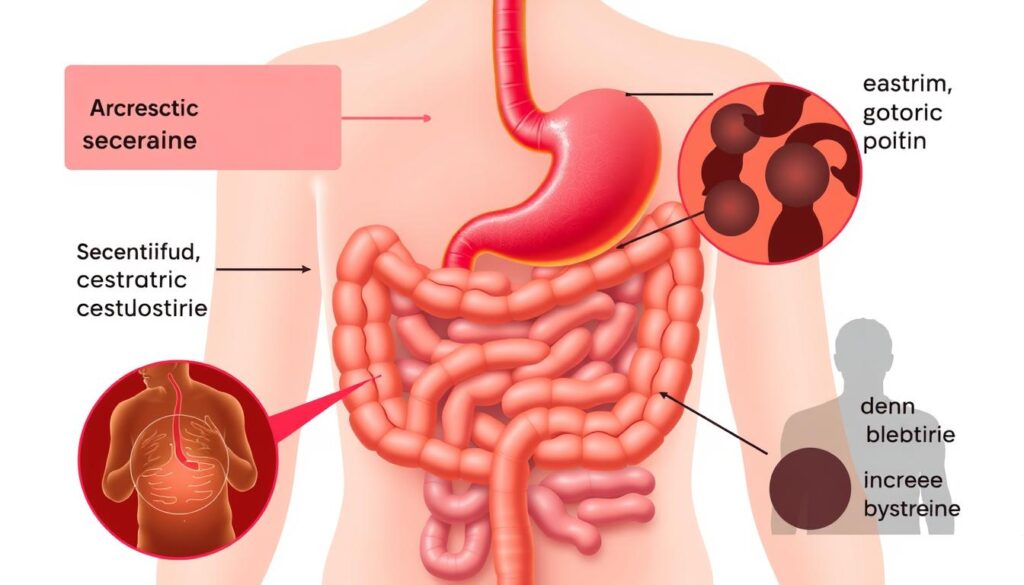
Zollinger-Ellison syndrome (ZES) is a rare digestive disorder caused by gastrinoma tumors. These tumors trigger excessive stomach acid production, leading to significant health issues12. ZES typically develops in the pancreas or small intestine, causing major digestive problems2.
ZES usually affects people aged 20 to 50, with men slightly more at risk12. Common symptoms include abdominal pain, diarrhea, and severe heartburn12. These symptoms can seriously disrupt daily life.
Early detection and treatment of ZES are vital for effective health management. Gastrinomas may spread to nearby lymph nodes or the liver1. Quick action can help prevent complications and improve outcomes.
Key Takeaways
- ZES is a rare digestive disorder caused by gastrinoma tumors
- Symptoms include diarrhea, abdominal pain, and severe heartburn
- Most commonly affects individuals between 20-50 years old
- Tumors can potentially spread to lymph nodes or liver
- Proactive medical management is critical for optimal health
What is Zollinger-Ellison Syndrome
Zollinger-Ellison syndrome is a rare condition causing unusual gastric acid production and tumor formations. It disrupts normal digestive function and mainly affects adults aged 20 to 503. Men are slightly more likely to develop this syndrome3.
Understanding Gastric Acid Hypersecretion
The syndrome stems from a neuroendocrine tumor called gastrinoma. These tumors grow in the pancreas or duodenum, causing excessive gastrin hormone production4.
Gastrinomas lead to increased stomach acid, which can result in peptic ulcers. This excess acid production severely impacts the digestive system.
- Gastrinomas produce large amounts of gastrin hormone
- Excessive gastrin leads to increased stomach acid production
- Increased acid can cause peptic ulcers and digestive complications
The Role of Gastrinomas
Gastrinomas can be benign or malignant tumors. About half to two-thirds of these tumors are cancerous4. They grow slowly but can spread to nearby lymph nodes or the liver.
Connection to Multiple Endocrine Neoplasia
About 25% of Zollinger-Ellison syndrome cases link to multiple endocrine neoplasia type 1 (MEN1)5. MEN1 is an inherited condition that increases tumor risk in various endocrine glands.
“Understanding the intricate mechanisms of Zollinger-Ellison syndrome is key to effective management and treatment.”
| Characteristic | Details |
|---|---|
| Prevalence | 1 in 100,000 people5 |
| Age of Onset | 30-60 years old5 |
| Sporadic Cases | 75% of diagnosed instances5 |
Common Signs and Digestive Complications
Zollinger-Ellison syndrome causes tough digestive issues that can mess up your daily routine. About 90% of patients get stomach and duodenal ulcers from too much stomach acid6. This excess acid leads to painful symptoms that need careful medical care.
Your gut might show these warning signs:
- Persistent diarrhea
- Burning or dull abdominal pain
- Frequent heartburn
- Unexpected weight loss
- Nausea and vomiting
The syndrome can cause serious gut problems. Recurrent ulcers may pop up in your food pipe, stomach, and small intestine7. If not treated, these ulcers might bleed or make holes in your gut.
Tests show key info about how the syndrome progresses:
| Complication | Frequency |
|---|---|
| Peptic Ulcers | 90% of patients |
| Multiple Endocrine Neoplasia Type 1 | 25-30% of cases |
| Malignant Gastrinomas | Over 50% of single tumors |
“Early recognition of symptoms can significantly improve management and treatment outcomes.”
Your doctor might suggest proton pump inhibitors to control acid and ease symptoms. Regular check-ups are key to spot problems and tweak treatment plans6.
Knowing these signs helps you manage Zollinger-Ellison syndrome better. This can boost your gut health and life quality.
Diagnostic Methods and Treatment Options
Zollinger-Ellison syndrome diagnosis requires a thorough approach. Healthcare providers use advanced techniques to identify and manage this rare condition8.
Blood Tests and Imaging Techniques
Diagnosis starts with blood tests measuring gastrin levels. Initial fasting serum gastrin levels can indicate prognosis9.
Advanced imaging helps locate gastrinomas. These procedures include:
- CT scans
- Magnetic Resonance Imaging (MRI)
- Endoscopic ultrasound
- Radionuclide scanning
Medication Management Strategies
Treatment aims to control excessive stomach acid production. Proton pump inhibitors are the main medication strategy.
Drugs like omeprazole and lansoprazole provide essential relief. Long-term use may be recommended through specialized treatment protocols.
Surgical Intervention Guidelines
Gastrinoma resection is crucial for patients without multiple endocrine neoplasia type 1 (MEN1). Surgical approaches depend on tumor characteristics and spread.
Aggressive tumor removal can potentially cure the condition9. MEN1 patients have limited surgical options, often focusing on larger tumor removal.
Understanding your specific condition is key to developing an effective treatment plan.
Advanced cases may require somatostatin analogs or chemotherapy8. ZES affects 1 in 1 million people, usually between ages 30 and 508.
Conclusion
Zollinger-Ellison Syndrome management requires a tailored approach. Patients typically experience initial symptoms around age 48. Your treatment strategy depends on whether your gastrinoma developed sporadically or as part of MEN-11011.
Effective gastrinoma treatment involves multiple strategies. Proton pump inhibitors control acid production, while periodic monitoring tracks digestive health. For non-MEN-1 patients, surgery might offer a potential cure10.
Medical research shows that few peptic ulcer disease patients are diagnosed with this syndrome11. Long-term management involves regular medical assessments and treatment adjustments.
MEN-1 patients need more complex interventions. They often require lifelong medication and targeted surgical approaches. Work closely with your healthcare team to navigate Zollinger-Ellison Syndrome challenges.
FAQ
What is Zollinger-Ellison Syndrome (ZES)?
ZES is a rare digestive disorder marked by gastrinomas. These tumors form in the pancreas or small intestine. They cause excess stomach acid, leading to ulcers, diarrhea, and abdominal pain.
Who is most likely to develop Zollinger-Ellison Syndrome?
ZES mainly affects people aged 20 to 50, with a slight male prevalence. About 20-25% of cases link to multiple endocrine neoplasia type 1 (MEN1). MEN1 is an inherited condition that raises tumor risk.
What are the main symptoms of Zollinger-Ellison Syndrome?
Common symptoms include persistent diarrhea and abdominal pain. Severe heartburn, nausea, vomiting, and unintended weight loss may occur. You might also experience acid reflux and excessive burping.
How is Zollinger-Ellison Syndrome diagnosed?
Diagnosis involves blood tests to measure gastrin levels. Imaging procedures like CT scans and MRI are also used. Endoscopic exams help locate gastrinomas and assess their impact.
A secretin stimulation test may be performed. Upper GI endoscopy is another diagnostic tool used.
What are the primary treatment options for ZES?
Treatment focuses on managing acid production with high-dose proton pump inhibitors (PPIs). Omeprazole and lansoprazole are common PPIs used. Surgical removal of gastrinomas may be recommended for patients without MEN1.
If tumors have spread, additional treatments like chemotherapy might be necessary.
Is Zollinger-Ellison Syndrome curable?
For patients without MEN1, surgical removal of gastrinomas can potentially cure ZES. Those with MEN1 need a more complex approach. This typically involves long-term medication and targeted surgical interventions.
What complications can arise from untreated ZES?
Untreated ZES can lead to severe peptic ulcer disease and GERD. Digestive tract bleeding and esophagitis are possible complications. Esophageal stricture and ulcer-related blockages may also occur.
How often do patients need follow-up care?
Regular follow-ups and imaging studies are crucial to monitor ZES. Your doctor will set check-up frequency based on your condition. This helps adjust treatment strategies as needed.
Source Links
- Zollinger-Ellison syndrome – Symptoms and causes – https://www.mayoclinic.org/diseases-conditions/zollinger-ellison-syndrome/symptoms-causes/syc-20379042
- Zollinger-Ellison Syndrome – https://www.hopkinsmedicine.org/health/conditions-and-diseases/zollingerellison-syndrome
- Zollinger-Ellison Syndrome – NIDDK – https://www.niddk.nih.gov/health-information/digestive-diseases/zollinger-ellison-syndrome
- Zollinger-Ellison syndrome: MedlinePlus Medical Encyclopedia – https://medlineplus.gov/ency/article/000325.htm
- Zollinger–Ellison syndrome – https://en.wikipedia.org/wiki/Zollinger–Ellison_syndrome
- What Is Zollinger-Ellison Syndrome? – https://www.webmd.com/digestive-disorders/zollinger-ellison-syndrome
- Zollinger-Ellison syndrome: Symptoms, diagnosis, and treatment – https://www.medicalnewstoday.com/articles/186793
- Zollinger-Ellison Syndrome: Symptoms, Treatment, and More – https://www.healthline.com/health/zollinger-ellison-syndrome
- Zollinger-Ellison Syndrome Treatment & Management: Medical Care, Surgical Care – https://emedicine.medscape.com/article/183555-treatment
- Gastrinoma and Zollinger Ellison syndrome: A roadmap for the management between new and old therapies – https://www.wjgnet.com/1007-9327/full/v27/i35/5890.htm
- Zollinger-Ellison Syndrome: Classical Considerations and Current Controversies – https://pmc.ncbi.nlm.nih.gov/articles/PMC3903066/

