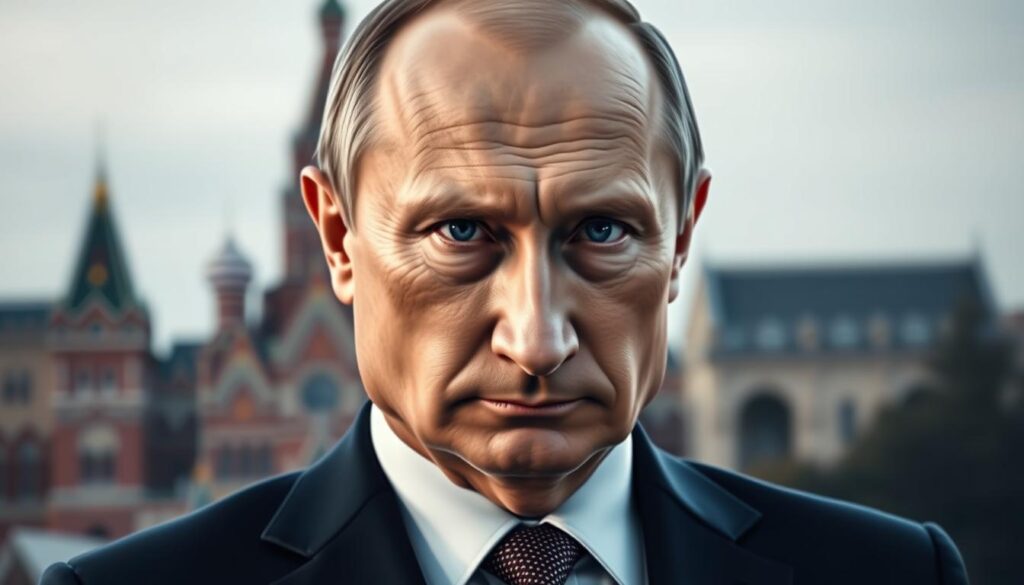
Vladimir Putin has been a key player in Russian politics for over 20 years. He has shaped the country’s governance and influenced international relations, mainly from the Kremlin1. Putin has been President of Russia from 2012, with a break from 2000 to 2008. He also served as Prime Minister from 1999 to 2000 and again from 2008 to 20121.
His leadership has had a big impact on Russian politics and the world. During his presidency, Russia has scored low on corruption, democracy, freedom, and press freedom indices1.
Under Putin, the Russian economy has grown by an average of seven percent each year1. He has been linked to the United Russia political party throughout his career2. Putin’s party won most seats in the 2007 parliamentary elections2.
As President, Putin has strengthened the state’s control in Russia. The state now controls up to 70% of the economy under his leadership2.
Key Takeaways
- Vladimir Putin has been the dominant figure in Russian politics for over two decades.
- He has served as President of Russia from 2012 and previously from 2000 to 2008.
- Putin has also held the position of Prime Minister of Russia from 1999 to 2000 and from 2008 to 2012.
- Russia’s economy has grown by an average of seven percent per year under Putin’s presidency1.
- Putin has reinforced centralized control in Russia, with the state controlling up to 70% of the Russian economy under his leadership2.
- Putin’s impact on Russian politics and the global landscape is significant, with Russia consistently scoring low on corruption, democracy, freedom, and press freedom indices during his presidency1.
Early Life and Education
Vladimir Putin’s journey started in Leningrad, now Saint Petersburg, after World War II. This city shaped his strong character in tough times.
Background and Family
Putin was born on October 7, 1952, as the oldest of three kids3. His dad was in the Soviet Navy, teaching him discipline. His mom worked at a factory, keeping their home stable3.
Academic Pursuits
Putin studied law at Leningrad State University and graduated in 1975. His hard work in school helped him think critically, skills he’d use later3.
KGB Career
Putin then joined the KGB for 16 years, becoming a lieutenant colonel. This job sharpened his strategic mind and global knowledge43.
| Aspect | Details |
|---|---|
| Birth | October 7, 1952, Leningrad, Soviet Union3 |
| Education | Law degree from Leningrad State University, 19753 |
| KGB Service | 16 years as a foreign intelligence officer, lieutenant colonel43 |
Political Rise and Leadership Style
Vladimir Putin started his journey in Russian politics in the early 1990s in Saint Petersburg. Moving to Moscow in 1996 was a big step towards gaining more political power in Russia5.
Early Political Career
Putin joined President Boris Yeltsin’s team. He worked as Director of the Federal Security Service (FSB) and Secretary of the Security Council. His skills led to him becoming Prime Minister in 1999, preparing him for the presidency5.
Presidency Highlights
Putin won the presidential elections on March 26, 2000, with 52.94% of the vote5. He was re-elected in 2004 with 71.31% of the vote5. In 2012, he changed the constitution to run for two more terms, keeping his power5. He has led Russia, either as president or Prime Minister, ever sense 19996.
Governance Approach
Putin’s rule is marked by a strong focus on power and a smart way to handle opposition. He believes in the importance of intelligence and determination, inspired by the Great Man Theory5. His government mixes economic freedom with limited openness, creating a controlled political scene6.
Domestic Policies and Initiatives
Under Vladimir Putin, Russian politics have seen big changes. These changes aimed to make the Kremlin stronger and keep power in Russia. The economy grew a lot during his first time in office.
Economic Strategies
Putin’s team made the economy grow by seven percent each year. This made Moscow the 7th biggest economy worldwide7. They also made taxes simpler and cut corporate taxes, making Russia competitive with Europe7.
Investments went up by 125%, and industries grew by 76%. This built a strong economic base7.
Social Reforms
Putin focused on improving education and healthcare. Real incomes doubled, and the middle class grew from 8 million to 55 million7. These changes aimed to make life better for Russians, focusing on health and education.
National Security
Keeping the country safe was a top goal. Putin tackled internal conflicts like the Chechen war to regain control7. He also worked to update the military, ensuring Russia’s safety at home and abroad.
| Economic Indicator | Value During First Term | Reference |
|---|---|---|
| Average Annual GDP Growth | 7% | <kkk>1</kkk> |
| Industry Growth | 76% | <kkk>1</kkk> |
| Investment Increase | 125% | <kkk>1</kkk> |
| Middle Class Expansion | 8M to 55M | <kkk>1</kkk> |
International Relations and Impact
Vladimir Putin has greatly influenced Russia’s role on the world stage. He has shaped its relationships and alliances globally.
Relations with the West
For over 20 years, Russia’s ties with Western countries have been tense. This is due to disagreements on many global issues8. The annexation of Crimea in 2014 made things worse. NATO stopped working with Russia, and Western countries put sanctions on them8.
These steps have made the relationship between Russia and the West very tense. It’s like the Cold War all over again9.
Influence in Eastern Europe
Putin has worked hard to keep Russia’s influence in Eastern Europe. He has strengthened ties with countries not in the West10. This way, Russia stays important in the area, even with sanctions and criticism from others10.
Global Political Landscape
Russia, under Putin, has made big moves on the world stage. For example, in Syria, Putin showed Russia’s power as a key player9. Russia has also grown its ties with China and India, reaching a record in trade10.
These actions have helped Russia fight off Western sanctions. They’ve also made Russia a key player in a world with many powers109.
FAQ
What is Vladimir Putin’s significance in Russian and global politics?
Vladimir Putin has been a key figure in Russian politics for over 20 years. He has served multiple terms as president. His leadership has greatly influenced Russia’s governance, economy, and international relations.
How did Vladimir Putin’s early life influence his political career?
Putin was born in post-war Leningrad (now Saint Petersburg). He grew up in a modest family. This upbringing helped him develop a resilient and strategic mindset.
He studied law at Leningrad State University and worked for 16 years in the KGB. These experiences shaped his leadership style and governance approach.
What were the key moments in Vladimir Putin’s rise to power?
Putin’s political journey started in Saint Petersburg, where he held various roles. He moved to Moscow and joined Yeltsin’s administration. In 1999, he became Prime Minister.
After Boris Yeltsin resigned, Putin took over as President. He quickly consolidated power through strategic decisions and authoritative governance.
How does Vladimir Putin’s governance style impact Russian politics?
Putin has centralized power in the Kremlin. He manages opposition and maintains stability through authoritative measures. His governance emphasizes strong leadership, economic modernization, and assertive foreign policies.
What are the major domestic policies implemented by Vladimir Putin?
Putin’s domestic policies focus on oil and gas exploitation, leading to an economic boom. He has also introduced social reforms in education and healthcare.
He prioritizes national security by modernizing the military and addressing internal conflicts like the Chechen war. These initiatives have profoundly affected Russian society.
In what ways has Vladimir Putin shaped Russia’s international relations?
Putin has redefined Russia’s relations with Western powers through actions like the annexation of Crimea. He has also been involved in the Ukraine conflict.
His influence extends to Eastern Europe, where he uses strategies to maintain Russia’s sphere of influence. Putin’s interventions in regions like Syria and participation in international organizations have solidified Russia’s global role.
What is Vladimir Putin’s legacy in Russian and world affairs?
Putin’s legacy is marked by his long-term leadership of Russia. He has significantly impacted the country’s political and economic structures. His influence extends to global geopolitics.
His tenure has left a lasting mark on Russian politics and international relations. Putin’s leadership has shaped the Kremlin’s strategy and Russia’s position in the world.
Source Links
- https://en.wikipedia.org/wiki/Vladimir_Putin – Vladimir Putin
- https://www.britannica.com/biography/Vladimir-Putin – Vladimir Putin | Biography, KGB, Political Career, & Facts | Britannica
- https://unacademy.com/content/general-awareness/vladimir-putin-biography/ – A Complete Biography of Vladimir Putin
- https://www.history.com/topics/european-history/vladimir-putin – Vladimir Putin ‑ Russia, President & Ukraine | HISTORY
- https://www.scirp.org/journal/paperinformation?paperid=134935 – Vladimir Putin’s Leadership Charisma, Power Dynamics, and Influence through the Lens of Leadership Traits and Theoretical Perspectives
- https://en.wikipedia.org/wiki/Russia_under_Vladimir_Putin – Russia under Vladimir Putin
- https://en.wikipedia.org/wiki/Domestic_policy_of_Vladimir_Putin – Domestic policy of Vladimir Putin
- https://en.wikipedia.org/wiki/Foreign_policy_of_Vladimir_Putin – Foreign policy of Vladimir Putin
- https://eng.globalaffairs.ru/articles/putins-foreign-policy/ – Putin’s Foreign Policy
- https://gjia.georgetown.edu/2024/08/28/demystifying-the-enemy-putins-geopolitical-calculus-and-the-war-in-ukraine/ – Putin’s Geopolitical Calculus and the War in Ukraine | GJIA