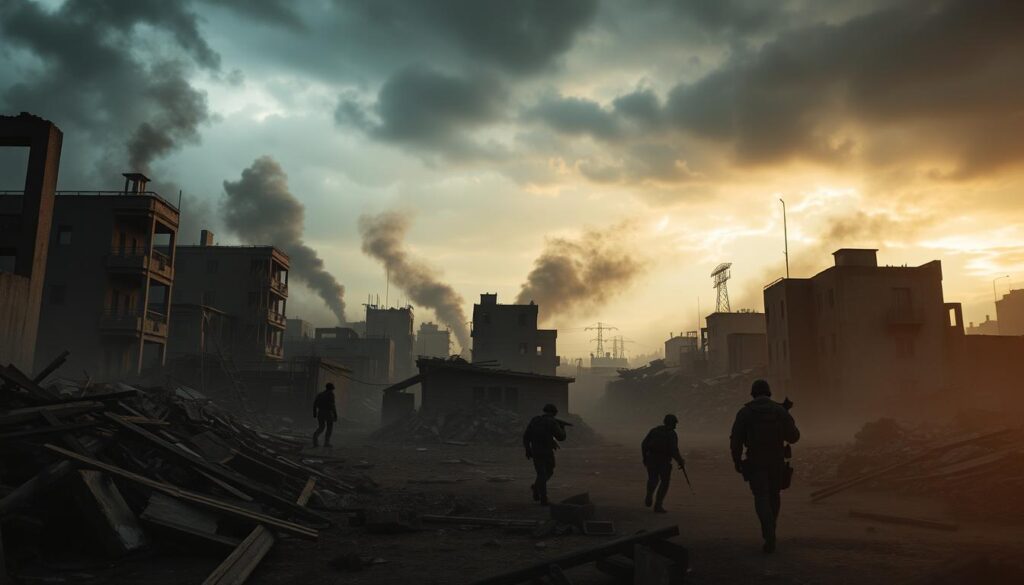
The War on Terror started after the September 11 attacks. It has changed how we see global security and fight terrorism1. This fight has lasted for about 20 years, making it a major global conflict2.
This war has changed how countries work together and their laws. It focuses on stopping terrorism and keeping the world safe.
The US and its allies have fought against the 9/11 attacks. They have taken away al-Qaida’s safe place in Afghanistan3. This war has also made countries work together more than ever before. They are sharing information and working together to fight terrorism3.
Key Takeaways
- The War on Terror is a global conflict started by the US after the 9/11 attacks. It aims to fight terrorism and keep the world safe.
- The main part of the War on Terror lasted about 20 years2.
- Over 3,000 people died or are missing from more than 80 countries after 9/111.
- The US and its allies have fought back against the 9/11 attacks. They have taken away al-Qaida’s safe place in Afghanistan3.
- An estimated 4.5-4.6 million people were killed in the War on Terror. Over 937,000 died directly, including 387,000 civilians. About 3.6-3.7 million died indirectly2.
- The War on Terror has had a big impact on global security. 196 countries support the financial fight against terrorism. 142 countries have frozen terrorist assets1.
- The US Treasury spent over $8 trillion on the post-9/11 wars2.
Historical Context of the War on Terror
The War on Terror started in a complex world. It was shaped by extremist ideas in the late 20th century. Knowing its history helps us understand the fight against counterterrorism.
Origins of the Conflict
The conflict began due to political instability and foreign actions in the Middle East. These issues helped extremist groups grow. They wanted to fight against Western power.
Key Events Leading to the War
- September 11, 2001: Nearly 3,000 lives lost in the 9/11 attacks4.
- December 7, 2001: Fall of Kandahar, the Taliban’s last stronghold4.
- May 2, 2011: Osama bin Laden’s death at the hands of U.S. forces4.
The Role of Al-Qaeda
Al-Qaeda, led by Osama bin Laden, was the main target at first. This extremist group planned big attacks. These actions changed how we think about security worldwide5.
It was key to understand and stop these threats. Focusing on Al-Qaeda showed the hard work needed to fight extremist groups.
Military Strategies and Operations
The War on Terror has seen many military strategies. These aim to break down terrorist networks and protect our homeland defense. Major military campaigns have shaped the conflict’s path.
Major Military Campaigns
Important operations include Operation Enduring Freedom in Afghanistan and Operation Iraqi Freedom in Iraq. These efforts aimed to remove terrorist bases and bring stability to dangerous areas.
Counterterrorism Tactics
Counterterrorism has grown, with new tactics like drone warfare. This method allows for precise strikes with little risk to soldiers6. Better surveillance and intelligence help stop terrorist plans, boosting national security.
Global Coalitions and Alliances
Working together globally is key in fighting terrorism. Forming coalitions lets countries share info, resources, and plans, making them more effective6. Groups like NATO help coordinate against global threats.
Impact and Consequences
The War on Terror has changed many things in global and national security. It has left deep marks on politics, economies, and societies around the world.
Political Ramifications
Governments have updated their security plans to face new dangers. They now use stronger surveillance and have changed how they work with other countries. The focus is on sharing intelligence and working together to improve global security.
Economic Costs of the War
The War on Terror has cost a lot of money, with the U.S. spending over $8 trillion7. This spending has affected national budgets and changed economic policies at home and abroad.
Societal Effects in Affected Regions
Places involved in the conflict have seen big changes, like 38 million people displaced and over 4.5 million deaths7. These areas struggle with broken social structures and ongoing security issues. These problems keep affecting global security.
FAQ
What triggered the War on Terror?
The War on Terror started after the September 11 attacks in 2001. These attacks were done by Al-Qaeda. They changed how we see security worldwide, leading to a big effort to fight terrorism everywhere.
How did the September 11 attacks change global security strategies?
The September 11 attacks made us see threats differently. We started new ways to fight terrorism. This includes protecting our homes, getting better at finding threats, and working together with other countries.
What role did Al-Qaeda play in the War on Terror?
Al-Qaeda was the main target in the War on Terror. They planned big attacks, like September 11. This led to big military actions and working together with other countries to stop them.
What were the major military campaigns in the War on Terror?
The main fights were in Afghanistan and Iraq. We wanted to stop terrorists, remove bad leaders, and make places safer. These fights changed how we think about security and defense.
How have counterterrorism tactics evolved during the War on Terror?
We’ve gotten better at fighting terrorism. We use drones and better ways to watch and listen. This helps us find and stop terrorists, making our homes safer.
What is the significance of drone warfare in the War on Terror?
Drones are key in the War on Terror. They let us attack terrorists without risking soldiers. This helps us watch and act fast, making the world safer.
How have global coalitions and alliances impacted the War on Terror?
Working together has been very important. It helps us share resources and work as a team. This makes our fights more effective and changes the war’s path.
What are the political implications of the War on Terror?
The War on Terror has changed politics a lot. It has led to new laws and how we see the world. It has also changed how we work with other countries.
What are the economic costs associated with the War on Terror?
The War on Terror costs a lot of money. It includes spending on the military and how it affects the economy. This money affects our budgets and how we plan our economy.
How has the War on Terror affected societies in regions directly involved?
The War on Terror has changed life in many places. It has affected how people live, their rights, and the world’s safety. It has made life hard and raised big questions about freedom and rights.
Source Links
- The Global War on Terrorism: The First 100 Days – https://2001-2009.state.gov/s/ct/rls/wh/6947.htm
- War on terror – https://en.wikipedia.org/wiki/War_on_terror
- Today’s Realities in the War on Terror – https://georgewbush-whitehouse.archives.gov/nsc/nsct/2006/sectionII.html
- The War on Terror ‑ Timeline & Facts | HISTORY – https://www.history.com/topics/21st-century/war-on-terror-timeline
- Understanding the ‘war on terror’ – https://magazine.college.unc.edu/tar-heels-up-close/the-war-on-terror/
- The National Security Strategy of the United States of America – https://georgewbush-whitehouse.archives.gov/nsc/nssall.html
- Global War on Terror | George W. Bush Library – https://www.georgewbushlibrary.gov/research/topic-guides/global-war-terror