
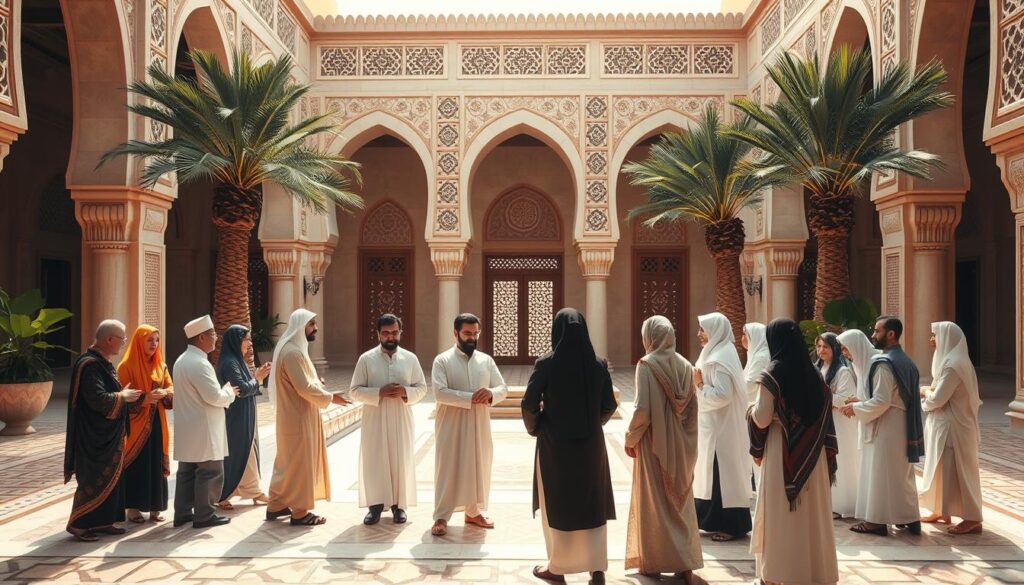
Islamic greetings are more than just pleasantries. They represent a deep spiritual bond rooted in peace and respect. When you use Muslim greetings, you join a rich cultural tradition1.
These greetings bridge gaps between people. They show the core values of compassion and unity in the Muslim community2.
In Islam, greeting others is a spiritual practice. It shows respect and seeks divine blessings. Prophet Muhammad stressed the importance of greetings in social interactions2.
Understanding Islamic greetings can improve your social connections. Each greeting has deep meaning. It links people through shared spiritual values1.
Key Takeaways
- Islamic greetings are spiritual expressions of peace
- Greetings reflect core Muslim community values
- Respectful interactions are central to Islamic social traditions
- Greeting others is considered a sacred social duty
- Words carry profound spiritual significance in Muslim culture
Understanding Islamic Greetings
Islamic greetings are more than simple words. They connect Muslims worldwide through a profound cultural practice. These phrases build bridges of respect, peace, and community among 1.6 billion Muslims globally3.
The Spiritual Significance of Salaam in Islam
Salaam in Islam carries deep spiritual meaning. It reflects core values of peace and mutual respect. Muslims participate in a sacred tradition when exchanging these greetings.
Cultural Nuances of Islamic Polite Greetings
Islamic greetings share fundamental principles of respect across cultures:
- Men typically shake hands with other men3
- Women may side kiss or hug when greeting other women3
- Avoiding direct eye contact with the opposite gender is common3
Greeting Etiquette in Muslim Communities
“The best greeting is the one that brings peace and blessings to both parties.”
Islamic greeting protocols involve subtle cultural expectations. Politeness and respect are crucial in Muslim social interactions4. Prophet Muhammad provided guidance on greeting order in various situations.
Embracing these traditions shows cultural sensitivity. It also strengthens spiritual connections within Islamic communities34.
The Most Common Islamic Greeting: As-Salamu Alaikum
The Islamic greeting “As-Salamu Alaikum” is a powerful tradition of peace. It embodies respect and goodwill in Muslim communities worldwide. This phrase is the cornerstone of Islamic greeting manners.
Breakdown of the Greeting
“As-Salamu Alaikum” means “Peace be upon you” in Arabic. It carries deep spiritual significance in Islam5.
Muslims use this phrase in both verbal and written communication. It’s a universal tool that bridges cultural gaps5.
Responses and Variations
The typical response is “Wa Alaikum Assalam”, meaning “And peace be upon you”5. There are several variations of this greeting:
- Shortened version: “Salam”5
- Extended version: “As-Salamu Alaikum wa Rahmatullahi wa Barakatuh”5
- Festive greetings: “Eid Mubarak” during Islamic festivals5
When to Use This Greeting
“As-Salamu Alaikum” fits any social interaction. It’s not limited to specific times or contexts6.
The greeting goes beyond social norms. It expresses a genuine wish for peace and well-being6.
The true essence of the greeting lies not just in the words, but in the genuine intention of spreading peace and protection.
| Greeting | Meaning | Context |
|---|---|---|
| As-Salamu Alaikum | Peace be upon you | Daily interactions |
| Jumu’ah Mubaraka | Blessed Friday | Friday gatherings |
| Eid Mubarak | Blessed Festival | Religious celebrations |
Other Ways to Greet in Islamic Culture
Islamic greetings go beyond “As-salamu alaikum.” Muslim greetings vary across cultures and social settings. They range from formal verbal exchanges to subtle non-verbal cues78.
Many Islamic communities root greetings in respect and culture. Some use time-specific greetings like “Sabah al-kheir” for morning. Others use “Masaa al-kheir” for evening8.
These variations show the diversity in Islamic traditions. Each greeting holds unique meaning and emotional depth7.
Non-verbal cues are key in Islamic greeting etiquette. Placing your right hand over your heart shows sincerity. Light embraces between close friends express warmth. Islamic greeting customs involve complex social rules beyond words.
In conservative settings, respecting gender boundaries is crucial7. Embracing these greetings can build cultural bridges. It shows respect and joins a tradition of human dignity8.
FAQ
What is the most common Islamic greeting?
“As-Salamu Alaikum” is the most common Islamic greeting. It means “Peace be upon you” in English. Muslims worldwide use this greeting to express peace and goodwill.
How do you respond to “As-Salamu Alaikum”?
The proper response is “Wa-Alaikumussalam”. It means “And upon you be peace” in English. A longer version is “Wa-Alaikumussalam wa-Rahmatullah”.
Are Islamic greetings only used between Muslims?
No, Islamic greetings can be used with non-Muslims too. They show respect and goodwill to everyone. These greetings reflect the Islamic focus on peace.
What are the cultural considerations when greeting in Islamic settings?
Gender segregation is an important factor in Islamic greetings. Most Muslim women don’t shake hands with men. It’s polite to wait for a woman to offer her hand first.
Muslim men usually shake hands with other men when greeting. Respecting these customs shows cultural awareness and sensitivity.
Are there non-verbal greetings in Islamic tradition?
Yes, non-verbal greetings play a big role in Islamic culture. Placing the right hand over the heart shows sincerity and respect.
In some cultures, men may greet with a light hug or cheek kisses. This depends on their relationship and local traditions.
When can I use Islamic greetings?
Islamic greetings work for any time of day or situation. They can be used in formal meetings or casual chats. These greetings help spread peace and build stronger bonds in Muslim communities.
Do Islamic greetings vary in different cultures?
Yes, greetings can change based on context and culture. Close friends or family might use more casual greetings. Some may add affectionate terms to the standard greeting.
Source Links
- The correct Quranic greeting – https://quranaloneislam.org/the-correct-quranic-greeting/
- Microsoft Word – AdabUnit1Greetingweb.doc – https://islamicbulletin.org/en/ebooks/kids/alsalam_greetings_in_Islam.pdf
- Understanding Islamic Etiquette – https://www.altaregional.org/sites/main/files/file-attachments/uie_aw._islamic_etiquette_training.ppt_embedded.pdf?1597350315
- The Book of Salutions and Greetings (KITAB AS-SALAM) – https://www.iium.edu.my/deed/hadith/muslim/026_smt.html
- Islam greetings – https://doyouknowislam.com/islam-greetings/
- What is “Assalamu Alaykum” For? | About Islam – https://aboutislam.net/family-life/your-society/what-is-assalamu-alikum-for/
- What is the way that Muslims greet each other? – https://www.islamiqate.com/5749/what-is-the-way-that-muslims-greet-each-other
- Arabic Greetings And farewells: Beginner’s Guide – https://preply.com/en/blog/arabic-greetings/

