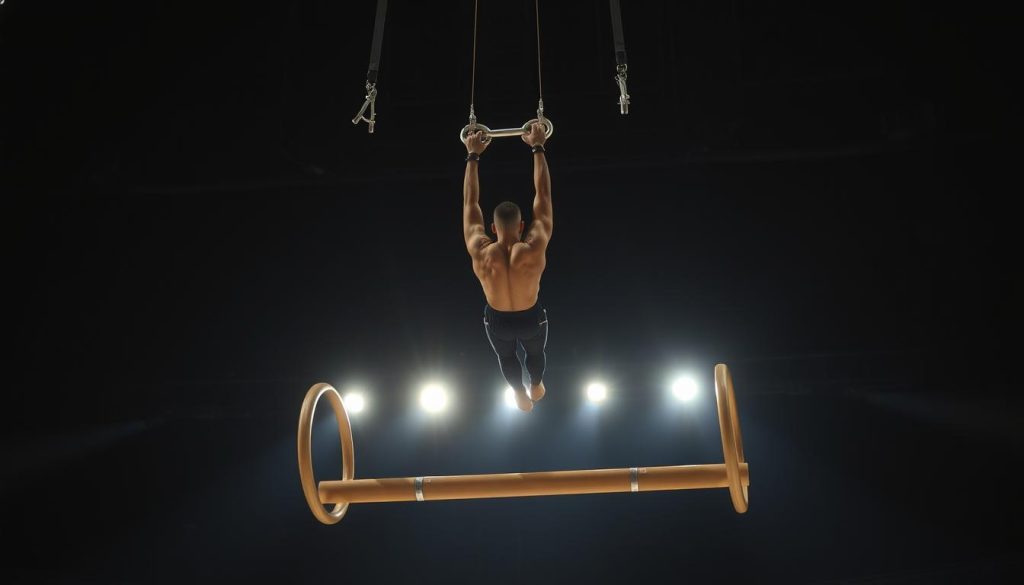
Gymnastics rings showcase extraordinary athletic skill in the Olympics. Male gymnasts perform on these suspended rings, demonstrating incredible strength and precision. These challenging apparatus test upper body control and muscular endurance.
Rings have been a key part of Olympic gymnastics since 1896. They hang 2.5 meters above the ground, demanding extreme physical and mental prep. This calisthenics-based discipline highlights remarkable athletic abilities.
Gymnasts perform complex routines blending strength, balance, and artistry. Judges score both difficulty and execution. Top international performances usually score between 14.5 and 15.5 points1.
Key Takeaways
- Gymnastics rings are an exclusive men’s Olympic event
- Athletes demonstrate exceptional upper body strength
- Routines combine technical difficulty with artistic performance
- Rings require extreme muscle control and precision
- The event has been part of Olympic competition since 1896
History and Evolution of Olympic Rings Competition
Gymnastic rings showcase athletic innovation and human strength. Friedrich Ludwig Jahn developed them in the early 19th century. These rings evolved from training tools to a prestigious Olympic event2.
The 1896 Athens Olympics marked a significant milestone. It introduced gymnastic rings as a competitive event2.
Origins of Competitive Rings
Gymnastic rings began as a groundbreaking strength exercise platform. Called “roman rings,” they spread globally through European training programs2.
Early designs differed from today’s precision equipment. In 1842, Adolf Spiess introduced triangular-shaped “flying rings”2.
Olympic Journey and Champions
The Olympic rings competition boasts a rich history of exceptional athletes. Some notable achievements include:
- Ioannis Mitropoulos won the first Olympic Gold Medal in 18962
- Albert Azaryan became the first two-time gold medalist in 19602
- Eleftherios Petrounias emerged as a modern rings specialist
The rings event has seen remarkable technical progress. Gymnasts developed increasingly complex skills, such as:
- First double stooping somersault backward in 19712
- First double somersault forward in 19732
- First triple somersault performed in 19812
Technical Specifications and Performance
Modern gymnastic rings have precise specifications. They have an inner diameter of 18 cm and are suspended at a measured height3.
Gymnasts must show incredible gymnastic grips and strength exercises. These skills help them perform complex routines.
The rings showcase human athletic potential. They combine strength, precision, and artistic expression in an extraordinary Olympic discipline.
Understanding Gymnastics Rings Equipment and Requirements
Gymnastic rings showcase strength and precision in Olympic competitions. Made of wood or metal, they measure 28 mm in diameter with an 18 cm inner width. Suspended 2.5 meters high and 50 cm apart, they challenge athletes’ control during routines4.
Ring dips demand incredible upper body strength and stability. These exercises target multiple muscle groups, requiring precise movements and absolute stillness5. Pull-up rings are crucial for developing muscular coordination needed in Olympic-level performances5.
Ring rows build foundational strength for Olympic gymnasts. They enhance muscle control and body awareness for competitive routines5. Mastery of body mechanics is essential, as rings must remain stationary during performances4.
Judges carefully evaluate competitive ring performances. They assess each movement’s precision and difficulty. Athletes must show exceptional strength, balance, and control to excel in this Olympic discipline4.
FAQ
What exactly are gymnastics rings in the Olympic Games?
Gymnastics rings are a unique Olympic discipline combining strength, balance, and grace. Suspended from cables, these rings challenge athletes to perform complex bodyweight exercises. They showcase extraordinary muscular control and physical precision in one of gymnastics’ most demanding events.
How did gymnastics rings originate?
Friedrich Ludwig Jahn, the “father of gymnastics,” developed gymnastics rings in the early 19th century. Initially a training tool for strength and conditioning, rings evolved into a competitive Olympic event.
What makes gymnastics rings different from other Olympic gymnastics events?
Rings focus solely on upper body strength and static holds. Athletes perform difficult moves while maintaining absolute control, often in challenging positions.
The rings move independently, adding an extra layer of difficulty to every movement. This requires tremendous muscular tension and core stability.
What are the key techniques used in ring gymnastics?
Key techniques include ring dips, ring rows, and various static holds like the iron cross. Athletes perform complex routines showcasing strength elements, swings, and precise movements.
These techniques demand years of specialized training in calisthenics and bodyweight strength exercises. They demonstrate exceptional body control and physical prowess.
How are ring performances judged in Olympic competitions?
Olympic ring performances are evaluated based on difficulty, execution, and artistry. Judges assess movement complexity, body control, technique, and the ability to maintain perfect form.
Deductions are made for any loss of control, body wobble, or improper technique. Precision and stability are crucial in scoring high marks.
What equipment specifications are used for Olympic gymnastics rings?
Olympic gymnastics rings are made of wood or composite materials, suspended about 5.75 meters above the ground. They must meet strict International Gymnastics Federation (FIG) specifications for size, strength, and stability.
The rings allow maximum movement while providing a stable platform for complex athletic performances. This balance is crucial for athlete safety and performance.
How do athletes train for gymnastics rings?
Athletes train through intensive bodyweight exercises and calisthenics, focusing on upper body and core strength. Their regimen includes progressive strength exercises, flexibility work, and countless hours practicing specific ring techniques.
Many incorporate weight training, specialized grip strength exercises, and extensive conditioning. This comprehensive approach prepares them for Olympic-level performances on the rings.
Source Links
- A bluffer’s guide to artistic gymnastics: Rings – https://www.olympics.com/en/news/a-bluffer-s-guide-to-artistic-gymnastics-rings
- A 3 Minute History Of Gymnastic Rings – https://atomiciron.com.au/blogs/insights/gymnastic-rings-history?srsltid=AfmBOopQfeAOmGMMUljVbutWv5OtThJpGTypJmLx73SAywm1_ae9eTg5
- Rings (gymnastics) – https://en.wikipedia.org/wiki/Rings_(gymnastics)
- How to score in Artistic Gymnastics: Apparatus, performance, rules and competition format – https://www.olympics.com/en/news/how-to-score-in-artistic-gymnastics-apparatus-performance-rules-and-competition
- The Benefits of Gymnastic Rings & Exercises You Can Do With Them – https://www.dmoose.com/blogs/product-specific-exercises/what-are-gymnastic-rings?srsltid=AfmBOoqJlRGKgbXR_hjUggWU8N4w_zj4sUiAcNcVIcEOUefFnsj92mYb