
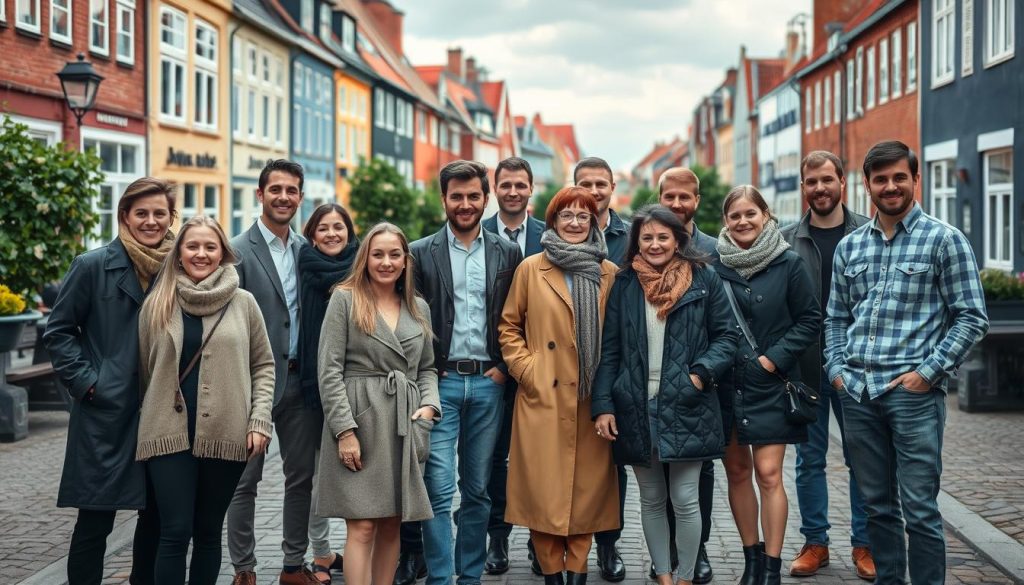
People from Denmark are called “Danes”1. This term represents an ethnic group and nationality deeply connected to Denmark. It encompasses both historical and cultural aspects2.
Denmark is a compact Nordic country with about 5.8 million people1. Roughly 89.60% of the population identifies as ethnic Danes2. This strong cultural identity stems from centuries of shared history and traditions.
Danish names and naming traditions reveal a rich cultural tapestry. The Danish language is a key part of this heritage. About 5.5 million people speak Danish, mostly within Denmark’s borders1.
Key Takeaways
- Danes are the people from Denmark
- Danish identity is strongly tied to cultural heritage
- The majority of the population identifies as ethnic Danes
- Danish language plays a crucial role in national identity
- Denmark has a population of approximately 5.8 million
Origins and Identity of Danish People
Danish people have a rich historical tapestry blending ancient Germanic roots and Viking heritage. Their cultural landscape shaped Danish name origins. This Nordic nation’s history is both complex and remarkable3.
The earliest records of Danish people date back to the 6th century. Scandinavian names carry deep meanings reflecting this civilization’s cultural depth3.
Viking Age and Cultural Foundations
Danish cultural identity began to form during the Viking Age, starting around 800 AD. Vikings were sophisticated seafarers who established complex social structures3.
They also developed intricate Nordic naming customs. Their influence spread far beyond raids, shaping European settlements and traditions.
- First Viking raids occurred in 793 AD
- Established settlements across Europe
- Developed intricate Nordic naming customs
Modern Danish Identity Formation
The Danish national state emerged in the 19th century, solidifying a unique cultural identity. This period saw significant changes in population growth and social structures4.
“Denmark’s strength lies in its ability to preserve cultural heritage while embracing modern progress.”
Cultural and Religious Background
Lutheranism played a crucial role in shaping Danish cultural identity. The concept of danskhed (Danishness) emerged as a powerful cultural phenomenon.
This idea influenced everything from social norms to Danish name meanings. Today, Denmark blends ancient traditions with contemporary global perspectives5.
People from Denmark Name: Understanding Danish Terminology
Danish surnames reflect Denmark’s rich cultural heritage. They showcase a unique approach to family identification. Traditional Danish naming customs have evolved over centuries6.
Danish surnames once followed a patronymic system. Children were named after their fathers. Male names ended in “søn” or “sen,” while female names ended in “datter”6.
This practice was common until 1828. Church orders then began to limit its use6.
- Jensen is the most common Danish surname7
- Approximately 1/3 of Danes carry one of the top 15 surnames7
- Nielsen and Hansen are among the most popular Danish surnames7
Modern Danish baby names mix traditional and contemporary influences. Popular names often have Norse or Germanic roots. This showcases the country’s rich cultural background6.
A law passed in 1856 “froze” surnames. This led to a decline in patronymic naming practices6.
Denmark introduced a new naming law in 2006. It allows more flexibility, including the use of patronymics again. This preserves cultural traditions while embracing modern approaches6.
Danish surnames are diverse and tell unique stories. Names like Pedersen, Andersen, and Christensen are common. Each represents a distinct family heritage7.
Conclusion
Danish names showcase a rich tapestry of cultural heritage and tradition. Danes have a fascinating naming history that reflects their connection to family practices. Their names have evolved from traditional systems to modern conventions, highlighting Denmark’s dynamic cultural identity6.
Denmark’s naming traditions offer insight into the country’s social fabric. These customs emphasize family and individual identity, from historical practices to modern laws. The Danish approach blends historical respect with contemporary flexibility68.
Danish names adapt while maintaining their unique character as global connections grow. The Danish diaspora helps spread cultural awareness and preserve their naming heritage8.
These naming traditions offer a window into Danish identity for those interested in the culture. Danish names are living stories of heritage, family, and cultural continuity. Understanding these traditions deepens appreciation for this remarkable Nordic nation8.
FAQ
What are people from Denmark called?
People from Denmark are called Danes. This term correctly and respectfully refers to Danish citizens and natives.
What are the origins of Danish names?
Danish names have roots in Norse and Germanic traditions. They often reflect Denmark’s rich Viking heritage.
Many names have historical significance tied to Denmark’s cultural and linguistic background.
Are there specific rules for naming in Denmark?
Denmark has strict naming laws. The government keeps an official list of approved names.
Parents must choose from this list or seek special approval for unlisted names.
What is the structure of Danish names?
Danish names typically include a given name and a surname. Historically, patronymic surnames were common.
These surnames came from the father’s first name. Today, most Danes use inherited family surnames.
What are some popular Danish names?
Popular Danish boys’ names include Magnus, Emil, and William. For girls, Emma, Alma, and Sofia are common.
Many names have Nordic origins and hold meaningful cultural connections.
How have Danish naming traditions changed over time?
Danish naming has evolved from traditional Norse and patronymic systems. There’s a growing trend of using international names.
This shift reflects Denmark’s increasing global connections.
What is the significance of names in Danish culture?
Danish names are more than just identifiers. They represent connections to historical heritage and family traditions.
Names also reflect the broader concept of “Danishness” (danskhed) that defines national identity.
Do Danish names have specific meanings?
Many Danish names have deep meanings rooted in Old Norse, Germanic, or Christian traditions.
Names often relate to natural elements, historical figures, or personal traits.
How do Danish naming conventions differ from other countries?
Danish naming conventions are unique in their government regulation. They also have a strong connection to cultural heritage.
The historical use of patronymics sets Danish naming apart from practices in many other countries.
Are international names becoming more common in Denmark?
International names are becoming more prevalent in Denmark due to globalization. However, traditional Danish naming practices remain respected.
There’s still a strong emphasis on preserving cultural identity through names.
Source Links
- Danish Names – Behind the Name – https://www.behindthename.com/names/usage/danish
- What are Citizens of Denmark Called? – https://www.worldatlas.com/articles/what-are-citizens-of-denmark-called.html
- Danes (tribe) – https://en.wikipedia.org/wiki/Danes_(tribe)
- Culture of Denmark – history, people, clothing, traditions, women, beliefs, food, customs, family – https://www.everyculture.com/Cr-Ga/Denmark.html
- Danes – https://en.wikipedia.org/wiki/Danes
- Understanding Danish Names – https://www.genealogistkottal.com/blog/understanding-danish-names/
- The Most Common Danish Last Names and What They Mean – https://www.thoughtco.com/most-common-danish-last-names-meanings-1422650
- The Danish Identity: What Are People From Denmark Called? – https://denmarkexpat.com/what-are-people-from-denmark-called/

