
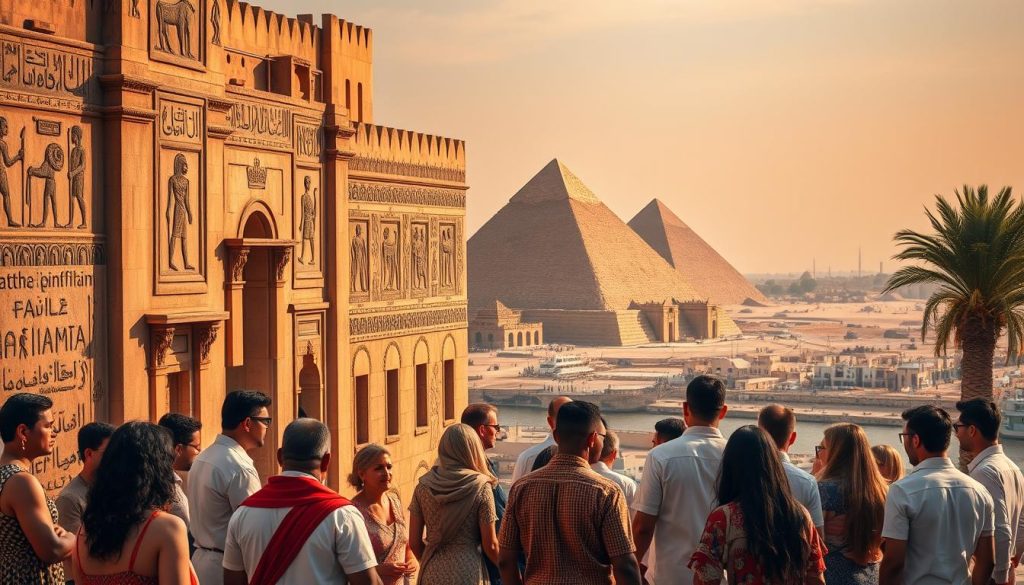
Egyptian Arabic is a unique and influential dialect. It’s spoken by 92 million people as their mother tongue. This makes it one of the most significant regional varieties in the Arabic-speaking world1.
The Egyptian dialect has gained popularity through media, especially in cinema and entertainment2. Cairo’s importance has made the Masry dialect the most understood Egyptian dialect2.
Egyptian Arabic blends influences from various languages. It has absorbed words from Turkish, Greek, Italian, French, and English. This mix reflects Egypt’s rich history and interactions1.
Pronunciation differs between dialects. Cairene Arabic pronounces ج as a “g” sound. The Sa’idi dialect keeps the traditional “j” pronunciation1. These differences show the complexity of Arabic dialects.
Key Takeaways
- Egyptian Arabic is spoken by 92 million people in Egypt
- The dialect has significant influences from multiple languages
- Masry dialect is the most understood Egyptian variation
- Pronunciation varies between different Egyptian regions
- Egyptian Arabic is widely used in media and entertainment
Historical Evolution and Cultural Context of Egyptian Arabic
Egyptian Arabic reflects Egypt’s rich cultural tapestry. This dialect blends influences from various civilizations that shaped the region3. Nile Delta and Upper Egyptian Arabic showcase unique characteristics, demonstrating the language’s adaptability.
Egyptian Arabic’s journey spans multiple historical periods. It incorporates elements from ancient Egyptian, Coptic, Arabic, and other regional languages. About 66.7% of Egypt’s population speaks Egyptian Arabic as their primary dialect4.
Origins and Cultural Roots
Egyptian Arabic’s development is deeply intertwined with cultural identity. The dialect emerged through complex historical influences.
- Pharaonic linguistic traditions
- Islamic cultural exchanges
- Ottoman linguistic contributions
- Modern global communication patterns
Regional Distribution and Linguistic Diversity
Egyptian Arabic shows remarkable regional variations. The dialect dominates urban centers, while different regions have unique linguistic features. Sa’idi Arabic, spoken by 24.1% of the population, is a distinct variant in Upper Egypt4.
Egyptian Arabic’s popularity comes from Egypt’s cultural influence through media and arts. It’s the most understood dialect in the Middle East-North Africa region3.
The linguistic landscape of Egypt reflects a dynamic, evolving communication system that continues to adapt and transform.
Egyptian Arabic is a living language carrying centuries of cultural memory. It continues to adapt and transform with ongoing social changes3.
Egyptian Arabic vs Sa’idi Arabic: Understanding the Regional Variations
Arabic dialects in Egypt show amazing variety. Egyptian Arabic and Sa’idi Arabic are two distinct regional types5. Egyptian Arabic is widely understood across the Arab world6.
Egyptian Arabic and Sa’idi Arabic differ in several ways:
- Phonological variations that distinguish pronunciation patterns
- Unique lexical differences in vocabulary
- Distinct grammatical structures
Sa’idi Arabic, spoken in Upper Egypt, has unique features. It’s related to Modern Standard Arabic but maintains its own character7.
Egyptian dialects vary greatly across regions. The Arabic language varieties show complex historical and cultural influences5.
Linguistic diversity within Egypt highlights the rich cultural tapestry of the region, where each dialect tells a unique story of local identity and heritage.
Egyptian Arabic has about 55 million speakers. Sa’idi Arabic has around 19 million speakers6. These numbers show how important regional dialects are.
| Dialect | Number of Speakers | Primary Region |
|---|---|---|
| Egyptian Arabic | 55 million | Nile Delta, Cairo |
| Sa’idi Arabic | 19 million | Upper Egypt |
Studying these regional varieties gives us fascinating insights. It shows how dynamic the Arabic language truly is5.
Phonological and Lexical Features of Egyptian Dialect
Egyptian Arabic is a vibrant linguistic system with unique phonological variations. It differs from other Arabic dialects due to its rich cultural heritage. The Egyptian Arabic phonology shows complex features shaped by diverse historical influences8.
Egyptian Arabic’s linguistic diversity shines through its distinct sound patterns. Speakers use a complex consonant inventory with unique pronunciation styles. Specific phonemes vary across different regions9.
The pronunciation of certain sounds, like *q, can change dramatically. It may be a glottal stop or [g] in various areas. This creates a rich tapestry of linguistic expression9.
Egyptian Arabic vocabulary showcases cultural identity through borrowing and innovative language use. Modern Egyptian Arabic has over 12,000 words from Ancient Egyptian. This highlights its deep historical connections8.
The dialect borrows words from many languages. This reflects Egypt’s extensive cultural exchanges and historical interactions.
Regional dialect variations add to Egyptian Arabic’s complexity. Each area, from Cairo to Alexandria, adds unique words and pronunciations. This makes the dialect dynamic and ever-changing8.
Egyptian Arabic has about 78 million native speakers. It remains a powerful tool for communication and cultural expression8.
FAQ
What makes Egyptian Arabic unique among Arabic dialects?
Egyptian Arabic stands out due to its widespread use in media and entertainment. It has been influenced by Pharaonic, Islamic, and Ottoman eras, creating a rich linguistic tapestry. Its prominence in Egyptian cinema and music has made it widely understood throughout the Middle East.
How does Egyptian Arabic differ from Sa’idi Arabic?
Egyptian Arabic and Sa’idi Arabic have notable differences in pronunciation, vocabulary, and grammatical structures. Certain consonant pronunciations vary between the two dialects. There are distinct lexical variations that reflect the regional cultural nuances of different parts of Egypt.
What historical influences have shaped Egyptian Arabic?
Egyptian Arabic has evolved through multiple historical periods, incorporating influences from various languages. The dialect reflects Egypt’s rich historical interactions, including Greek, Roman, Islamic, and Ottoman rule. These periods have all contributed to its unique linguistic characteristics.
Are there significant phonological differences in Egyptian Arabic?
Egyptian Arabic has distinctive sound patterns that set it apart from other Arabic dialects. It features unique consonant pronunciations and vowel sounds that differ from Standard Arabic. The dialect also incorporates specific phonetic modifications that make its pronunciation immediately recognizable.
Why is Egyptian Arabic so popular in media?
Egyptian Arabic has become the lingua franca of Arabic media due to Egypt’s cultural influence. Since the early 20th century, Egyptian cinema and music have been widely consumed across the Middle East. This has made the dialect familiar and somewhat standardized across different Arabic-speaking countries.
How different is Egyptian Arabic from Modern Standard Arabic?
Egyptian Arabic differs substantially from Modern Standard Arabic in pronunciation, grammar, and vocabulary. Modern Standard Arabic is used in formal writing and official communications. Egyptian Arabic is the everyday spoken language, with its own unique grammatical structures and idiomatic expressions.
Can speakers of other Arabic dialects understand Egyptian Arabic?
Most Arabic speakers can understand Egyptian Arabic to some degree, thanks to Egypt’s cultural influence through media. However, there can be challenges with specific local expressions and slang. The widespread exposure to Egyptian media has made the dialect more accessible across the Arabic-speaking world.
Source Links
- The Industry Arabic Guide to Egyptian Arabic – Industry Arabic – https://industryarabic.com/egyptian-arabic/
- Arabic Dialects Within Egypt – Arab America – https://www.arabamerica.com/arabic-dialects-within-egypt/
- What Languages Are Spoken in Egypt? – https://www.idiomasfachse.edu.pe/2024/10/30/what-language-spoken-in-egypt/
- Languages of Egypt – https://en.wikipedia.org/wiki/Languages_of_Egypt
- Inside the Arabic Language: Varieties Across Regions – https://www.daytranslations.com/blog/arabic-language-varieties/
- Arabic Language: Tracing its Roots, Development and Varied Dialects – https://www.daytranslations.com/blog/arabic-language-dialects/
- What Languages are Spoken in Egypt – arabicwithhamid – https://www.arabicwithhamid.com/what-languages-are-spoken-in-egypt/
- Egyptian Arabic – https://en.wikipedia.org/wiki/Egyptian_Arabic
- Rural Dialect of Egyptian Arabic: An Overview – https://journals.openedition.org/ema/1952?file=1

