
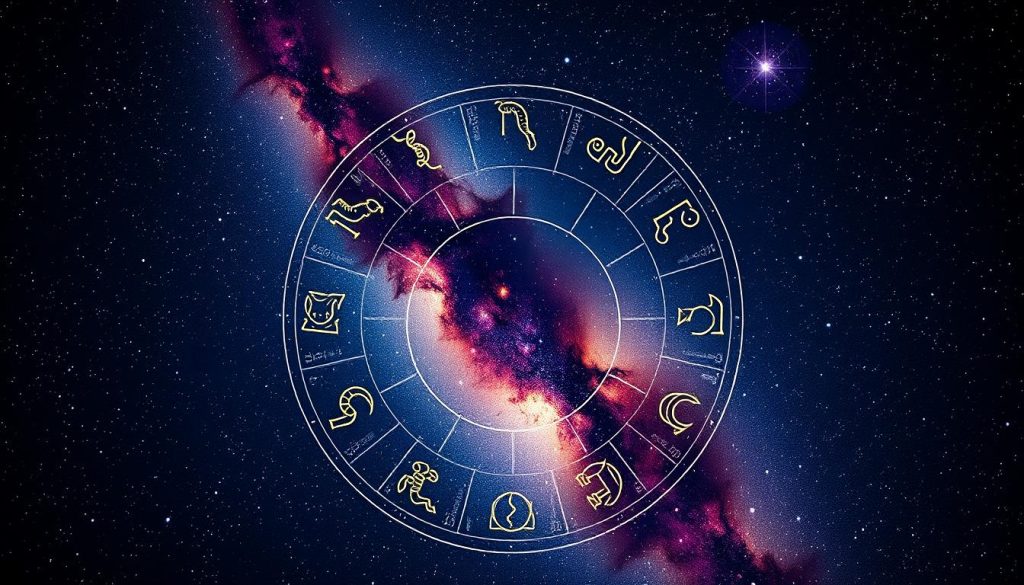
The zodiac has fascinated people for thousands of years. It offers a peek into celestial understanding. The horoscope calendar shows astrological birth dates rooted in ancient history1.
The zodiac has 12 unique astrological signs. Each sign has its own place in the celestial landscape1.
Babylonians created these zodiac sign dates around 500 BCE. They’ve stayed the same through centuries of cultural change1.
Each sign takes up 1/12 of the ecliptic. This creates a balanced view of celestial movements1.
People are still interested in astrology today. A 2022 poll showed 27% of Americans believe in it. Among younger folks, that number jumps to 37%1.
Key Takeaways
- Zodiac system originated with Babylonians around 500 BCE
- 12 distinct astrological signs represent celestial divisions
- Each sign covers approximately 30 degrees of the ecliptic
- Modern interest in astrology remains significant
- Zodiac signs reflect cultural and astronomical traditions
Understanding the Zodiac Calendar and Its Origins
The zodiac is a captivating celestial system that’s fascinated humans for millennia. It shows how ancient cultures mapped the sky and understood celestial movements. The star sign dates we know have deep roots in astronomical observations and cultural traditions2.
Ancient Babylonian Roots of Celestial Mapping
The zodiac birth chart originated in ancient Mesopotamia around 2000 B.C. Babylonian priests were expert astronomers who precisely documented celestial events. They recorded about 7,000 celestial omens across 70 cuneiform tablets2.
The Celestial Path of Constellations
The zodiac is a belt extending about 9 degrees on each side of the Sun’s apparent yearly path. This celestial map contains 12 distinct constellations, each spanning roughly 30 degrees of the sky3.
Earth’s axial wobble causes a gradual shift in constellation alignments. As a result, the spring equinox now occurs in Pisces instead of Aries3.
Constellation Characteristics
- The term “zodiac” comes from the Greek phrase meaning “circle of animals”2
- Each zodiac sign corresponds to a approximately 30-day period3
- Ophiuchus exists as a constellation along the zodiac path but is not traditionally included3
The zodiac has kept its cultural importance from royal courts to modern newspapers. The first horoscope column appeared in 1930, sparking widespread interest in astrological interpretations2.
Zodiac Sign Dates and Their Seasonal Alignments
The celestial sign periods show a fascinating cosmic journey through the year. Each zodiac sign represents a unique part of Earth’s orbit around the Sun. These signs align with seasonal changes4.
From Aries in early spring to Pisces at the end, astrological signs map cosmic rhythms. These schedules reveal an intricate pattern of celestial movements5.
Birth horoscope calendars link each sign to its element and season. The zodiac has four groups: Fire, Earth, Air, and Water6. These timelines reflect both star positions and nature’s yearly cycle4.
The zodiac signs are precisely calculated, each covering 30 degrees of the sky6. This setup helps astrologers track traits based on birth time.
They create a map of potential characteristics and compatibility6. Western astrology uses the Tropical Zodiac, keeping signs linked to seasons.
This system connects the cosmic story to our earthly experience6. Each sign, from fiery to earthy, offers insight into human nature and seasonal patterns.
FAQ
What exactly are zodiac sign dates?
Zodiac sign dates are specific periods linked to astrological signs. They typically span about 30 days each. These dates follow the sun’s path through constellations during Earth’s yearly orbit.
How do I determine my correct zodiac sign?
Your zodiac sign depends on the sun’s position when you were born. Match your birth date to standard ranges like Aries (March 21-April 19) or Taurus (April 20-May 20).
For precise results, check an accurate birth chart. Exact times can vary slightly.
Are zodiac sign dates the same every year?
Zodiac sign dates stay mostly consistent. Small changes can happen due to precession, shifting dates by a day or two.
Most astrologers use traditional Gregorian calendar dates for simplicity.
What is a cusp date in astrology?
A cusp date is the transition between two zodiac signs. It occurs a few days before and after a sign change.
People born on these dates might feel they have traits from both signs. Exact birth time is key to determine the correct sign.
How do zodiac sign dates relate to seasonal changes?
Zodiac sign dates align with seasonal shifts in the Northern Hemisphere. Aries starts at the spring equinox, Cancer at summer solstice.
Libra begins at the autumn equinox, and Capricorn at the winter solstice. This reflects Earth’s yearly journey.
Can my zodiac sign change?
Your zodiac sign stays the same throughout your life. It’s set by your birth date.
What can change is how you understand and interpret your sign’s traits as you grow.
Do zodiac sign dates have scientific validity?
Zodiac sign dates come from astronomical observations of celestial movements. Modern science sees them as cultural and historical artifacts.
They’re not considered predictive tools. However, many people still find personal meaning in them.
Source Links
- Zodiac | Signs, Dates, Symbols, & Facts | Britannica – https://www.britannica.com/topic/zodiac
- What are the ancient origins of your zodiac sign? – https://www.nationalgeographic.com/history/article/history-of-horoscopes
- Zodiac: Signs, symbols, history, constellations – https://www.astronomy.com/science/a-scientific-guide-to-the-zodiac-symbols-signs-and-flaws/
- Astrological sign – https://en.wikipedia.org/wiki/Astrological_sign
- Astrological Signs by Season – https://www.dummies.com/article/body-mind-spirit/religion-spirituality/astrology/astrological-signs-by-season-268240/
- Zodiac Signs: 12 Astrology Sign with Dates and Meaning – https://www.astroyogi.com/zodiac-signs

