
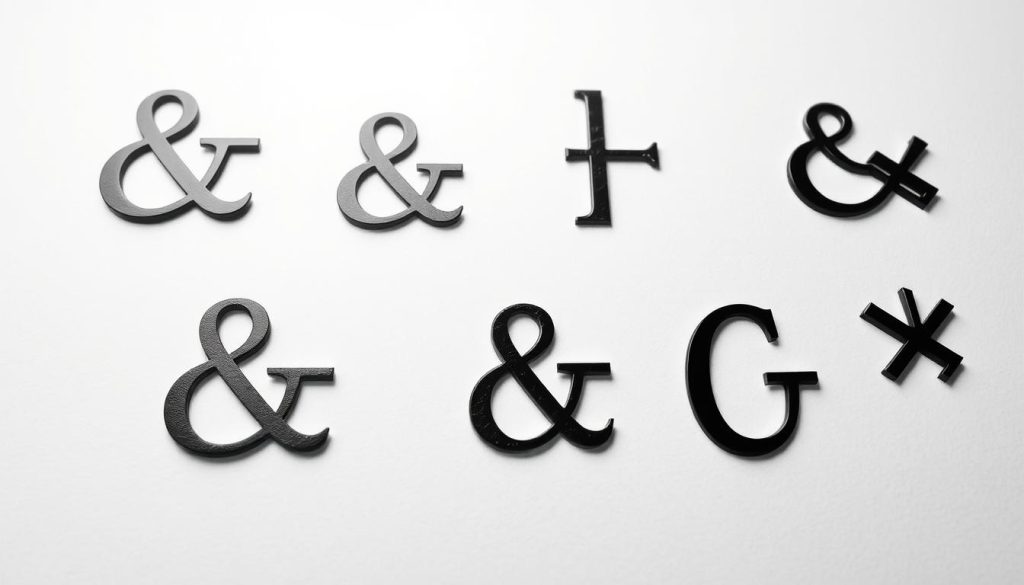
Typographical symbols are vital for clear written communication. They help writers express precise meaning and improve text clarity. The asterisk, or star symbol, serves many important functions in writing and digital communication1.
These special characters indicate footnotes, anonymize text, and highlight specific information1. Writers and professionals use the asterisk in various contexts, from academic writing to digital messaging.
You can type an asterisk using shift+8 on a standard keyboard2. This makes it easy to access for multiple uses in your writing.
Typographical symbols are powerful tools for effective communication. They break down complex information and create visual interest in text. From literature to computing, these symbols help writers convey their ideas clearly.
Key Takeaways
- Typographical symbols enhance written communication
- The asterisk serves multiple purposes in writing
- Symbols help clarify and emphasize text information
- Digital communication relies heavily on special characters
- Understanding symbol usage improves writing precision
Understanding Common Typographical Symbols
Typographical symbols are crucial for written communication. They help express meaning beyond words. These marks guide readers through text, convey tone, and clarify complex ideas.
Different symbols serve unique purposes in communication. Punctuation marks structure written language. The asterisk has many uses, from academic footnotes to programming.
Essential Punctuation Marks
- Period (.): Ends declarative sentences3
- Comma (,): Separates clauses and lists3
- Question mark (?): Indicates interrogative sentences3
- Exclamation point (!): Expresses emotional emphasis3
Special Characters in Writing
Special characters like the asterisk are vital in digital communication. In programming, the asterisk serves multiple functions. It’s used for pattern matching and annotation.
Advanced Typographical Elements
- Dashes: En dash (–) and em dash (—) provide nuanced punctuation3
- Brackets: Parentheses (), square brackets [], and curly brackets {} offer additional context3
- Symbols with specialized uses: Ampersand (&), hashtag (#), and at symbol (@)3
Knowing these symbols helps writers communicate clearly. They can express ideas precisely across various platforms. This knowledge enhances overall writing skills.
Asterisk Symbol Name and Related Characters
The asterisk (*) is a versatile symbol with a long history. It’s known as the “star” or “splat” in various contexts. The symbol originated from medieval manuscript annotations, linking text with notes.
The asterisk serves many purposes in modern writing. It’s used in digital applications for multiplication and computing. Programmers use it in several ways:
- As a wildcard character in search queries4
- For multiplication in spreadsheet formulas4
- In programming languages for specific operations4
Academic styles give guidelines for asterisk footnote usage. The Chicago Manual of Style suggests using an asterisk for few notes. For complex documents, a sequence like * † ‡ § can be used5.
| Context | Asterisk Usage |
|---|---|
| Programming | Multiplication, wildcard searches |
| Typography | Footnotes, omissions |
| Digital Communication | Feature access codes, keyboard shortcuts |
The asterisk continues to evolve, adapting to new communication technologies while maintaining its core communicative functions.
Modern usage goes beyond traditional applications. Disclaimers often use asterisks to highlight fine print. This shows the symbol’s ongoing importance in communication5.
Essential Writing and Digital Symbols
Digital communication has changed how we use symbols in writing. The asterisk punctuation is key in this digital world. It links various forms of communication6.
Email and web symbols are now crucial for our interactions. The at sign (@) is vital for email addresses and social media handles. The pound sign (#) has changed social media, helping users sort content6.
These symbols guide us through online communication. They make it easier to share ideas and connect with others.
Math and science fields use specific symbols often. The percentage sign (%) shows ratios, while the asterisk (*) marks scientific notation67. Researchers use asterisks to show important stats in studies7.
Currency symbols help global financial talks. The dollar sign ($) stands for many types of money. It’s used for Canadian (CAD$) and Australian (AUD$) dollars6.
These symbols show how punctuation has grown to meet our complex needs. They help us communicate clearly in our digital world.
FAQ
What exactly is an asterisk?
An asterisk is a star-shaped symbol (*). It’s used in writing, programming, and math. This versatile symbol can indicate extra info or serve as a wildcard character.
How do I pronounce “asterisk”?
Say “AS-tuh-risk” with stress on the first syllable. The word comes from Greek, meaning “little star”.
What are the most common uses of an asterisk?
Asterisks have many uses. They mark footnotes, censor words, and show corrections. In computer searches, they act as wildcards.
In math, asterisks represent multiplication. They can also highlight important text.
How is an asterisk used in programming?
In coding, asterisks play various roles. They multiply, declare pointers in C and C++, and act as wildcards. Programmers also use them for multiplication or referencing in different contexts.
Where did the asterisk symbol originate?
The asterisk dates back to ancient Greek manuscripts. Scholars used it to mark interesting passages or corrections. Librarians in Alexandria first used it as a critical mark around 250 BCE.
Can an asterisk be used in academic writing?
Yes, asterisks are common in academic papers. They mark footnotes and show statistical significance. Authors use them to note omitted text or add extra comments.
How do I type an asterisk on different devices?
On most keyboards, press Shift + 8 for an asterisk. Mobile devices usually have it in the symbol keyboard. You can also copy and paste it or use its HTML code.
Are there different styles of asterisks?
The standard asterisk is a six-pointed star (*). However, fonts can change its look. Some typefaces feature more elaborate or stylized asterisk designs.
Source Links
- Typing signs and writing symbols, e.g. * # & % $ | Writing – https://www.englishclub.com/writing/symbols.php
- Fun Facts About Common Keyboard Symbols – https://www.thoughtco.com/common-keyboard-symbols-1078337
- 26 Types of Punctuation Marks & Symbols – https://www.thesaurus.com/e/grammar/what-are-the-major-punctuation-marks/
- What is an Asterisk? – https://www.computerhope.com/jargon/a/asterisk.htm
- What Are Asterisks (*) and What Are They Used for in Writing? – https://www.thoughtco.com/what-is-asterisk-symbol-1689143
- Learn Easily What Symbol Is That in English – https://learnlaughspeak.com/what-symbol/
- When to Use Asterisks in Academic Writing – Enago Academy – https://www.enago.com/academy/when-to-use-asterisks-in-academic-writing/

