
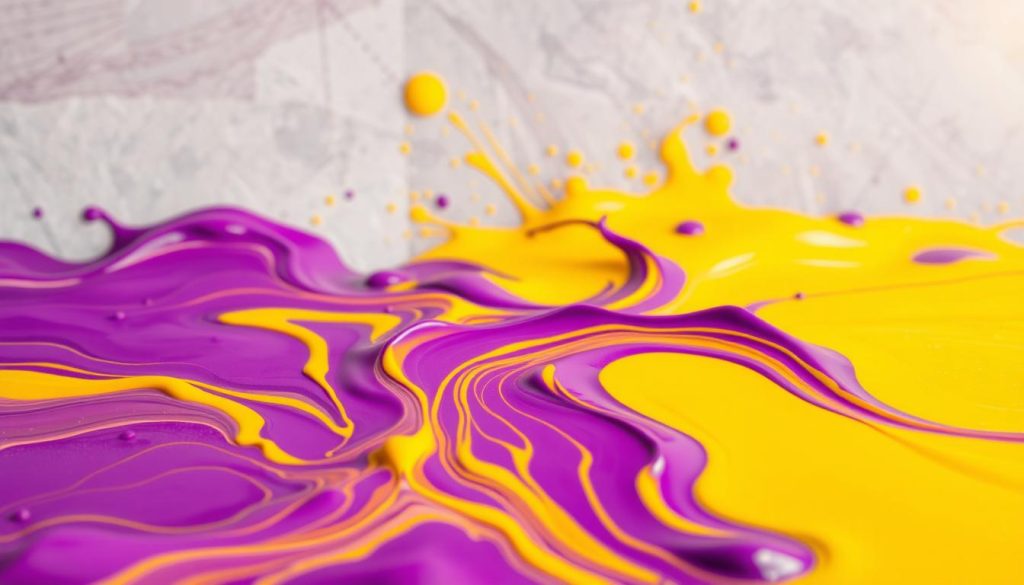
Color mixing reveals unexpected transformations. Purple and yellow, vibrant complementary colors, create intriguing results. The outcome depends on factors like saturation and medium1.
Artists explore these color interactions for unique palettes. They develop visual experiences that captivate viewers. Digital tools enable precise experimentation with color mixing.
Mixing purple and yellow can yield surprising outcomes. Digital experiments show results ranging from dusty mauve to rich, rusty brown2. These variations depend on the specific shades and saturation levels used2.
Color theory explains why purple and yellow interact uniquely. They’re complementary colors on opposite sides of the RYB color wheel. Their combination naturally produces brown tones with different intensities1.
Professional artists use this knowledge in their work. They create nuanced color compositions that enhance their art. Understanding color interactions allows for more expressive and impactful creations.
Key Takeaways
- Purple and yellow are complementary colors that create brown when mixed
- Color mixing results vary based on saturation and specific shades
- Digital tools like Procreate enable precise color experimentation
- The RYB color model explains complementary color interactions
- Artists can manipulate color mixing to achieve desired visual effects
Understanding Color Theory Basics
Color theory explores visual perception and artistic expression. It delves into how colors interact and create harmony. Artists and designers use these principles to craft captivating visual experiences.
Sir Isaac Newton developed the first circular color diagram in 1666. His work led to the traditional color wheel. This tool remains crucial for understanding secondary colors and warm-cool tones.
The RYB Color Model Explained
The RYB (Red, Yellow, Blue) model is key in art and design. It features three primary colors that can’t be mixed3:
- Red
- Yellow
- Blue
Complementary Colors on the Color Wheel
Complementary colors sit opposite each other on the color wheel. They create striking contrasts that energize compositions. These color pairs bring balance to artistic works3.
Primary vs Secondary Colors
Primary colors stand alone, while secondary colors come from mixing. This difference is vital in color theory.
| Color Type | Definition | Examples |
|---|---|---|
| Primary Colors | Cannot be created by mixing | Red, Yellow, Blue |
| Secondary Colors | Created by mixing two primary colors | Purple, Orange, Green |
Color theory’s magic lies in understanding these complex relationships. It allows artists to create vibrant, harmonious visuals. Mastering these concepts opens up endless creative possibilities4.
Purple and Yellow Mixed: Results and Variations
Mixing purple and yellow creates fascinating color changes. The result usually produces various brown shades. The exact tone depends on the specific hues and amounts used56.
Artists find that purple and yellow make interesting tertiary shades. Darker combinations yield deeper browns. Lighter shades create more subtle, muted colors5.
- Bright yellow with warm purple can create almost orange-like hues
- Cool, blue-purple mixed with bright yellow might generate greenish tones
- Different mixing ratios produce unique color variations
Purple and yellow are complementary colors on the color wheel. This explains their amazing blending abilities. Vibrant hues emerge when carefully adjusting color amounts and pigment quality6.
Color mixing is an art of subtle nuances and creative exploration.
Artists can create many browns, mauves, and surprising color combos. They do this by trying different purple and yellow shades. Understanding how pigments interact is key56.
Methods for Adjusting Mixed Color Shades
Artistic color mixing requires skill in manipulating purple and yellow blends. Artists can transform base brown into their desired shade. Adding different pigments is key to achieving the perfect hue. Color mixing techniques can boost your creative process7.
White paint is crucial for creating lighter tints. Adding white gradually softens and subdues the brown8. Professionals suggest incremental additions for precise control. Different purple and yellow shades produce unique variations with white7.
Darkening colors needs a strategic approach. Black paint or more purple can create richer, dramatic brown tones8. Artists often use small amounts of complementary colors to fine-tune shades7.
Advanced techniques involve subtle color adjustments. Tiny amounts of red or blue can shift the brown’s undertone dramatically. Understanding lighting and pigment types improves artistic skills7.
FAQ
What color do purple and yellow make when mixed?
Mixing purple and yellow creates various shades of brown. The exact hue depends on the tones and proportions used. The result can range from rich, dark browns to lighter, neutral tones.
Why do purple and yellow create brown when mixed?
Purple and yellow are complementary colors on the color wheel. Their opposing color components neutralize each other when combined. The mix of red, blue, and yellow naturally produces brown tones.
How can I control the shade of brown when mixing purple and yellow?
The final color depends on pigment quality and the ratio of purple to yellow. Darker purples and vibrant yellows create different browns than lighter or muted shades.
Can I modify the mixed color after combining purple and yellow?
Yes, you can adjust the mixed color easily. Add white for lighter tints or black to darken the tone. Small amounts of other colors can fine-tune the hue for your projects.
What art mediums work best for mixing purple and yellow?
This color mixing technique works well in various mediums. These include acrylic paint, watercolors, oil paints, and digital design platforms. Each medium offers slightly different results due to pigment density and blending properties.
Are there any professional color mixing tips I should know?
Use high-quality pigments and mix colors gradually. Experiment with small amounts of additional colors to achieve the desired shade. Always test your color mix on a separate surface before applying it.
How do warm and cool tones affect purple and yellow mixing?
Warm and cool tones greatly impact color mixing. Combining warm purple with cool yellow, or vice versa, creates nuanced brown tones. This results in greater depth and complexity compared to straightforward color combinations.
Source Links
- What Color Do Purple and Yellow Make When Mixed? – https://www.color-meanings.com/what-color-purple-yellow-make-mixed/
- What Do Yellow and Purple Make When Mixed? – Drawings Of… – https://drawingsof.com/what-do-yellow-and-purple-make/
- Understanding Color Theory: The Basics – https://sarahrenaeclark.com/understanding-color-theory-basics/?srsltid=AfmBOorW6WETf81C2jaEGYt_I0eppSw3SaeBgdw86PzFv5id1OUWwp47
- Basic Color Theory – https://www.colormatters.com/color-and-design/basic-color-theory
- What color does purple and yellow make when mixed? – https://iheartcraftythings.com/what-color-does-purple-yellow-make.html
- What Do Purple and Yellow Make? – https://www.homemade-gifts-made-easy.com/purple-and-yellow-make.html
- What Color Do Purple and Yellow Make? – https://www.designyourway.net/blog/what-color-do-purple-and-yellow-make/
- 3 Ways to Mix Colors – wikiHow – https://www.wikihow.com/Mix-Colors

