
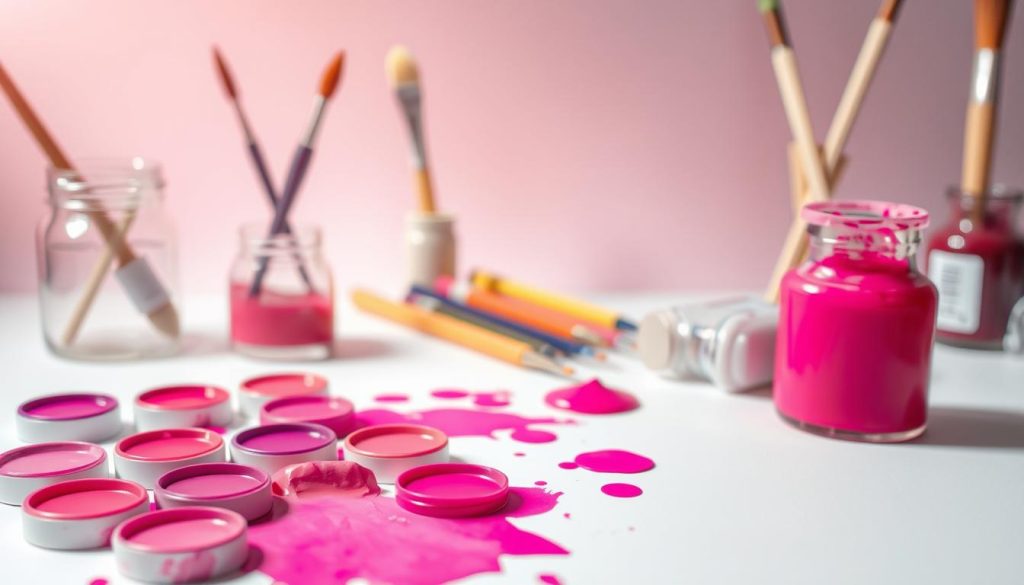
Making the perfect pink shade requires understanding color mixing principles. It starts with two key pigments: red and white1. Artists explore various ways to create unique pink hues2.
Creating pink is more complex than just mixing two colors. The type of red and the amount of white affect the final shade1. Many artists buy individual pigments to make their own special pinks1.
Pink wasn’t always linked to a specific gender. In 18th-century Europe, both men and women wore pink3. This challenges our current ideas about color.
Today, mixing pink is a refined art. It offers endless chances for creative expression3.
Key Takeaways
- Red and white are the primary colors for creating pink
- Different red pigments produce varied pink shades
- Ratio of colors determines the intensity of pink
- Customizing pink is more flexible than using pre-mixed paints
- Color mixing is both a science and an artistic technique
Understanding Basic Color Theory for Pink Creation
Pink creation is a fascinating journey into color mixing and perception. Artists and designers explore blending colors to make pink, uncovering the science behind this hue. Pink is a tint, created by combining red and white pigments4.
The Science of Pink Pigments
Pink color combination dives into the world of light and pigmentation. It doesn’t appear in the natural light spectrum, but emerges through mixing wavelengths and pigments4.
The visible light spectrum ranges from 400 to 800 nanometers. Red light sits around 700 nanometers4.
White’s Transformative Role in Pink Creation
The amount of white added greatly influences the final pink shade. More white creates lighter, softer pinks, while less white results in deeper tones4.
Artists can craft an incredible range of pink variations5:
- Powder pink: A historically favored soft shade5
- Blush: A muted pink first described in 15905
- Camellia rose: A vibrant pink inspired by Japanese flowers5
Exploring Pink Undertones
Pink creation isn’t just about red and white. Different undertones can transform the entire character of the color5.
Reds with blue undertones produce cooler, more subdued pinks. Reds with yellow hints create warmer, more vibrant coral shades5.
The paint medium also plays a crucial role. Acrylics tend to dry darker, while oils maintain their vivid pink characteristics5.
“Color is a power which directly influences the soul.” – Wassily Kandinsky
Colors to Mix for Pink: Essential Combinations
Creating pink paint is a skill that requires understanding color ratios and pigment interactions. Artists can make a stunning pink palette by blending red pigments with white6. The perfect pink comes from choosing the right base colors and understanding their undertones.
- True Pink: Combine 1 part Cadmium Red with 2 parts Titanium White for a classic pink shade6
- Light Pink: Mix 1 part Cadmium Red with 3 parts Titanium White for a softer tone6
- Hot Pink: Create vibrant pink by mixing Quinacridone Magenta with Titanium White6
Pink mixing depends on paint type and desired outcome. Warm reds like Cadmium Red make coral-like pinks. Cool reds such as Alizarin Crimson create purplish pink tones6.
Different white pigments offer various effects. Zinc white creates translucent pinks. Titanium white produces more opaque results6.
Pro tip: To mute pink shades, add a small amount of green-yellow, which is pink’s complementary color6.
The emotional impact of your pink shade matters. Darker pinks like magenta convey passion. Lighter pastel pinks feel sweet and delicate6.
By mastering these mixing techniques, artists can create the perfect pink for any project. Experiment with different combinations to find your ideal shade.
Professional Tips for Mixing Perfect Pink Shades
Creating the perfect pink shade demands precision and color knowledge. Artists know that successful pink color mixing hinges on choosing the right red base. Understanding paint properties is also crucial78.
Start by picking reds with specific undertones. Blue-tinged reds yield cooler pinks, while yellow-based ones create warmer hues8. Quinacridone Red and Alizarin Crimson produce bright, vibrant pinks7.
Steer clear of earth-tone reds. They can muddy your palette and reduce the pink’s vibrancy.
Different paint types need unique approaches. Acrylic paints dry darker, so mix slightly lighter shades8. For oil paints, use zinc white for normal pink shades8.
Paint on white or light surfaces. This maximizes pink’s brilliance and ensures accurate color representation8.
To balance warm pink tones, try green or blue. A dash of yellow can boost hot pink’s intensity8. Mastering pink requires understanding color bias and practicing mixing techniques7.
FAQ
What basic colors do I need to mix to create pink?
Red and white are the key ingredients for pink. Mix these two colors to create various pink shades. The red-to-white ratio determines the pink’s intensity and lightness.
How does white affect red when creating pink?
White lightens red pigments, creating different pink hues. More white produces lighter, pastel pinks. Less white results in deeper, more saturated pink tones.
The type of white and red pigments also influences the final color.
Can I create pink without using white?
Yes, you can make pink-like colors without white. Try mixing magenta with a lighter color. Some paint pigments can also produce pink shades without traditional white mixing.
What’s the difference between warm and cool pink undertones?
Warm pink undertones have hints of orange or red. They create a vibrant and energetic color. Cool pink undertones lean towards blue or purple.
These cooler tones result in softer, more muted pink shades. The pigments used determine these undertone characteristics.
How do different paint mediums affect pink color mixing?
Each paint medium impacts color mixing differently. Acrylics dry quickly and may appear slightly darker. Oils allow for more blending and subtle color transitions.
Watercolors create translucent pink shades with delicate variations.
What are common mistakes when mixing pink?
Common mistakes include using muddy red pigments and adding too much or too little white. Not considering undertones is another frequent error.
Use high-quality pigments and mix gradually to avoid these issues. Test your color on a palette before applying it to your artwork.
How can I create vibrant hot pink?
Use a bright red pigment like cadmium red or magenta. Mix it sparingly with white. Add small amounts of white gradually to achieve the desired intensity.
This method prevents creating a pale, washed-out color.
Are there professional tips for achieving the perfect pink shade?
Experiment with different red bases and practice subtle mixing techniques. Mix colors in good lighting and use a clean palette.
Keep track of your pigment ratios for consistent results. Understanding color theory is also crucial for achieving perfect pink shades.
Source Links
- What colors to mix to make Pink? – https://www.meyspring.com/blogs/meyspring-pigments/what-colors-to-mix-to-make-pink?srsltid=AfmBOoqgHGXN-skS7aRW6T4C_npox929zOur7UZX3rkjg9HmNAxWjzdR
- How to Make Pink Paint with Watercolors, Acrylics, or Oils – https://www.wikihow.com/Mix-Paint-to-Make-the-Colour-Pink
- How to Make Pink Color: Paint, Food Coloring & More – https://www.wikihow.com/Mix-Colors-to-Make-Pink
- What Colors Make Pink? How to Make Pink Easily · PrepScholar – https://blog.prepscholar.com/what-colors-make-pink
- The Color Pink: Essential Color Theory, Symbolism and Design Application | Dunn-Edwards Paints – https://www.dunnedwards.com/pros/blog/the-color-pink-essential-color-theory-symbolism-and-design-application/
- What Colors Make Pink? – Easy Recipes for 25 Pink Shades – https://artincontext.org/what-colors-make-pink/
- How to Make Pink? (and Purple) Colour Mixing with Acrylics – https://willkempartschool.com/how-to-mix-the-perfect-pink-paint-with-acrylics/
- How to Make Pink with Acrylic Paint vs. Oil Paint – https://www.milanartinstitute.com/blog/how-to-make-pink-with-acrylic-paint-vs.-oil-paint

