
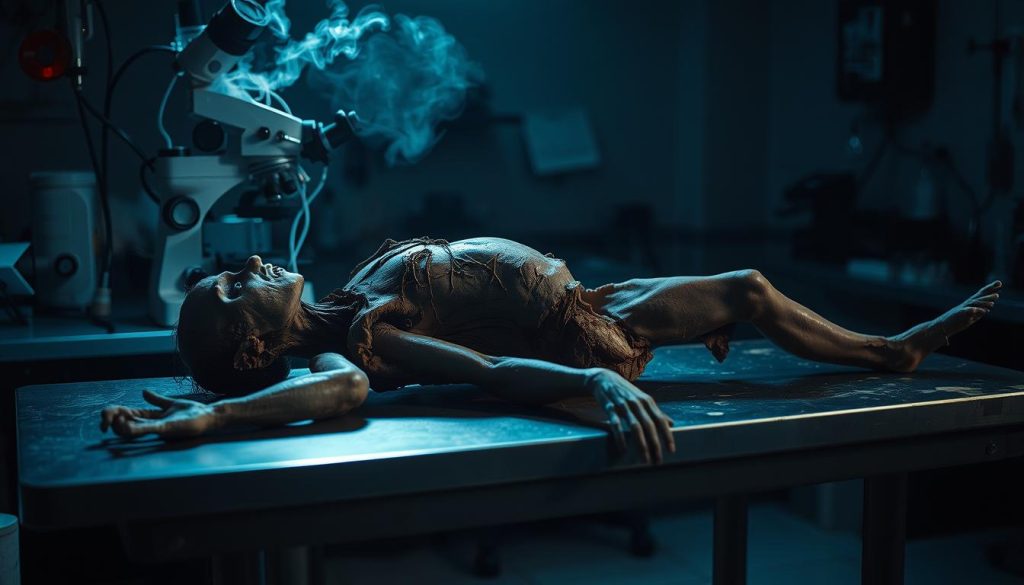
The smell of a dead body is a complex and unsettling process. It begins 24-48 hours after death, marking the start of biological breakdown1. These cadaveric gases create an intense and overwhelming sensory experience.
Decomposition odor develops through chemical reactions involving multiple compounds. The smell peaks 4-10 days after death, depending on environmental factors1. Eight primary gases contribute to this distinctive scent profile2.
The chemical makeup includes toxic compounds like cadaverine, putrescine, and hydrogen sulfide. These gases create an unbearable stench and can pose health risks12.
Key Takeaways
- Decomposition smell starts within 24-48 hours after death
- Odor intensity peaks between 4-10 days post-mortem
- Multiple chemical compounds contribute to the dead body smell
- Cadaveric gases can be toxic and potentially harmful
- Environmental conditions significantly impact decomposition rate
Understanding the Science Behind Decomposition Odors
Decomposing remains produce a complex mix of volatile organic compounds. Scientists have studied this process extensively. The scent reveals intricate molecular changes in human tissue.
Chemical Compounds Driving Decomposition Odors
Nine primary chemical compounds emerge during decomposition. These create distinct post-mortem smells. The odors range from rotten eggs to fecal matter3.
- Hydrogen sulfide (rotten egg smell)
- Cadaverine (putrid odor)
- Putrescine (decaying flesh scent)
- Skatole (fecal-like smell)
- Indole (musty odor)
- Dimethyl disulfide
- Dimethyl trisulfide
- Methyl mercaptan
- Trimethylamine (fishy smell)
Factors Influencing Decomposition Intensity
Environmental factors affect the strength of decomposition odors. Temperature, humidity, and exposure can speed up the breakdown process4.
Bodies in different environments produce varying odor profiles. Water-submerged remains show unique chemical signatures3.
Insects and environmental conditions affect decomposition speed. A single fly can lay up to 250 eggs quickly. This speeds up decay and intensifies the smell5.
The Dead Body Smell: Timeline and Stages
Human decomposition is a complex process with distinct stages. Each stage has unique changes in the smell of rotting flesh. This timeline helps experts understand how human remains break down.
Decomposition starts soon after death. It goes through several stages that change the corpse’s smell. Here are the main stages:
- Fresh Stage (1-3 days): Minimal odor present6
- Putrefaction Stage (3-10 days): Initial development of death reek7
- Active Decay (7-20 days): Significant tissue breakdown8
- Advanced Decay (29-51 days): Continued decomposition8
- Dry/Skeletonization (52-207 days): Final stage of decomposition8
In the putrefaction stage, bacteria become very active. They make gases like hydrogen sulfide and methane. These gases cause the strong corpse smell.
The body’s temperature rises due to insect activity. This speeds up the decomposition process.
| Stage | Duration | Key Characteristics |
|---|---|---|
| Fresh Stage | 1-3 days | Minimal odor, initial bacterial activity |
| Putrefaction | 3-10 days | Gas production, intense death reek |
| Active Decay | 7-20 days | Significant tissue breakdown |
Environmental factors affect the decomposition timeline and smell intensity. These include temperature, humidity, and exposure. Forensic experts use these stages to estimate time since death.
They also help experts understand the complex biological processes involved. This knowledge is crucial for forensic investigations and research.
Health Risks and Safety Concerns from Decomposition Exposure
Decomposing bodies release a cadaverine stench that can cause serious health issues. Exposure to these gases may lead to respiratory problems and other symptoms. People with asthma or other conditions are at higher risk9.
When dealing with decomposition, professional help is crucial. Biohazard cleaning services have special training to handle dangerous fluids safely. They know how to manage the risks of decomposing bodies, especially those with infectious diseases910.
Close contact with deceased bodies can expose people to chronic infectious diseases. These include hepatitis B and C, HIV, tuberculosis, and possibly cholera11. The smell warns of harmful microorganisms that need expert cleaning9.
Safety is key when near decomposing bodies. Wear face masks and avoid touching any fluids. Call professionals right away for help. They use special machines and methods to remove odors and health risks910.
FAQ
What causes the distinctive smell of a decomposing body?
The dead body smell comes from chemical compounds released during decomposition. These include putrescine, cadaverine, and other organic gases produced by bacteria. The odor grows stronger as decomposition progresses and can be harmful to health.
How quickly does the smell of a decomposing body develop?
The cadaveric odor usually starts during putrefaction, a few days after death. At first, there’s little smell, but it quickly gets stronger as gases are released.
Factors like temperature, humidity, and environment can speed up or slow down this process.
What are the primary chemical compounds responsible for the death smell?
Nine key chemical compounds create the death smell. These include cadaverine, putrescine, and sulfur-containing gases. Each compound adds its own unpleasant scent to the mix.
Can exposure to decomposition odors be dangerous?
Yes, exposure to post-mortem smells can be harmful. People might feel sick, get headaches, or have trouble breathing. Long-term exposure can lead to serious health risks.
It’s important to use proper gear like masks, gloves, and goggles when handling decomposing remains.
How long does the smell of a decomposing body last?
The corpse smell changes as the body decomposes. It starts a few days after death and can last for weeks or months.
The smell is strongest during active and advanced decay stages. It slowly fades as the body turns into a skeleton.
What factors affect the intensity of decomposition odors?
Temperature, humidity, air flow, and the surroundings all affect the death smell. Warm, humid conditions make decomposition faster and smells stronger. Cool, dry conditions slow things down.
When should I call professional help for a decomposing body?
Call professional cleanup services right away if you find a decomposing body. They have special tools, protective gear, and cleaning methods to safely remove the smell.
These experts can also prevent health hazards associated with decaying remains.
Source Links
- Describing the Smells of a Dead Body | Crime Scene Cleanup – https://www.crimescenecleanup.com/dead-body-smell/
- The Smell of Death — BIOGONE – https://www.biogone.com/blog/the-smell-of-death
- Deadly secrets—the science of decomposition – https://www.science.org.au/curious/decomposition
- Identifying the Smell of a Dead Body/ Understanding the Components and Causes of Decomposition Odor – 360 Hazardous Cleanup – https://360haz.com/identifying-the-smell-of-a-dead-body-understanding-the-components-and-causes-of-decomposition-odor/
- The Chemistry of the Odour of Decomposition – https://www.compoundchem.com/2014/10/30/decompositionodour/
- Stages of decomposition – https://australian.museum/learn/science/stages-of-decomposition/
- How Long for the Smell of a Decomposing Body To Dissipate? – https://affinitybioaz.com/smell-decomposing-body-dissipate/
- The smell of death. State-of-the-art and future research directions – https://pmc.ncbi.nlm.nih.gov/articles/PMC10538644/
- Bio SoCal – https://biosocal.com/can-the-smell-of-a-dead-body-be-harmful/
- The Dangers of a Decomposing Body – https://www.servicemasterrestore.com/servicemaster-kwik-hartford/why-us/blog/2018/october/the-dangers-of-a-decomposing-body/
- Health risks from dead bodies – https://en.wikipedia.org/wiki/Health_risks_from_dead_bodies

