
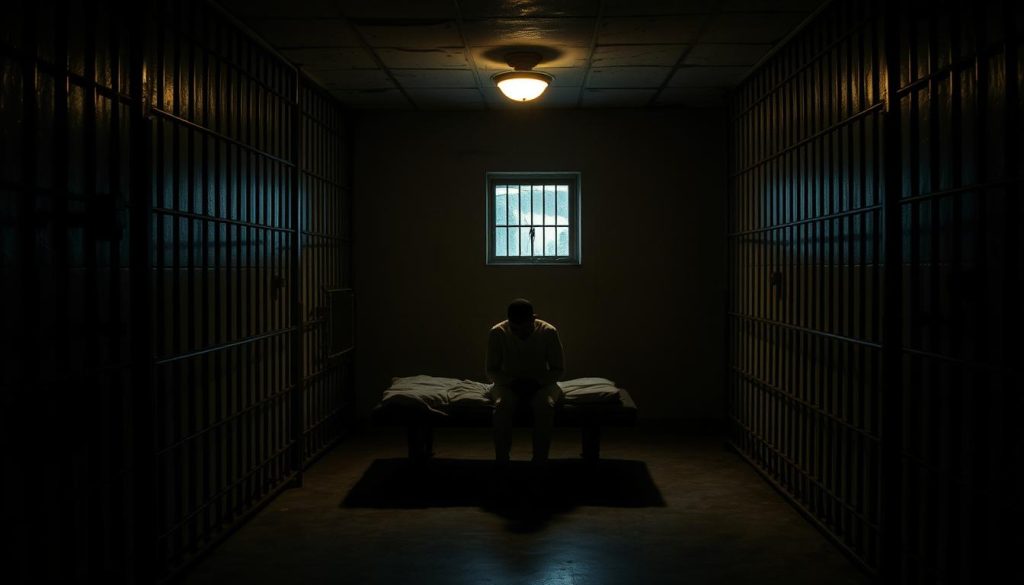
A life sentence is the harshest punishment in the U.S. criminal justice system. It can mean spending one’s entire life in prison. The exact terms depend on state laws and court decisions1.
Life sentences differ greatly across the country. About one in seven prisoners serve life sentences. This amounts to roughly 203,865 people in federal and state prisons12.
Life sentences are complex due to their varied application. Some states require life imprisonment for first-degree murder. Others impose it for crimes like aircraft hijacking or terrorism1.
Racial inequalities are evident in life sentences. Over two-thirds of those serving life without parole are people of color. One in five Black men in prison faces a life sentence2.
Key Takeaways
- Life sentences represent the most severe punishment in the US criminal justice system
- Approximately 203,865 prisoners are serving life sentences
- Life sentence terms vary significantly across different states
- Racial disparities are prominent in life sentence distributions
- Life sentences can be mandatory for specific serious crimes
Understanding Life Sentences in the American Justice System
Life sentences in the U.S. are complex, reflecting the intricacies of criminal justice. Prisoners face different legal paths based on their circumstances and conviction jurisdiction3.
Life sentences fall into two main types: determinate and indeterminate. These affect parole eligibility and release potential. In 2020, one in seven U.S. prisoners served a life sentence3.
Determinate vs. Indeterminate Sentences
Determinate life sentences mean spending life in prison without parole. Indeterminate sentences offer a potential path to release through parole eligibility.
Key differences include release chances in indeterminate sentences and complete imprisonment in determinate ones. Sentencing varies based on violent crimes and felony convictions.
- Chance of release in indeterminate sentences
- Complete imprisonment in determinate sentences
- Variations in sentencing based on violent crimes and felony convictions
Parole Eligibility and Requirements
Parole eligibility varies greatly across states. Some allow consideration after serving part of the sentence. Others maintain strict requirements.
In Mississippi, those sentenced for unarmed violent crimes can seek parole after serving 50% of their sentence4.
State-by-State Variations
Each state has unique approaches to life sentences. Some have lenient policies, while others maintain strict guidelines. Recidivism rates drop by one-third after 10 years in prison4.
Nearly 2 million people are incarcerated in the U.S. 57% serve sentences of 10 years or more3. This shows the big impact of long-term sentencing on the justice system.
Life Sentence USA: Types and Statistical Overview
In 2024, almost 200,000 people were serving life sentences in the United States. This represents a large part of the prison population. Life sentences are an important alternative to the death penalty for serious crimes.
Life sentences come in different forms. They have special rules for repeat offenders. Here are the main types:
- Life Without Parole (LWOP): 56,245 individuals in 20245
- Life with Possible Parole: 97,160 individuals5
- Virtual Life Sentences (50+ years): 41,398 individuals5
Race plays a big role in life sentencing. Nearly half of those serving life sentences are Black. This varies a lot between states.
Commutation offers some prisoners hope. It could lead to shorter sentences for some.
| Sentence Type | Number of Individuals | Percentage |
|---|---|---|
| Life Without Parole | 56,245 | 28.9% |
| Life with Parole | 97,160 | 49.9% |
| Virtual Life Sentences | 41,398 | 21.2% |
Federal sentencing data shows interesting trends. Life sentences make up less than 1% of federal cases. From 2016 to 2021, 709 federal offenders got life in prison.
Murder convictions account for 48.7% of these sentences. This shows how serious the crimes are that lead to life sentences.
Conclusion: The Future of Life Imprisonment in America
The U.S. criminal justice system faces challenges with life sentences. Over 200,000 people serve life terms, a large part of the prison population6. Debates on clemency and sentencing reform have grown as public views change7.
New laws hint at a shift in life sentence views. Second-look legislation in California and D.C. shows a change in thinking about rigid sentencing6. Some argue for more clemency programs to allow rehabilitation and redemption8.
Racial issues remain a big concern in life sentences. More than two-thirds of those serving life terms are people of color6. The system faces pressure to fix these unfair practices.
Public awareness is growing about life imprisonment issues. This might lead to major changes in how life sentences are used and reviewed7.
Balancing public safety and rehab potential will remain a challenge. The ongoing talks point to a slow but real shift towards kinder, smarter long-term sentencing68.
FAQ
What exactly is a life sentence in the United States?
A life sentence means spending the rest of one’s life in prison. It can vary by state and circumstances. Some sentences offer parole after a certain number of years, while others don’t.
How long does a typical life sentence actually last?
Most life sentences allow parole after 15-25 years. However, some states have life without parole options. These truly mean imprisonment until death.
What’s the difference between determinate and indeterminate life sentences?
Determinate life sentences have a set minimum time before parole eligibility. Indeterminate sentences leave release up to a parole board. The board considers the prisoner’s rehabilitation and behavior.
How do three-strikes laws impact life sentencing?
Three-strikes laws can lead to life sentences for three serious felony convictions. This system automatically imposes long-term imprisonment on repeat offenders.
Can a life sentence be commuted or reduced?
Life sentences can be commuted through executive clemency or gubernatorial pardons. However, these are rare occurrences. They depend on specific legal and political circumstances.
How do life sentences vary across different states?
Each state has its own laws for life sentences. Some offer earlier parole chances. Others have stricter life without parole conditions, especially for violent crimes.
How common are life sentences in the United States?
The U.S. has one of the highest life sentencing rates globally. About 50,000 people are serving life sentences. Around 10,000 of these have no possibility of parole.
Are life sentences used as an alternative to the death penalty?
Many states prefer life sentences over capital punishment. This provides a long-term punishment option. It also avoids the ethical and legal issues tied to the death penalty.
Source Links
- Life imprisonment in the United States – https://en.wikipedia.org/wiki/Life_imprisonment_in_the_United_States
- Life Sentencing: How Does it Work in the United States? – https://blairdefense.com/criminal-defense-resources/life-sentencing/
- Research Shows That Long Prison Sentences Don’t Actually Improve… – https://www.vera.org/news/research-shows-that-long-prison-sentences-dont-actually-improve-safety
- I’m Serving Life in Prison. It’s a Slow-Motion Death Sentence – https://www.rollingstone.com/politics/political-commentary/life-in-prison-opinion-1234879659/
- A Matter of Life: The Scope and Impact of Life and Long Term Imprisonment in the United States – The Sentencing Project – https://www.sentencingproject.org/reports/a-matter-of-life-the-scope-and-impact-of-life-and-long-term-imprisonment-in-the-united-states/
- America’s Enduring Reliance on Life Imprisonment – The Sentencing Project – https://www.sentencingproject.org/reports/no-end-in-sight-americas-enduring-reliance-on-life-sentences/
- Sentencing for Life: Americans Embrace Alternatives to the Death Penalty | Death Penalty Information Center – https://deathpenaltyinfo.org/research/analysis/reports/in-depth/sentencing-for-life-americans-embrace-alternatives-to-the-death-penalty
- PDF – https://www.sentencingproject.org/app/uploads/2022/10/Still-Life.pdf

