
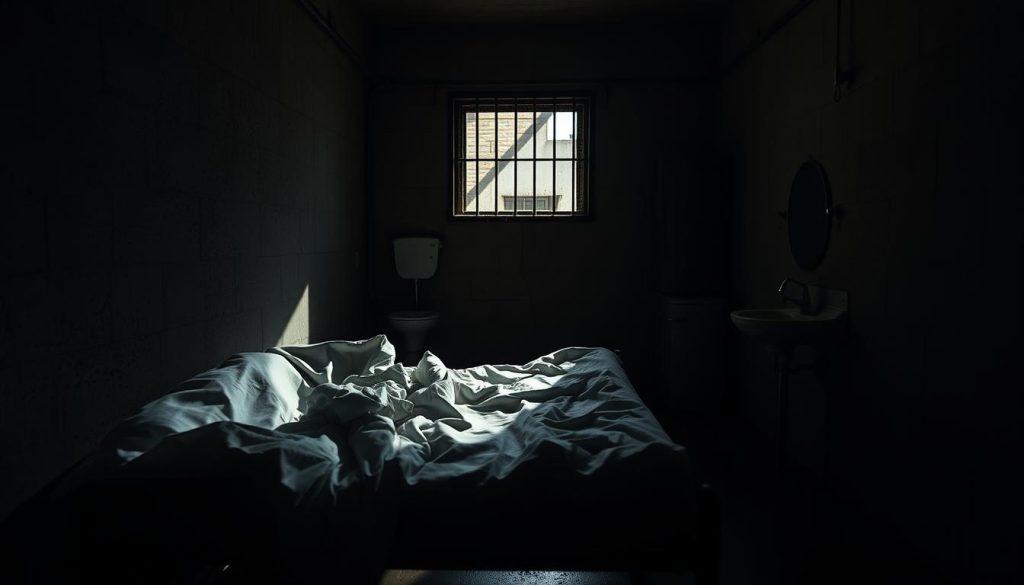
Prison cells are tiny living spaces in correctional facilities. They’re designed to meet basic needs while keeping security tight. These cells usually measure about 6 by 8 feet.
Modern cells have a bed, toilet, and sink. These features offer minimal comfort but ensure maximum security. Overcrowding is a big problem in many prisons.
Some facilities operate beyond their capacity. This often forces inmates to share cells meant for fewer people. Cell design isn’t just about physical limits.
International laws set guidelines for prison conditions. These ensure adequate space, light, and medical care access. U.S. Prison Standards regulate minimum cell size and outdoor exercise time1.
Key Takeaways
- Prison cells are typically small, measuring around 6 by 8 feet
- Basic amenities include a bed, toilet, and sink
- Overcrowding is a persistent issue in many correctional facilities
- International standards aim to ensure humane living conditions
- Cell design prioritizes security while meeting basic human needs
Understanding Basic Prison Cell Structure and Dimensions
Jail architecture balances security and livable conditions. Penitentiary design creates safe, functional environments that meet legal and humanitarian standards2.
Standard Cell Measurements and Space Requirements
Detention centers must follow specific space standards. The International Committee of the Red Cross recommends minimum cell sizes for different occupancies.
| Country | Cell Size |
|---|---|
| United States (typical old cell) | 48 sq ft (6 by 8 feet)2 |
| Germany | 9 m² (97 sq ft)2 |
| Norway | 10 m² (110 sq ft)2 |
| Switzerland | 12 m² (130 sq ft)2 |
Essential Cell Features and Security Elements
Modern prison cells have key security features. These ensure inmate and staff safety.
- Steel or brick walls
- Barred or solid doors with observation windows
- Anchored furnishings to prevent vandalism2
Building Materials and Construction Methods
Modern prisons use advanced building techniques. Pre-cast cells are popular, offering standardized, secure spaces that are quick to assemble2.
The American Correctional Association suggests 70 sq ft for prison cells. This space meets basic needs while maintaining strict security2.
Types of Prison Cells Across Security Levels
U.S. federal prisons have five security levels, each with unique designs and protocols. These levels impact inmate living conditions significantly. Cell types range from open minimum-security spaces to highly restrictive maximum-security units3.
High-security prisons, called United States Penitentiaries (USPs), have the tightest controls. They feature constant guard monitoring and extensive camera surveillance3. These units are built to manage dangerous inmates and prevent escapes.
Over 60,000 people in the U.S. are held in extreme solitary confinement4. This represents the most intense form of inmate isolation.
Minimum-security facilities, known as Federal Prison Camps (FPCs), offer a different environment. They house non-violent offenders and have minimal perimeter security3. Inmates here enjoy more personal freedom than those in higher-security prisons.
Prison cell designs reflect the complex needs of the justice system. They balance security requirements with basic human living standards. Each environment is crafted to manage different inmate types and their potential risks3.
FAQ
What are the typical dimensions of a standard prison cell?
U.S. prison cells usually measure 48 to 80 square feet for single occupancy. Federal and state facilities have different standards. Maximum security cells are smaller than minimum security housing units.
What basic amenities are found in a typical prison cell?
Most cells have a bed, toilet, sink, and minimal storage space. Maximum security cells offer bare essentials. Minimum security cells provide slightly more comfort and personal space.
How do maximum security cells differ from minimum security cells?
Maximum security cells have more restrictive features and constant surveillance. They offer minimal windows and personal space. Minimum security cells have open designs and fewer direct security barriers.
What materials are typically used in prison cell construction?
Cells use durable materials like reinforced concrete and steel-reinforced walls. Metal fixtures and tamper-resistant surfaces are common. Modern facilities may use pre-cast concrete panels and impact-resistant materials.
What is a solitary confinement cell like?
Solitary cells are tiny, usually 6 by 8 feet, with minimal furnishings. They’re built for complete isolation with restricted movement. These cells have limited sensory input and maximum security controls.
How do international prison cell standards compare to U.S. standards?
International standards often recommend more spacious cells than U.S. practices. European countries like Norway provide larger cells with more personal space. U.S. facilities focus on security and space efficiency over rehabilitation.
Are prison cells the same in every correctional facility?
No, cell designs vary based on security level, facility age, and jurisdiction. Federal prisons, state facilities, and county jails have unique configurations. Private detention centers also have their own design philosophies.
Source Links
- Prison Cell Innovations: Modernizing Inmate Living Spaces – SteelCell – https://www.steelcell.com/prison-cell-innovations-modernizing-inmate-living-spaces/
- Prison cell – https://en.wikipedia.org/wiki/Prison_cell
- Breaking Down the Different Types of Prisons in America – https://www.rasmussen.edu/degrees/justice-studies/blog/different-types-of-prisons/
- Prison Conditions | Equal Justice Initiative – https://eji.org/issues/prison-conditions/

