
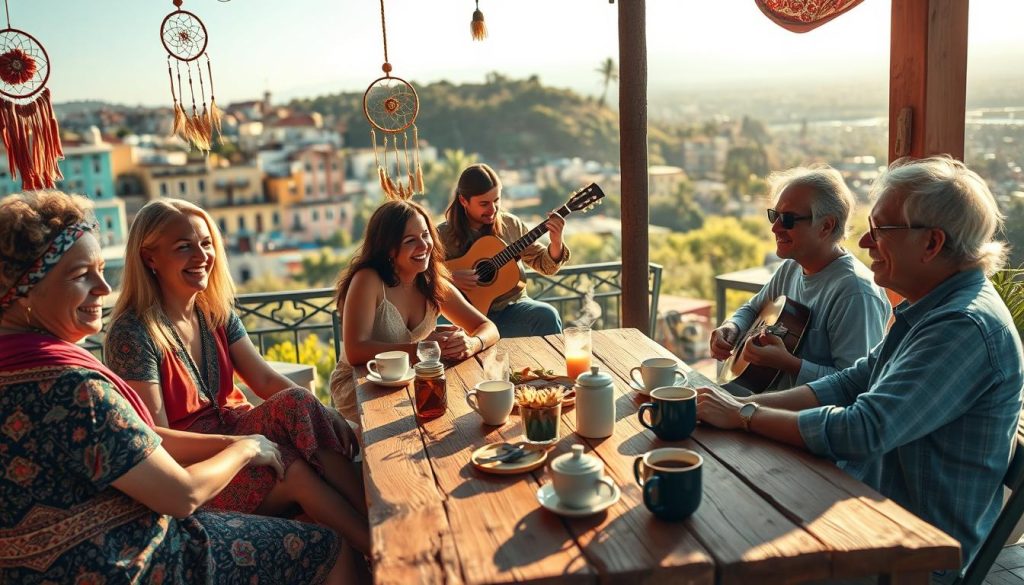
“Boheme” is a French term that captures artistic rebellion and unconventional living. It’s both a noun and adjective, pronounced /bɔɛm/, hinting at a romantic lifestyle1. The word describes a unique approach to life filled with creativity and non-traditional values.
The term’s history stems from a cultural mix-up. French speakers linked it to Romani people, thinking they came from Bohemia2. This connection turned “bohème” into a descriptor for those who reject mainstream society.
“Une vie de bohème” means “a bohemian lifestyle,” celebrating artistic freedom1. Someone described as “très bohème” is committed to creativity and personal expression1. This lifestyle embraces spontaneity and challenges societal norms.
Key Takeaways
- Boheme represents a non-conformist artistic lifestyle
- The term originated from French linguistic traditions
- Bohemian culture celebrates creative independence
- It challenges traditional societal norms
- The concept transcends geographical and cultural boundaries
The Historical Origins of Boheme
Boheme emerged as a vibrant cultural phenomenon in 19th-century Paris. It challenged traditional societal norms and celebrated free-spirited artistic expression. This movement captured the essence of unconventional living.
Parisian youth reimagined social boundaries, drawing inspiration from a unique cultural intersection. The term “bohemian” came from “Bohémien,” associated with Roma people in Paris’s lower-rent districts3.
French Etymology and Cultural Roots
Boheme’s linguistic journey reveals a fascinating cultural narrative. Writers like Victor Hugo romanticized this lifestyle during the 19th-century Romantic period. They transformed it into a powerful cultural symbol3.
- Originated in urban artistic communities
- Represented rejection of mainstream social structures
- Celebrated individual creative expression
Connection to Romani People and Bohemia
The Roma people began their migratory existence about 1,500 years ago. They played a crucial role in shaping this cultural identity. The Kingdom of Bohemia provided them with rare protections4.
Evolution in 19th Century Paris
Giacomo Puccini’s opera “La Bohème” premiered in 1896. It captured the spirit of young artists in Paris’s Latin Quarter. These artists embodied the free-spirited essence of Bohemian culture3.
A lifestyle defined by artistic freedom and unconventional choices.
Boheme’s legacy continues to inspire creative communities today. It reminds us of the power of individual expression. It also encourages rejection of restrictive social norms.
The meaning of “Boheme” in Modern Culture
The bohemian lifestyle has evolved into a symbol of artistic counterculture5. It now celebrates unconventional living6 and embraces creativity beyond mainstream expectations. Individual freedom is at its core.
Modern bohemianism includes various forms of artistic rebellion. It rejects traditional norms and prioritizes creative passion over conventional success. Alternative lifestyle choices are a key part of this movement.
- Rejection of traditional societal norms
- Prioritizing creative passion over conventional success
- Embracing alternative lifestyle choices
The bohemian spirit now includes digital nomads, creative professionals, and independent artists6. These groups embody the movement’s core values in new ways.
| Subculture | Bohemian Characteristics |
|---|---|
| Digital Nomads | Location independence, creative work |
| Independent Artists | Unconventional career paths |
| Minimalist Entrepreneurs | Rejecting traditional corporate structures |
Jonathan Larson’s musical “Rent” continues to romanticize the bohemian lifestyle5. The environmental movement shares similar principles of sacrifice and anti-consumerism5.
Modern bohemians are known for their commitment to authentic self-expression. They challenge societal expectations through avant-garde fashion and experimental lifestyles. Bohemianism remains a powerful counterpoint to mainstream culture6.
Conclusion
Boheme is a timeless artistic counterculture that inspires creatives worldwide. It began in 19th-century Paris and now embodies freedom and unconventional thinking7. The artistic legacy of Boheme challenges norms and celebrates authentic human experiences8.
This spirit symbolizes creative rebellion and unique artistic visions. It has long inspired artists, writers, and musicians who value personal expression over conformity. Puccini’s La Bohème portrays struggling artists, showcasing the emotional depth of this lifestyle9.
Boheme represents more than just artistic struggle. It’s about living authentically and pursuing passionate creative endeavors. This philosophy encourages people to break free from society’s expectations.
It challenges conventional thinking and promotes self-exploration. Boheme’s enduring relevance proves that true artistic innovation transcends time and culture7.
FAQ
What exactly is the concept of “Boheme”?
Boheme is a cultural concept from 19th-century Paris. It represents an unconventional lifestyle focused on artistic freedom and personal expression. Boheme rejects mainstream societal norms and embraces a free-spirited approach to living.
This counterculture includes artists, writers, musicians, and intellectuals. They prioritize creativity over traditional social expectations.
How did the term “Boheme” originally come about?
The term came from the French view of Romani people, called “Bohemians”. They were thought to have come from Bohemia. Young Parisian artists adopted this term for their unconventional lifestyle.
They associated themselves with the free and nomadic existence of Romani culture.
Is Boheme still relevant in modern culture?
Yes! The bohemian spirit still influences today’s subcultures, from hipsters to digital nomads. It represents an ideal of creative freedom and challenging societal norms.
Modern interpretations appear in artistic movements and lifestyle choices. These prioritize individual creativity and non-conformity.
How does Boheme relate to artistic expression?
Boheme is closely linked to artistic expression. It represents a lifestyle that values creativity over conventional success. This philosophy encourages artists to pursue their passions and live authentically.
It has influenced many art forms, including literature, music, and visual arts.
What are some famous examples of Boheme in art and culture?
Puccini’s opera “La Bohème” shows the bohemian lifestyle of struggling artists in Paris. Jonathan Larson’s musical “Rent” updates these themes for a modern audience.
Artists like Vincent van Gogh and Oscar Wilde embody the bohemian spirit. The Beat Generation writers also challenged societal norms in their work.
Is Boheme just a romantic notion or a real lifestyle?
Boheme is a real lifestyle that values artistic integrity and personal freedom. It prioritizes creative expression over material success. However, modern interpretations often struggle with balancing authentic counterculture and commercialization.
How has the Boheme lifestyle evolved over time?
Boheme has grown from its 19th-century Parisian roots to a global concept. It now includes various forms of creative and unconventional living.
Today’s bohemian lifestyle encompasses digital nomadism and independent artistic careers. It also includes alternative community living that challenges traditional social structures.
Source Links
- bohème – https://dictionary.cambridge.org/us/dictionary/french-english/boheme
- Bohemianism – https://en.wikipedia.org/wiki/Bohemianism
- Rhapsodizing About ‘Bohemian’ – https://www.merriam-webster.com/wordplay/bohemian-word-history-origin
- How Bohemians Got Their Name – Village Preservation – https://www.villagepreservation.org/2013/04/16/how-bohemians-got-their-name/
- What is bohemian? – https://www.bbc.com/news/magazine-12711181
- The Art and Popular Culture Encyclopedia – https://www.artandpopularculture.com/Bohemianism
- Scenes of Bohemian Life – The Art and Popular Culture Encyclopedia – https://www.artandpopularculture.com/Bohemians_of_the_Latin_Quarter
- PDF – https://www.metopera.org/globalassets/discover/education/access-opera/educator-guides/boheme-aoguide.pdf
- La bohème: Story, Plot & More | ENO – https://www.eno.org/operas/la-boheme/

