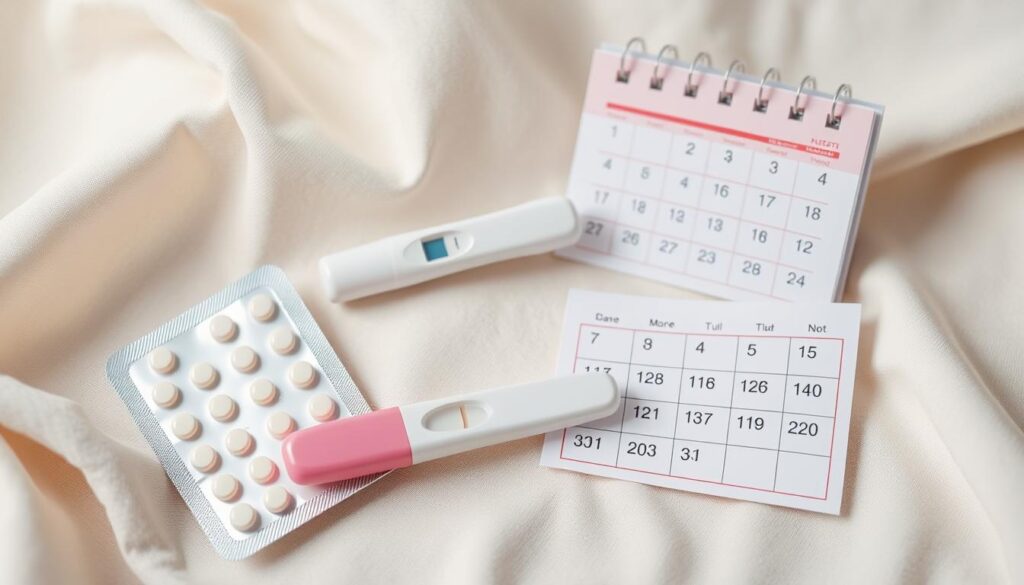
Emergency contraception prevents unintended pregnancy after unprotected sex. The morning-after pill, like Plan B One-Step, offers a quick solution. It’s useful for contraceptive failure or unplanned sexual encounters12.
Plan B One-Step contains levonorgestrel, a hormone that stops or delays ovulation1. It works best when taken soon after unprotected sex. The highest success rate is within 24 hours.
However, it can still be effective up to 5 days after intercourse2. Knowing about emergency contraception helps with reproductive health choices. It’s a backup option, not for regular use.
Different types of emergency pills are available. You can get them over-the-counter or by prescription12.
Key Takeaways
- Emergency contraception helps prevent unintended pregnancy after unprotected sex
- Morning-after pills work by delaying or preventing ovulation
- Most effective when taken within 24 hours of unprotected intercourse
- Not a substitute for regular birth control methods
- Available in both over-the-counter and prescription forms
Understanding Emergency Contraception
Emergency contraception prevents unintended pregnancies after unprotected sex or contraceptive failures. It’s a crucial safety net when standard birth control methods fail3.
Definition and Purpose
Emergency contraceptives are for urgent situations where regular birth control is compromised. They’re used after condom breakage, missed pills, or late injections3.
These methods aim to prevent pregnancy within a short time after unprotected intercourse.
Types of Emergency Contraceptive Pills (ECPs)
- Levonorgestrel Pills: Most effective within 72 hours, with 94% success rate in first 24 hours4
- Ulipristal Acetate: Can be taken up to 120 hours after, with 98% effectiveness in first day4
- Plan B One-Step®: A progestin-only option available over the counter5
IUD as Emergency Contraception
The copper IUD is the most effective emergency contraception. It reduces pregnancy chances by 99.9% when inserted within five days5.
Both copper and hormonal IUDs offer excellent protection against unintended pregnancy.
Remember, emergency contraception is not intended for routine use but serves as a crucial backup when primary contraceptive methods fail.
Important considerations: Emergency contraceptive pills work best when taken quickly. They may cause mild side effects but don’t affect long-term fertility5.
When to Use Emergency Contraception
Emergency contraception prevents unintended pregnancy after unprotected sex or contraceptive failure. It’s a vital safety net for reproductive health. Knowing when to use it can make a big difference.
Time Frame for Effectiveness
Quick action is key for emergency contraception. You can use it within 5 days after sex. But remember, the sooner you take it, the better it works.
Situations Requiring Emergency Contraception
- Condom breakage or slippage
- Missed birth control pills
- Sexual assault
- Contraceptive failure
- Unprotected sexual intercourse
Understanding Your Options
There are two main types of emergency contraception. These are emergency contraceptive pills (ECPs) and intrauterine devices (IUDs). ECPs can stop over 95% of possible pregnancies6.
The copper IUD is the most effective option. It prevents more than 99% of pregnancies6. Each method has its benefits, so choose what’s best for you.
Dispelling Common Myths
Let’s clear up some myths about emergency contraception. These methods don’t cause abortion or harm future fertility6. Most people can safely use them.
- Do not cause abortion
- Do not harm future fertility6
- Can be used by most individuals
Emergency contraception is a responsible choice for reproductive health management.
Different methods have varying levels of effectiveness. For example, pills with ulipristal acetate work better between 72-120 hours after sex6. Choose the right option for your situation.
How Emergency Contraception Works
Emergency contraception helps prevent unintended pregnancies. It’s a vital safety net for your reproductive health. Knowing how it works can guide your decisions.
Mechanism of Action
Emergency contraceptive pills stop pregnancy in different ways. They mainly prevent or delay ovulation7. Their goal is to stop fertilization before it happens.
Effectiveness Rates
The success of emergency contraception depends on the method used. Emergency contraceptive pills can cut pregnancy risk by about 75%8.
Here’s how effective different methods are:
- Levonorgestrel pills (Plan B): Stops 50-80% of possible pregnancies7
- Ulipristal acetate (Ella): Works for 5 days after unprotected sex8
- Copper IUD: Over 99% effective when used within 5 days8
Factors Affecting Success
Several key factors impact how well emergency contraception works:
- Timing of use: The earlier you take it, the better it works7
- Body weight: Some pills work less well for people with higher BMI8
- Ovulation stage: Success varies based on when unprotected sex happened8
“Emergency contraception is a crucial option for preventing unintended pregnancies when primary contraception fails.”
Take emergency contraception within 72 hours after unprotected sex9. Your doctor can help you pick the best method for you.
Types of Emergency Contraceptive Pills
Emergency birth control protects when regular methods fail. Learning about different emergency pills helps you make smart choices. Your reproductive health matters, so stay informed.
The U.S. offers four main emergency contraception methods. Three are pills, while one is a copper intrauterine device. Each option has unique features to consider.
Levonorgestrel-based Pills
Plan B and similar morning-after pills are common choices. These cost between $11 and $50, depending on the brand. They’re easy to find and use.
- Most effective when taken within 72 hours of unprotected sex
- Can be used up to 5 days after intercourse
- May be less effective for individuals weighing over 165 pounds10
Ulipristal Acetate
Ella is a prescription-based emergency contraceptive with unique benefits. It offers advantages over other options. Consider Ella for extended protection.
- More effective than levonorgestrel pills between 72-120 hours
- Can be obtained online with next-day delivery
- Potentially less effective for individuals weighing 195 pounds or more10
Recap of Alternatives
The Yuzpe method using combined oral contraceptives is another option. However, the copper IUD remains the most effective emergency contraception overall.
Remember, emergency contraception is a backup method and not intended for regular birth control.
| Pill Type | Effectiveness Window | Cost Range |
|---|---|---|
| Levonorgestrel (Plan B) | Up to 5 days | $11-$50 |
| Ella | Up to 5 days | Prescription required |
| Copper IUD | Up to 5 days | Varies |
Accessing Emergency Contraception
Emergency contraception is now easier to get. You have many options to buy Plan B and similar pills. Knowing where to find these medications helps you make smart choices about your health.
There are several easy ways to get emergency contraception. Over-the-counter EC has made it simpler for people to get quick reproductive healthcare.
Where to Obtain Emergency Contraceptive Pills
You can buy emergency contraception from various places:
- Local pharmacies
- Chain drugstores
- Online medical platforms
- Healthcare clinics
Over-the-Counter Availability
Levonorgestrel pills are easy to get without age limits. Chain pharmacies often have these medications. About 77% of them offer over-the-counter options11.
The average price is between $40 and $50. This depends on the brand you choose11.
Prescription Requirements
Some emergency contraceptives need prescriptions, but many don’t. Ulipristal acetate usually requires a prescription. Levonorgestrel-based pills can be bought directly12.
“Knowledge and accessibility are key to effective emergency contraception.” – Reproductive Health Expert
Emergency contraception can prevent pregnancy up to five days after unprotected sex12. Always talk to a doctor if you have concerns about your reproductive health.
Cost and Affordability
Emergency contraception costs vary widely. Options range from over-the-counter pills to prescription methods. Prices depend on several factors, affecting accessibility to reproductive healthcare13.
Average Prices of Emergency Contraceptive Options
Brand-name Plan B typically costs between $40 and $50. Generic versions are more budget-friendly, priced from $11 to $18 per pill14.
The copper IUD is pricier upfront. However, it’s a highly effective emergency contraception method13.
| Emergency Contraception Type | Average Cost | Effectiveness |
|---|---|---|
| Plan B One-Step | $40-$50 | 95% within 24 hours |
| Generic Plan B | $11-$18 | 95% within 24 hours |
| Copper IUD | Up to $500 | 99.9% within 5 days |
Insurance Coverage and Affordable Options
Many health insurance plans now cover emergency contraception. This helps reduce financial barriers13. You can also use:
- Health Savings Accounts (HSA)
- Flexible Spending Accounts (FSA)
- Health Reimbursement Arrangements (HRA)
Discount Programs and Access
Online platforms offer affordable emergency contraception options. Nurx provides generic Plan B for $14.99. Wisp sells it for $18 without a prescription14.
Public health clinics and family planning centers may offer reduced-cost or free emergency contraception13.
“Cost should never be a barrier to reproductive healthcare” – Women’s Health Advocates
In 2014, about 13% of women aged 19-64 were uninsured. This highlights the need for accessible, affordable emergency contraception options13.
Side Effects and Risks
Knowing emergency contraception side effects helps you make smart choices. Emergency contraceptive pills (ECPs) are safe but may cause brief body reactions.
Common Side Effects
Emergency contraception can cause short-term side effects. Most users have mild symptoms that go away quickly15:
- Nausea and vomiting
- Headaches
- Fatigue and dizziness
- Breast tenderness
- Menstrual cycle disruptions
Less than 20% of users get headaches with emergency contraception pills16. About 15% have painful periods and nausea16.
When to Seek Medical Attention
Most EC pill risks are small. But call a doctor if you have:
- Severe abdominal pain
- Heavy or prolonged vaginal bleeding
- No period within three weeks
- Persistent vomiting
Long-term Considerations
Using emergency contraception often is usually safe16. No long-term health problems have been linked to emergency contraception pills.
However, it’s not meant for regular birth control. Other methods work better for ongoing protection.
“Emergency contraception is crucial for reproductive health. But it shouldn’t replace regular contraception.”
Talk to your doctor if you have serious IUD issues. They can suggest other birth control options.
Emergency Contraception for Different Age Groups
Emergency contraception (EC) options vary by age and local rules. Understanding EC helps people make smart reproductive health choices. Your access to teen EC depends on these factors.
EC is vital for all ages in reproductive healthcare. Recent data shows interesting trends in EC use and access17. Let’s explore these findings.
- 28% of women aged 15-44 have used emergency contraception pills
- Women aged 15-24 and 25-34 are most likely to use EC
- Approximately 30% of Hispanic women report EC pill usage
Teens and Emergency Contraception
Teens face unique challenges when seeking EC. Many states have specific rules for teen EC access18. Sixteen states and D.C. have policies for EC use by those 16 and younger18.
College Students and EC
College students should know about EC options. Campus health centers often provide private EC resources and guidance. Over-the-counter EC pills have made access easier for this group17.
Older Adults and Emergency Contraception
EC remains an option throughout reproductive years. Women in their 30s and early 40s still use EC when needed. Effectiveness and age limits vary, so consult healthcare pros17.
Remember, emergency contraception is a personal healthcare choice that requires informed decision-making.
Knowing EC options for different ages helps make smart reproductive choices. It’s crucial to stay informed about your EC options.
Cultural Perspectives on Emergency Contraception
Emergency contraception sparks diverse conversations across different cultural landscapes. Its controversy stems from deep-rooted beliefs shaping community views on reproductive health19. Understanding these cultural nuances is key to improving access and education.
Varied Opinions and Beliefs
Cultural beliefs about EC differ widely across societies. Some communities view it through complex religious and moral lenses. They often misinterpret its main function of preventing fertilization.
These perspectives can greatly impact women’s reproductive choices and healthcare access20. Religious interpretations often challenge EC acceptance. Cultural norms dictate contraception discussions.
- Religious interpretations frequently challenge EC acceptance
- Cultural norms dictate contraception discussions
- Stigma remains a significant barrier to EC education
How Culture Influences Access
Your cultural background can greatly affect emergency contraception accessibility. In many regions, cultural restrictions create invisible barriers. These prevent women from getting critical reproductive healthcare19.
| Cultural Factor | Impact on EC Access |
|---|---|
| Religious Beliefs | High restrictiveness |
| Social Stigma | Limited public discussion |
| Educational Levels | Increased awareness |
Education and Awareness
EC education plays a key role in breaking down cultural barriers. Targeted programs can help dispel myths and provide accurate information. Open, respectful dialogues can help communities develop more inclusive approaches to reproductive health20.
“Knowledge is the first step toward understanding and acceptance.”
Effective EC education needs sensitivity to cultural contexts. It should provide clear, scientifically accurate information. This empowers individuals to make informed healthcare decisions19.
Disinformation and Emergency Contraception
Myths and misconceptions make understanding emergency contraception (EC) difficult. Knowing reliable EC facts is vital for making informed reproductive health choices.
Misinformation about EC can greatly affect people’s understanding and use of these vital healthcare options21. Most people have heard about EC from at least one source. However, many misconceptions still exist.
Common Myths Debunked
- Emergency contraception is not an abortion pill –22 About 73% of people wrongly think ECPs can end an existing pregnancy
- Emergency contraceptives do not cause permanent fertility issues
- ECPs are not dangerous or harmful when used as directed
Sources of Reliable Information
Finding trustworthy sources is crucial to understanding emergency contraception21. Few women report healthcare providers as their main information source. This shows a need for better education.
| Reliable Information Sources | Credibility Rating |
|---|---|
| World Health Organization | High |
| National Health Agencies | High |
| Certified Medical Websites | Medium-High |
The Importance of Education
21 People who learned about EC from health education sources scored higher on source credibility21. Most participants knew that EC doesn’t require a prescription. This shows the power of accurate information.
“Knowledge is the best protection against misinformation” – reproductive health experts
Stay informed and seek reliable EC facts. This will help you make smart choices about emergency contraception and your reproductive health.
Emergency Contraception and Other Contraceptive Methods
Knowing your contraceptive options helps you make smart choices about your reproductive health. Emergency contraception (EC) is different from regular birth control methods23.
Comparing EC and Regular Contraception
Emergency contraception isn’t a replacement for regular birth control. The effectiveness varies greatly among different methods24.
- Long-acting reversible contraceptives (IUDs): 0.1-0.8% failure rate24
- Oral contraceptives: 7% typical use failure rate24
- Emergency contraceptive pills: Higher failure rate compared to regular methods23
Emergency Contraception as a Backup
EC is a safety net when primary contraception fails or isn’t used properly. In 2015, 50% of women reported using EC after unprotected sex23.
Doctors suggest using regular contraception for better pregnancy prevention. EC is important, but it’s not as reliable as consistent birth control use.
Long-term vs. Short-term Solutions
For better reproductive health, think about long-term options like IUDs or implants from healthcare providers. These methods work better than EC and offer steady protection24.
Remember, emergency contraception is a backup, not a primary birth control method.
Pick your contraception based on your health, lifestyle, and future plans23. Your choice should fit your personal needs and goals.
Conclusion
Understanding emergency contraception is crucial for effective family planning. Your knowledge about EC resources can help you make informed decisions. Multiple options exist, with different effectiveness levels25. Levonorgestrel pills provide up to 95% effectiveness within 24 hours26.
Timing is key in reproductive health choices. Emergency contraception methods like copper IUDs and pills offer crucial protection. Options range from 58% to 95% effectiveness, depending on when you take them2526.
Seeking professional guidance from healthcare providers is the best approach. Every individual’s situation is unique. Personalized medical advice can help you select the most appropriate method.
Key Takeaways
Emergency contraception provides critical options for preventing unintended pregnancy. Stay informed and be proactive. Prioritize your reproductive health by understanding available EC resources.
Encouraging Open Conversations
Breaking stigma around emergency contraception starts with honest discussions. Share accurate information with others. Support those seeking reproductive healthcare options.
Resources for Further Information
Reliable sources offer comprehensive emergency contraception guides. Check the World Health Organization, local health clinics, and reputable medical websites. These resources support your family planning journey.
FAQ
What exactly is emergency contraception?
Emergency contraception prevents pregnancy after unprotected sex or contraceptive failure. It can stop up to 95% of pregnancies within 5 days. The main types are emergency pills and copper IUDs.
How quickly do I need to use emergency contraception after unprotected sex?
Use emergency contraception as soon as possible for best results. You have up to 5 days to use emergency pills. The copper IUD works best when inserted within 120 hours.
Are there any age restrictions for using emergency contraception?
There are no age limits for emergency contraception. Many countries offer Levonorgestrel pills over-the-counter without age restrictions. Minors can usually access these methods without parental consent.
Will emergency contraception harm my future fertility?
Emergency contraception doesn’t harm future fertility or stop an existing pregnancy. It works by preventing ovulation. This safe method temporarily stops unwanted pregnancy.
What are the most common side effects of emergency contraception?
Common side effects include nausea, fatigue, headache, and breast tenderness. Temporary menstrual changes may occur. These usually clear up without treatment.
If you have severe stomach pain or unusual bleeding, see a doctor.
Can I use emergency contraception multiple times?
It’s safe to use emergency contraception more than once. However, it’s not recommended as regular birth control. Repeated use may increase side effects and reduce effectiveness.
Talk to your doctor about long-term contraception options.
Is emergency contraception the same as an abortion pill?
No, emergency contraception isn’t an abortion pill. It prevents pregnancy by stopping ovulation or fertilization. Emergency pills don’t end an existing pregnancy.
How much does emergency contraception cost?
Over-the-counter emergency pills usually cost -. Some insurance plans cover prescription options. Family planning clinics may offer cheaper or free emergency contraception.
Do emergency contraceptive pills protect against sexually transmitted infections (STIs)?
Emergency contraceptive pills don’t protect against STIs. They only prevent pregnancy. If you’re worried about STI exposure, see a doctor for testing and treatment.
What’s the most effective form of emergency contraception?
The copper IUD is the most effective, stopping over 99% of pregnancies within 5 days. For pills, ulipristal acetate (ella) works slightly better than levonorgestrel-based options.
Source Links
- Morning-after pill – Mayo Clinic – https://www.mayoclinic.org/tests-procedures/morning-after-pill/about/pac-20394730
- Emergency contraception: MedlinePlus Medical Encyclopedia – https://medlineplus.gov/ency/article/007014.htm
- Patient education: Emergency contraception (Beyond the Basics) – https://www.uptodate.com/contents/emergency-contraception-beyond-the-basics/print
- Morning After Pill: What To Know – https://my.clevelandclinic.org/health/treatments/23386-morning-after-pill
- Understanding Emergency Contraception – NJFPL – https://njfpl.org/understanding-emergency-contraception/
- Emergency contraception – https://www.who.int/news-room/fact-sheets/detail/emergency-contraception
- Emergency contraception: how does it work? – PubMed – https://pubmed.ncbi.nlm.nih.gov/19281662/
- Emergency Contraception – “Morning After Pill” – https://yalehealth.yale.edu/topic/emergency-contraception-morning-after-pill
- Plan B One-Step Information – https://www.fda.gov/drugs/postmarket-drug-safety-information-patients-and-providers/plan-b-one-step-15-mg-levonorgestrel-information
- What Kind of Emergency Contraception Is Best For Me? – https://www.plannedparenthood.org/learn/morning-after-pill-emergency-contraception/which-kind-emergency-contraception-should-i-use
- Access to Emergency Contraception in the Over-the-Counter Era – https://pmc.ncbi.nlm.nih.gov/articles/PMC5106326/
- PowerPoint Presentation – https://portsmouth.tricare.mil/Portals/130/Emergency_Contraception_Resource_EC_Update_vF1.pdf
- Access to Emergency Contraception – https://www.acog.org/clinical/clinical-guidance/committee-opinion/articles/2017/07/access-to-emergency-contraception
- Plan B: Cost, Buying It, and How to Use It – https://www.healthline.com/health/birth-control/plan-b-cost
- Emergency Contraception Side Effects – https://www.healthline.com/health/emergency-contraception/possible-side-effects
- What are the side effects of emergency contraception? | IPPF – https://www.ippf.org/blogs/what-are-side-effects-emergency-contraception
- Emergency Contraception | KFF – https://www.kff.org/womens-health-policy/fact-sheet/emergency-contraception/
- Emergency Contraception – https://www.guttmacher.org/state-policy/explore/emergency-contraception
- Qualitative study on stigma as a barrier to emergency contraceptive pill use among university students in the Lango subregion, Uganda – https://pmc.ncbi.nlm.nih.gov/articles/PMC10910632/
- Pharmacists preventing access to emergency contraception on ‘cultural and religious’ grounds, government told – https://pharmaceutical-journal.com/article/news/pharmacists-preventing-access-to-emergency-contraception-on-cultural-and-religious-grounds-government-told
- Intentions to use emergency contraception: The role of accurate knowledge and information source credibility – https://pmc.ncbi.nlm.nih.gov/articles/PMC6214197/
- The Right to Contraception: State and Federal Actions, Misinformation, and the Courts | KFF – https://www.kff.org/womens-health-policy/issue-brief/the-right-to-contraception-state-and-federal-actions-misinformation-and-the-courts/
- Use of Emergency Contraception in the United States – https://www.guttmacher.org/fact-sheet/use-emergency-contraception-united-states
- Contraception and Birth Control Methods – https://www.cdc.gov/contraception/about/index.html
- Emergency contraception review: evidence-based recommendations for clinicians – https://pmc.ncbi.nlm.nih.gov/articles/PMC4216625/
- Emergency contraception – PMC – https://pmc.ncbi.nlm.nih.gov/articles/PMC2792670/