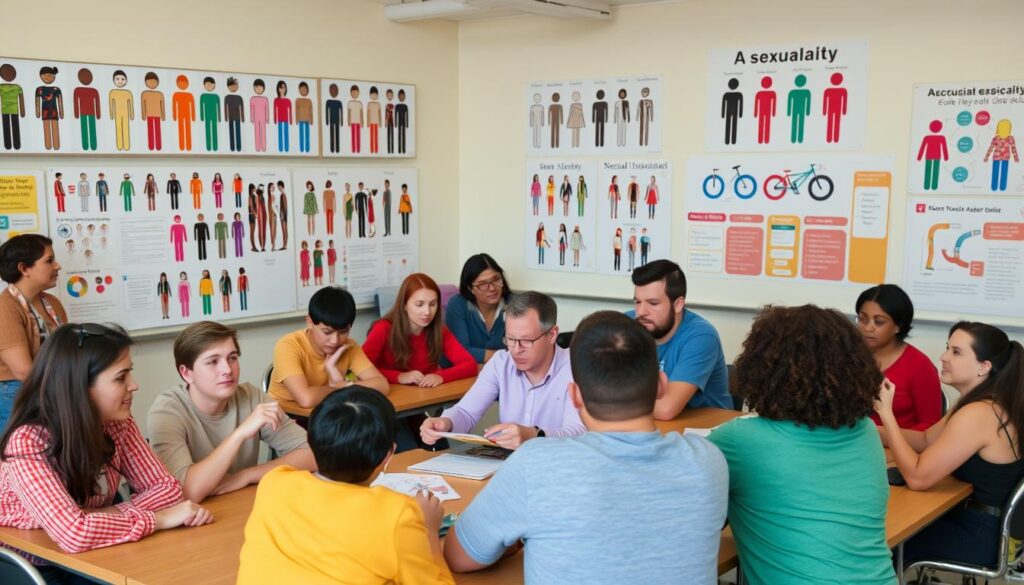
Sexual education needs to embrace diversity and create safe spaces for learning. Inclusive language supports LGBTQ+ individuals exploring their sexual identity1. It’s crucial to respect all sexual orientations, making every student feel valued and understood1.
Using inclusive terms helps young people challenge stereotypes about relationships and identity1. It creates an accepting atmosphere that recognizes diverse experiences1. This approach fosters a more open and respectful learning environment.
Traditional sex education often focuses only on heteronormative experiences. This leaves LGBTQ+ youth without important information about healthy relationships and sexual safety1. It also limits understanding for heterosexual peers about different sexual experiences1.
Key Takeaways
- Inclusive language validates diverse sexual identities
- Comprehensive sex education challenges stereotypes
- Respectful communication creates safer learning environments
- Understanding sexual orientation requires open dialogue
- Educational spaces should embrace LGBTQ+ experiences
Definition of Asexuality
Asexuality represents a unique spectrum of human sexual experience. It challenges traditional assumptions about attraction and intimacy. Exploring the asexual community reveals diverse experiences within this orientation.
Sexual orientation is complex, and asexuality education helps people recognize nuanced attraction experiences. Most scholars agree that asexuality is rare, affecting about 1% of the population2. This group experiences little to no sexual attraction.
What Does Asexuality Mean?
Asexuality is a lack of sexual attraction towards others, regardless of gender. However, asexual individuals can still experience romantic connections. They may engage in sexual activities for various reasons.
- Experience romantic connections
- Engage in sexual activities for various reasons
- Form meaningful relationships
Key Components of Asexual Identity
The asexual community recognizes multiple dimensions of attraction and identity. Many asexual people desire romantic relationships while experiencing minimal sexual desire3. The spectrum includes diverse experiences.
| Asexual Identity | Characteristics |
|---|---|
| Aromantic Asexual | No romantic or sexual attraction |
| Gray-Asexual | Rarely experiences sexual attraction |
| Demisexual | Sexual attraction only after emotional bond |
“Asexuality is not a choice, but a genuine sexual orientation that deserves respect and understanding.”
Asexuality is not a medical condition that needs “fixing”. It’s a valid and natural variation in human sexual experience3. Respecting this diversity helps create a more inclusive society.
Types of Attraction in Asexuality
Attraction isn’t just about sex. The asexual community recognizes many forms of connection beyond physical intimacy. These connections vary greatly among individuals4.
Sexual attraction is just one way people connect. Asexuality education shows that individuals can experience several distinct types of attraction:
- Sexual attraction
- Romantic attraction
- Aesthetic attraction
- Sensual attraction
- Emotional attraction
- Intellectual attraction
Understanding Different Forms of Attraction
Each attraction type offers a unique connection experience. Aesthetic attraction lets you admire someone’s beauty without sexual or romantic interest4.
Emotional attraction focuses on building deep psychological bonds5. These connections can be just as meaningful as physical ones.
Romantic Orientation in Asexual Individuals
Romantic orientation describes a person’s pattern of romantic attraction. It’s separate from sexual orientation. The asexual community recognizes various romantic experiences:
| Romantic Orientation | Description |
|---|---|
| Aromantic | No romantic attraction to any gender |
| Biromantic | Romantic attraction to two or more genders |
| Heteroromantic | Romantic attraction to a different gender |
| Panromantic | Romantic attraction regardless of gender |
About 74% of asexual individuals report feeling romantic attraction5. This shows the diversity within the asexual community.
“Attraction is not a one-size-fits-all experience. It’s a rich, multilayered spectrum of human connection.” – Asexual Community Advocate
The Asexual Spectrum
The asexual community represents diverse experiences that challenge conventional thinking about attraction. It showcases a rich spectrum of sexual identities, highlighting the complexity of human attraction.
Up to 1% of people identify within this spectrum. This statistic shows the importance of acceptance and awareness for asexual individuals.
Exploring Gray-Asexuality and Demisexuality
Gray-asexuality is a nuanced experience of sexual attraction. People in this category may feel attraction infrequently or at low intensity.
- Infrequently
- At low intensity
- In ambiguous or conditional ways6
Demisexuality offers another unique perspective on sexual orientation. These individuals feel attraction only after forming a deep emotional bond6.
Understanding Aromanticism
Aromanticism intersects with asexuality in fascinating ways. Some people identify as both asexual and aromantic. Others experience different romantic and sexual orientations7.
| Asexual Spectrum Identity | Characteristic |
|---|---|
| Gray-Asexual | Occasional or low-intensity sexual attraction |
| Demisexual | Sexual attraction after emotional bonding |
| Aromantic | Minimal or no romantic attraction |
“Sexuality is a spectrum, not a binary. Your identity is valid and unique.” – Asexual Community Advocate
Your sexual orientation is a personal journey. The asexual spectrum celebrates the diversity of human experiences. It promotes understanding beyond traditional definitions7.
Prevalence and Demographics of Asexuality
Asexuality education reveals a complex picture of population representation. It challenges traditional sexual identity frameworks. This often-overlooked orientation offers crucial insights into diverse sexual experiences.
Estimating the Asexual Population
Studies show that 1-4% of people identify as asexual. Population-based research found about 1.66% of individuals fall within the asexual spectrum8.
Age groups show variations in asexual identification9. Younger cohorts (ages 18-27) have higher asexual representation.
- Approximately 1-4% of the population identifies as asexual8
- Younger cohorts (ages 18-27) show higher asexual representation9
- Gender distribution varies across studies
Demographic Insights
Women and non-binary individuals are more likely to identify as asexual9. Asexual individuals show unique characteristics in demographic studies.
| Demographic Characteristic | Percentage |
|---|---|
| Women in Asexual Community | 63% |
| Gender Non-Binary | 26% |
| Men in Asexual Community | 11% |
“Asexuality is not a choice, but a valid sexual orientation that deserves recognition and respect.”
Challenges in Research
Researchers struggle to accurately capture asexual demographics. Self-identification issues and potential underreporting complicate population estimates8.
Despite challenges, awareness of asexuality continues to grow. This leads to more nuanced insights into this diverse community.
Exploring asexuality helps validate diverse sexual experiences. It contributes to a broader movement of recognition and understanding.
Asexuality vs. Other Sexual Experiences
Asexuality is a unique sexual orientation that’s often misunderstood. It differs from other sexual experiences in significant ways. Myths and facts about asexuality challenge how society views sexual identity.
Asexuality is more complex than simple definitions suggest. Aces don’t experience sexual attraction like others do10. However, they can still form meaningful connections and have romantic feelings.
Distinguishing Asexuality from Low Libido
Key differences between asexuality and low libido include:
- Asexuality is a sexual orientation, not a medical condition11
- Low libido can be temporary and influenced by various factors
- Asexual individuals may still engage in sexual activities without experiencing sexual attraction10
Asexuality and Past Trauma
Asexuality isn’t caused by past trauma or negative experiences. Acceptance and awareness help debunk myths about this orientation11.
“Asexuality is a valid sexual orientation, not a problem to be solved.” – Asexual Awareness Expert
| Characteristic | Asexuality | Low Libido |
|---|---|---|
| Sexual Attraction | Consistently absent | May fluctuate |
| Relationship to Trauma | Not related | Potentially influenced |
| Population Estimate | Approximately 1%11 | Varies widely |
Millions worldwide identify as asexual, though many may not recognize their orientation11. The journey of asexuality understanding continues to evolve. It breaks down misconceptions and promotes genuine acceptance.
Coming Out as Asexual
Discovering your asexual identity is a personal journey. It requires patience, self-reflection, and support. Embracing your identity can be challenging but rewarding12.
Recognizing Your Asexual Identity
Recognizing asexuality involves understanding your experiences with attraction and relationships. Self-exploration and personal reflection often lead to this realization12.
Key signs might include:
- Feeling different from peers’ sexual experiences
- Experiencing romantic attraction without sexual desire
- Feeling comfortable with limited or no sexual interactions
Communicating Asexuality to Others
Coming out as asexual needs careful planning. Here are tips from the asexual community:
- Start by telling trusted friends first13
- Bring a supportive friend when discussing with family13
- Prepare resources to address potential questions13
“Your identity is valid, and you deserve acceptance and understanding.”
Be ready for various reactions when sharing your identity. Some might express doubt or confusion. Approach these talks with confidence and pride13.
LGBTQ+ inclusivity means embracing diverse sexual orientations. Your journey helps build awareness in the broader community14.
Consider writing a letter if face-to-face talks feel overwhelming. Stay true to yourself and seek support from accepting people13.
Asexuality and Relationships
Asexual relationships are as varied as any other group’s. They require an open mind and respect for individual experiences15.
The split attraction model explains how asexuals experience connections. It shows that romantic and sexual attraction can exist separately15.
Some asexuals might find someone visually appealing without sexual desire. This is called aesthetic attraction15.
Navigating Romantic Partnerships
Asexual romantic relationships need clear communication and understanding. About 82% of asexuals face mental health challenges16.
These issues can affect their relationships. Open dialogue is key to navigating these complexities.
- Establish clear boundaries
- Communicate emotional needs
- Respect individual comfort levels
- Explore alternative intimacy forms
Non-Romantic Relationships in the Asexual Community
Asexuals form meaningful connections beyond traditional romance. ‘Squish’ describes platonic crushes, showing the rich emotional landscape of asexual relationships15.
“Love and attraction exist on a spectrum far more nuanced than traditional narratives suggest.”
Polyamory and queerplatonic partnerships offer alternative models for asexuals17. These connections focus on emotional intimacy and respect over sexual expectations.
| Relationship Type | Characteristics |
|---|---|
| Romantic Asexual Partnership | Emotional intimacy, potential limited physical contact |
| Queerplatonic Relationship | Deep emotional bond, no romantic or sexual expectations |
| Polyamorous Asexual Connection | Multiple emotional partnerships, varied intimacy levels |
Support and acceptance are vital for asexuals navigating relationship complexities. The asexual community challenges traditional relationship norms16.
They create space for diverse expressions of love and connection. This promotes understanding and inclusivity for all.
Challenges Faced by Asexual Individuals
Asexuality is often misunderstood, creating complex challenges for those who identify as asexual. These individuals face unique social and psychological obstacles. Greater awareness and acceptance are crucial to address these issues.
Social Misunderstanding and Stigma
Asexual people face significant social pressures and misconceptions about their orientation. Asexuality understanding remains limited in mainstream conversations, leading to stigmatization18.
Many asexual individuals report experiencing discrimination in social settings. They often feel marginalized due to societal expectations and misconceptions.
- Societal expectations of sexual engagement
- Persistent myths about sexual identity
- Pressure to conform to traditional relationship models
Medical and Psychological Misconceptions
The medical community has struggled with myths and facts about asexuality. Before 2013, diagnostic criteria often pathologized lack of sexual desire18.
Asexual individuals may experience higher rates of mental health challenges. This is often due to societal misunderstanding and lack of acceptance18.
| Challenge | Impact |
|---|---|
| Mental Health | Higher depression and anxiety rates18 |
| Age Demographics | 28% are 18 or younger19 |
| Community Identification | 41% identify as part of LGBT community19 |
“Acceptance and awareness are crucial in supporting asexual individuals’ mental health and social experiences.”
Recognizing and respecting asexual identities requires ongoing education and empathy. We must challenge existing stereotypes to create a more inclusive environment.
By doing so, we can better acknowledge the diverse spectrum of human sexual experiences. This approach fosters understanding and support for asexual individuals.
Asexuality in Popular Culture and Media
Media plays a vital role in promoting asexuality understanding. The journey of asexual characters in TV and film has been gradual. Their presence is becoming increasingly significant20.
In the past, asexual characters were scarce and often misunderstood. Early portrayals often showed asexuality as a to be solved20.
The scene began to shift with trailblazing characters. These new portrayals offered genuine representation of asexual individuals.
Landmark Representations in Media
- Todd Chavez in “BoJack Horseman” emerged as a pivotal asexual character20
- Raphael Santiago in “Shadowhunters” provided visibility21
- Peridot from “Steven Universe” expanded asexual character diversity20
Impact on Awareness and Acceptance
Asexual characters help challenge myths and promote acceptance. They raise awareness about asexuality in society. Representation matters deeply for asexual individuals seeking validation22.
“Visibility is the first step towards understanding and acceptance.”
| Year | Significant Asexual Character | Media Platform |
|---|---|---|
| 2014 | Lord Varys | Game of Thrones |
| 2017 | Todd Chavez | BoJack Horseman |
| 2021 | Lilith Clawthorne | The Owl House |
Progress is happening, but challenges remain22. About one percent of Americans identify as asexual. Media representation of asexuality continues to grow.
Generation Z is embracing and recognizing asexual identities more than ever22. This shift promises a more inclusive future for asexual representation.
Conclusion: Embracing Asexual Diversity
Grasping asexuality is vital for building an inclusive society. Your effort to learn about asexuals shows a strong commitment to LGBTQ+ inclusivity23. By acknowledging diverse asexual experiences, you help dispel harmful myths and foster acceptance24.
Understanding asexuality means recognizing sexual identity’s complexity. Studies show asexuals face unique challenges in discovering their orientation. They often confront traditional ideas about attraction25.
Your openness to learning can greatly reduce stigma. It promotes emotional well-being for asexual individuals. Continued education and empathy are crucial for supporting the asexual community.
By listening and advocating, you help create a more respectful world. Every sexual orientation deserves validation23. Asexuals merit recognition and support in their journey of self-discovery24.
The Importance of Asexuality Understanding
Your dedication to asexuality awareness fosters inclusivity. By tackling myths and boosting knowledge, you support diverse LGBTQ+ experiences25. This effort is crucial for a more accepting society.
Supporting the Asexual Community
Support thrives on education, respect, and active listening. Your eagerness to learn shows empathy’s power. It helps build connections and grasp various sexual identities23.
FAQ
What exactly is asexuality?
Asexuality is a sexual orientation where people lack sexual attraction to others. It affects about 1% of the population. Asexuality is recognized as valid within the LGBTQ+ community. Unlike celibacy, asexuality is an inherent orientation, not a choice.
Is asexuality the same as having a low sex drive?
No, asexuality differs from low libido or hypoactive sexual desire disorder (HSDD). Asexuality is a stable orientation without sexual attraction. Libido can change due to various factors.
Some asexual people may engage in sexual activity or masturbate. However, they don’t experience sexual attraction like others do.
Can asexual people have romantic relationships?
Absolutely! Asexuality is separate from romantic attraction. Many asexual individuals experience romantic feelings and form relationships. They may identify with different romantic orientations like biromantic, heteroromantic, or panromantic.
Some asexual people form queerplatonic relationships. These don’t follow traditional romantic or sexual relationship models.
What is the asexual spectrum?
The asexual spectrum includes identities between complete asexuality and sexual attraction. This includes gray-asexual (occasional or limited sexual attraction) and demisexual. Demisexual people only feel attraction after forming a strong emotional bond.
The spectrum acknowledges diverse experiences within the asexual community.
How do I know if I might be asexual?
Signs of asexuality include feeling little to no sexual attraction. Other signs are minimal interest in sex and difficulty relating to others’ sexual experiences.
Discovering your identity is personal. Explore resources from the Asexuality Visibility and Education Network (AVEN). Connect with asexual communities and be patient with yourself.
Do asexual people experience other types of attraction?
Yes! Asexual individuals can experience aesthetic, sensual, emotional, and intellectual attraction. Romantic attraction is important, as it’s separate from sexual attraction.
Some asexual people feel strong romantic, aesthetic, or emotional connections. They may not experience sexual attraction.
How can I support an asexual friend or partner?
Supporting an asexual person involves listening and respecting their identity. Avoid assumptions and communicate openly. Educate yourself about asexuality and challenge misconceptions.
Create an accepting environment. In romantic relationships, discuss boundaries and expectations. Find mutual understanding about intimacy and connection.
Are there any challenges specific to asexual individuals?
Asexual people face social misunderstanding, identity erasure, and pressure to conform. They may experience stigma from both heterosexual and LGBTQ+ communities.
Limited representation in media and society is also a challenge. Increasing awareness and education is crucial to address these issues.
Source Links
- PDF – https://www.healthyteennetwork.org/wp-content/uploads/Gender-Sexuality-Inclusive-Sex-Ed.pdf
- Asexuality – https://en.wikipedia.org/wiki/Asexuality
- What Does It Mean to Be Asexual? – https://www.healthline.com/health/what-is-asexual
- Asexuality, Attraction, and Romantic Orientation – https://lgbtq.unc.edu/resources/exploring-identities/asexuality-attraction-and-romantic-orientation/
- Asexuality Spectrum: Different Types of Asexuality — Talkspace – https://www.talkspace.com/blog/asexuality-spectrum/
- Asexual spectrum – https://lgbtqia.fandom.com/wiki/Asexual_spectrum
- Asexual Spectrum: Defining Attraction and Orientation – https://www.verywellhealth.com/asexual-8696950
- Demographics – https://www.asexuality-handbook.com/demographics
- Asexual and Non-Asexual Respondents from a U.S. Population-Based Study of Sexual Minorities – https://pmc.ncbi.nlm.nih.gov/articles/PMC7059692/
- Asexual women share how they realised they don’t experience sexual attraction – https://www.cosmopolitan.com/uk/love-sex/sex/a32865196/am-i-asexual/
- I’m Asexual and These Are The Myths I Wish I’d Stop Hearing – https://www.teenvogue.com/story/what-is-asexuality
- Asexuality: Coming out as ace – Archer Magazine – https://archermagazine.com.au/2016/03/asexuality-coming-out-as-ace/
- Asexuals on Coming Out: Advice – https://www.asexualityarchive.com/asexuals-on-coming-out-advice/
- Asexuality: The ascent of the ‘invisible’ sexual orientation – https://www.bbc.com/worklife/article/20210507-asexuality-the-ascent-of-the-invisible-sexual-orientation
- Asexuality, Love, and Romance – The Barefoot Backpacker – https://barefoot-backpacker.com/asexuality-love-and-romance/
- Understanding the Asexual Community – https://www.hrc.org/resources/understanding-the-asexual-community
- Asexual people and relationships – https://asexualitytrust.org.nz/what-is-asexuality/asexual-people-and-relationships/
- Asexuality & Mental Health – https://mhanational.org/lgbtq/asexual-community-mental-health
- Microsoft Word – AsexualityUPDATE2 – https://www.thetrevorproject.org/wp-content/uploads/2017/09/asexuality.pdf
- Media portrayal of asexuality – https://en.wikipedia.org/wiki/Media_portrayal_of_asexuality
- Asexuality is still hugely misunderstood. TV is slowly changing that. – https://www.vox.com/culture/2018/3/26/16291562/asexuality-tv-history-bojack-shadowhunters-game-of-thrones
- Asexual Presence in Media – https://dailydragon.dragoncon.org/2023/23-panels/asexual-presence-in-media/
- The Many Facets of Asexuality – LGBTI UNITED – https://lgbtiunited.mk/en/2023/10/27/the-many-facets-of-asexuality/
- Am I Asexual? Signs of Asexuality (Ace) – https://www.publiclyprivate.org/culture/asexuality-what-it-is-and-what-it-isnt
- Ace and Aro Journeys: A Guide to Embracing Your Asexual… – https://www.goodreads.com/book/show/63896177-ace-and-aro-journeys