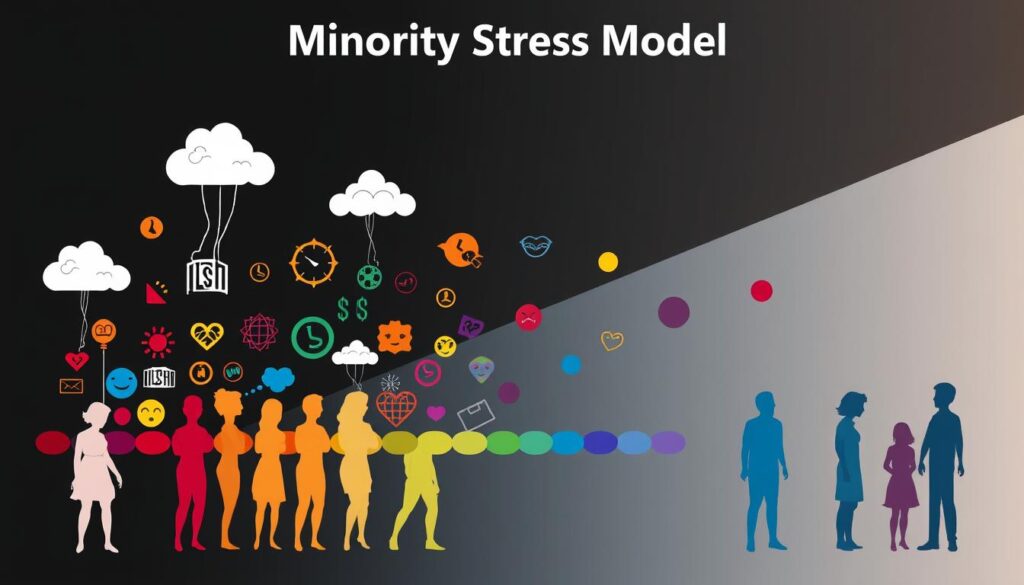
The minority stress model sheds light on the unique challenges LGBTQIA+ individuals face. Ilan H. Meyer introduced this framework in 2003. It explores how discrimination affects mental health in sexual minority populations1.
This model reveals how societal stigma impacts LGBTQ+ mental health. Sexual minorities often experience chronic stress from various sources. These include discrimination, anticipated rejection, and internalized negative beliefs1.
Such experiences can lead to increased mental health challenges. These issues extend beyond typical stressors1. Distal stressors play a significant role in minority stress.
External factors like discriminatory policies and microaggressions are distal stressors. Social rejection also falls into this category2. These challenges shape the complex landscape LGBTQIA+ individuals navigate daily.
Key Takeaways
- The minority stress model explains how societal discrimination impacts LGBTQIA+ mental health
- Chronic stress can lead to significant psychological challenges for sexual minority individuals
- External and internal stressors contribute to mental health disparities
- Understanding the model is crucial for developing supportive interventions
- Resilience and community support can help mitigate minority stress effects
Understanding Minority Stress
Minority stress deeply affects LGBTQ+ individuals. It’s a chronic stress caused by societal discrimination and stigma. This psychological phenomenon stems from ongoing challenges faced by marginalized communities3.
Defining Minority Stress
Minority stress is an extra burden for marginalized groups. For LGBTQ+ people, it comes from various factors. These include microaggressions, systemic discrimination, and social stigma4.
Key Factors Contributing to Minority Stress
- Discriminatory policies and social structures3
- Chronic experiences of prejudice
- Identity concealment pressures
- Internalized negative stereotypes
“Minority stress is not inherent to LGBTQ+ identities, but a result of societal challenges”
Multiple marginalized identities can worsen minority stress. LGBTQ+ individuals from racial minorities may face tougher psychological challenges. This intersection of identities adds complexity to their experiences4.
Impact on Health Disparities
Minority stress directly affects LGBTQ+ health. It can increase risks of mental health issues. Research shows clear links between these experiences and various health problems.
| Stress Outcome | Potential Health Impact |
|---|---|
| Emotional Dysregulation | Higher anxiety and depression rates |
| Social Challenges | Reduced interpersonal connections |
| Cognitive Risks | Increased vulnerability to psychological disorders |
Grasping minority stress is key to helping LGBTQ+ communities. It helps create supportive interventions. These address the unique challenges faced by these groups3.
The Impact of Minority Stress on Mental Health
Minority stress profoundly affects LGBTQ+ individuals’ mental health. It creates unique challenges that require understanding and compassionate support. These experiences shape the psychological well-being of the LGBTQ+ community.
Emotional Effects of Minority Stress
LGBTQ+ individuals often face emotional challenges from societal discrimination and stigma. Sexual minority women experience heightened psychological distress. Internalized homophobia is linked to lower self-esteem and increased loneliness5.
Navigating social environments can lead to chronic anxiety and persistent shame. It may also cause hypervigilance in social interactions and emotional exhaustion.
- Chronic anxiety
- Persistent feelings of shame
- Hypervigilance in social interactions
- Emotional exhaustion
Increased Risk of Mental Health Disorders
Research shows significant mental health disparities within the LGBTQ+ community. College students from sexual minority backgrounds have high rates of depression and anxiety. One study found 48.1% experiencing depression and 57.1% experiencing anxiety6.
| Mental Health Condition | Prevalence in Sexual Minority Women |
|---|---|
| Depression | 48.1% |
| Anxiety | 57.1% |
| Substance Abuse | Higher risk compared to heterosexual population |
Coping Mechanisms for LGBTQIA+ Individuals
Developing resilience is crucial for managing minority stress. Effective strategies can help LGBTQIA+ individuals cope with these challenges.
- Seeking supportive social networks
- Practicing self-compassion
- Engaging in mental health counseling
- Developing a strong sense of community pride
Remember, your identity is valid, and your mental health matters. Professional support and community resources can help navigate minority stress challenges.
“Resilience is not about never experiencing stress, but about developing healthy ways to manage and overcome it.”
Minority Stress in Different Contexts
LGBTQIA+ individuals face unique challenges across various life domains. These challenges affect their mental health and personal experiences. Supportive environments can help address these complex issues7.
Workplace Discrimination Challenges
LGBTQIA+ employees often encounter discrimination at work. This can greatly impact their mental well-being. Many face subtle and obvious forms of marginalization7.
Studies show 89% of respondents have faced discrimination. Many link these issues to their sexual orientation and gender identity7.
- Concealment of personal identity
- Expectations of potential rejection
- Systemic barriers in career advancement
LGBTQ+ Relationships and Social Dynamics
Minority stress significantly affects LGBTQ+ relationships. It creates extra emotional hurdles. Internal stigma and fear of rejection can strain personal bonds8.
Sexual minorities face more mental health issues. These directly impact their relationship dynamics8.
Community Resilience and Support Systems
Social support is key in fighting minority stress. Strong communities can greatly reduce negative mental health outcomes7. Supportive environments that validate experiences help lessen psychological distress8.
| Stress Factor | Impact Level |
|---|---|
| Workplace Discrimination | High |
| Relationship Challenges | Moderate to High |
| Community Support | Protective |
Addressing minority stress in various contexts is crucial. This can help create more inclusive spaces for LGBTQIA+ individuals78.
Strategies for Mitigating Minority Stress
LGBTQ+ individuals need mental health support and self-care strategies to address minority stress. Building supportive environments and advocating for systemic changes are crucial. Understanding minority stress dynamics is essential for resilience9.
Creating Supportive Spaces
LGBTQ+ inclusive policies help reduce stress. Sexual minority teens face higher risks of mental health issues. Research shows they’re 3 to 4 times more likely to have disorders9.
Affirming environments at work, school, and in communities can ease systemic pressures. These spaces provide much-needed support for LGBTQ+ individuals.
Mental Health and Resilience
Access to culturally competent resources is key for mental health advocacy. Social support from friends and family helps manage stress9. Personal self-care techniques boost resilience.
Connecting with supportive LGBTQ+ networks strengthens psychological defenses against minority stress10. These connections offer valuable support and understanding.
Policy and Systemic Change
Active participation in policy improvements drives meaningful change. Supporting non-discrimination laws and inclusive education helps dismantle barriers. Raising awareness about LGBTQ+ experiences is crucial11.
Your advocacy can transform societal attitudes. Both individual and collective efforts reduce minority stress. Together, we can create a more inclusive world.
FAQ
What is the Minority Stress Model?
The Minority Stress Model explains how stigma harms LGBTQIA+ mental health. It identifies stressors like discrimination and identity concealment. These factors lead to chronic stress and mental health issues.
How does minority stress affect mental health?
Minority stress raises the risk of mental health disorders in LGBTQIA+ individuals. It can cause mood disorders, anxiety, and substance abuse. Chronic shame, fear, and negative self-views often result from this stress.
What are the key factors contributing to minority stress?
Key factors include direct and indirect discrimination. Fear of future bias and hiding one’s identity also play a role. Internalized negative attitudes add to the stress burden.
These stressors can worsen with intersecting identities like race and socioeconomic status.
Where do LGBTQIA+ individuals experience minority stress?
Minority stress occurs in workplaces, relationships, and broader social settings. At work, people may face bias or feel pressured to hide. In relationships, they might struggle with internalized stigma and rejection fears.
How can minority stress be mitigated?
Creating supportive environments and anti-discrimination policies helps reduce minority stress. Providing culturally competent mental health resources is crucial. Advocating for LGBTQIA+ rights and promoting self-compassion are effective strategies.
Building strong community connections and developing resilience are also important.
What role does social support play in reducing minority stress?
Social support is vital in easing minority stress. Affirming environments and supportive relationships can reduce negative mental health impacts. Access to LGBTQIA+-friendly resources helps individuals develop positive coping skills.
Are mental health disparities inherent to LGBTQIA+ identities?
No, these disparities stem from societal stigma and discrimination. The Minority Stress Model shows that mental health challenges come from external stressors. They’re not caused by sexual orientation or gender identity itself.
How can individuals build resilience against minority stress?
Building resilience involves developing strong identity pride and seeking supportive communities. Practicing self-compassion and accessing culturally competent mental health resources are key. Developing effective coping strategies that validate one’s experiences is crucial.
Source Links
- Minority stress model: Definition, importance, and more – https://www.medicalnewstoday.com/articles/minority-stress-model
- The Minority Stress Framework and LGBTQIA+ Mental Health – https://www.joinviolet.com/resources/the-minority-stress-framework
- Minority stress theory: Application, critique, and continued relevance – https://pmc.ncbi.nlm.nih.gov/articles/PMC10712335/
- Minority stress – https://en.wikipedia.org/wiki/Minority_stress
- The Impact of Minority Stress on Mental Health and Substance Use Among Sexual Minority Women – https://pmc.ncbi.nlm.nih.gov/articles/PMC4059829/
- Minority stress, social support and mental health among lesbian, gay, and bisexual college students in China: a moderated mediation analysis – BMC Psychiatry – https://bmcpsychiatry.biomedcentral.com/articles/10.1186/s12888-023-05202-z
- Minority stress and psychological well-being in queer populations – Scientific Reports – https://www.nature.com/articles/s41598-024-78545-6
- The relationship between minority stress and biological outcomes: A systematic review – https://www.psychiatry.wisc.edu/wp-content/uploads/2021/07/FlentjeHeckBrennan-Meyer-2019_Article_TheRelationshipBetweenMinority.pdf
- Strategies employed by sexual minority adolescents to cope with minority stress – https://pmc.ncbi.nlm.nih.gov/articles/PMC4663988/
- Reducing behavioral health symptoms by addressing minority stressors in LGBTQ adolescents: a randomized controlled trial of Proud & Empowered – BMC Public Health – https://bmcpublichealth.biomedcentral.com/articles/10.1186/s12889-021-12357-5
- PDF – https://nhchc.org/wp-content/uploads/2019/08/minority-stress-and-trauma-informed-approaches.pdf