
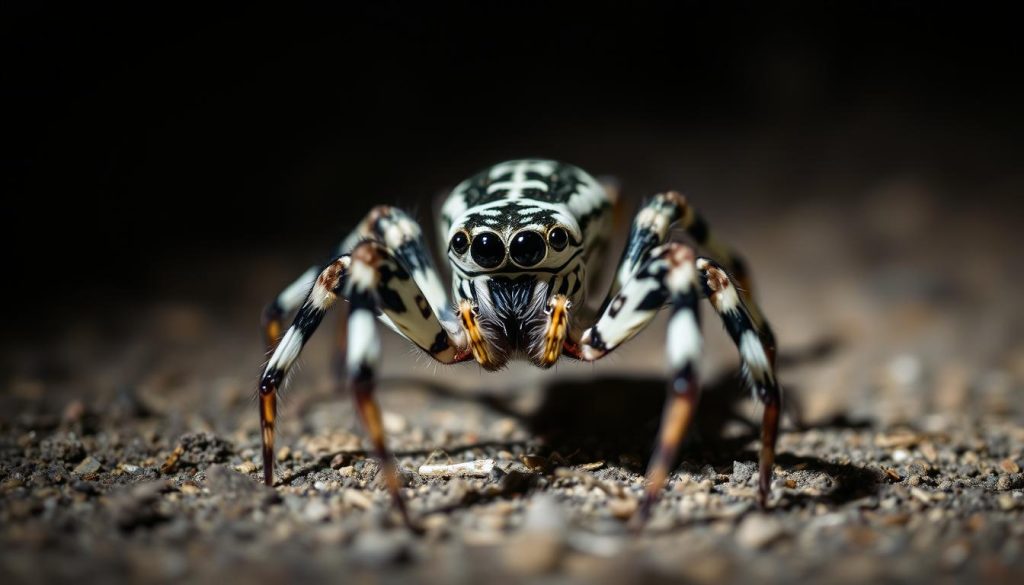
The zebra spider boasts a striking black and white striped pattern. This small arachnid stands out in the spider world. It plays a vital role in controlling insect populations12.
Spider lovers are often intrigued by banded spider species. The zebra spider is particularly fascinating among these. North America is home to over 3,400 spider species3.
Zebra spiders are more helpful than harmful. They rarely pose a threat to humans1. These spiders actively hunt insects in our homes and gardens2.
Key Takeaways
- Zebra spiders feature a distinctive black and white striped pattern
- These spiders are small and non-aggressive
- They play a beneficial role in controlling insect populations
- Zebra spiders are found throughout North America
- Their unique appearance makes them fascinating to observe
Understanding the Zebra Spider’s Unique Characteristics
Zebra spiders fascinate researchers and nature lovers with their striking features. These white-striped creatures belong to the jumping spider family. Their black and white pattern makes them easy to spot in various habitats.
These spiders stand out with their remarkable adaptations. They’re known for their exceptional hunting abilities. Their unique traits set them apart from other arachnids.
Physical Appearance and Remarkable Size
Zebra spiders have distinct physical traits. Female zebra spiders are 5-9 mm long, while males measure 5-6 mm4. Their compact bodies feature impressive eyes, with two large central ones5.
- Distinctive black and white striped pattern
- Eight eyes with exceptional vision
- Small but relatively large body compared to other spiders
Hunting and Jumping Prowess
Zebra spiders are amazing hunters. They jump at speeds of 0.64–0.79 m/s and can catch prey three times their size4. Their hunting style depends on the prey’s size and movement.
Habitat and Global Distribution
These white-striped spiders live in many places. They’re found across Europe, North America, and North Asia4. They like urban areas like garden fences, walls, and window sills6.
- Widespread in Holarctic regions
- Adaptable to urban and natural environments
- Thrives near human populations
Zebra spiders have amazing vision and communication skills. They adapt well to different environments. These traits make them fascinating for both casual observers and scientists.
Common Spider with White Stripes and Their Behavior
Striped spiders fascinate with their unique white-banded patterns. Orb weavers with stripes captivate nature lovers and scientists alike7.
White stripe patterns help spiders blend into their surroundings. These arachnids thrive in gardens, woodlands, and urban areas8.
Striped spiders play a vital role in controlling insect populations. This makes them valuable members of their ecosystems.
- Orb weavers with intricate web designs
- Jumping spiders with distinctive markings
- Crab spiders with camouflage capabilities
Some notable characteristics of these striped spiders include:
| Spider Type | Distinctive Features | Habitat |
|---|---|---|
| Orb Weaver | Intricate circular webs | Gardens, forests |
| Jumping Spider | Excellent vision, quick movements | Open areas, grasslands |
| Crab Spider | Color-changing abilities | Flower beds, shrubs |
Most striped spiders are harmless to humans and avoid confrontation. Their distinctive patterns serve as a defense mechanism7.
These patterns help spiders hide and protect themselves from predators. Nature’s design ensures their survival in various habitats.
Conclusion
Striped arachnids, like the zebra spider, are fascinating creatures. They control insect populations, showcasing their ecological importance. Adult jumping spiders can leap up to 50 times their body length9.
These spiders are crucial for maintaining nature’s balance. Research shows most white-striped spiders are harmless to humans. Spiders kill 400-800 million tons of prey yearly, regulating insect populations10.
If you find a striped spider at home, relocate it safely. These small creatures greatly benefit our environment. Understanding their role can turn fear into respect for these eight-legged neighbors.
Learning about spiders deepens our grasp of nature’s complexity. Their world continues to amaze, showing nature’s incredible diversity and resilience10.
FAQ
Are spiders with white stripes dangerous to humans?
Most striped spiders, like the zebra spider, are harmless to humans. They’re beneficial predators that help control insect populations. Their venom isn’t dangerous to people, even if they bite when threatened.
What is the most common spider with white stripes?
The zebra spider (Salticus scenicus) is the most recognizable striped spider. These small jumping spiders have distinctive black and white banded patterns. Their unique markings help them camouflage and hunt effectively.
Where are white-striped spiders typically found?
Striped spiders live in diverse habitats like gardens, forests, homes, and outdoor spaces. Zebra spiders are common in North America and Europe. You’ll often see them on walls, fences, and around windows.
How big are spiders with white stripes?
Most white-striped spiders are small, usually 5 to 10 millimeters long. The zebra spider has a compact body with a large head. This head size helps with their impressive jumping abilities.
Do white-striped spiders make webs?
Striped spiders like the zebra spider are active hunters, not web-builders. They use their excellent eyesight and jumping skills to catch prey directly. This makes them fascinating and efficient predators in their ecosystem.
Are white-striped spiders good to have in my garden?
Yes! Striped spiders are excellent natural pest controllers. They hunt and eat small insects like flies, mosquitoes, and other garden pests. These spiders help maintain a balanced ecosystem without chemical pesticides.
How can I identify a spider with white stripes?
Look for black and white banded patterns on the spider’s body. Notice its size, body shape, and movement. Zebra spiders have a unique jumping motion. They move in quick, precise movements when hunting.
Source Links
- Are Black And White Striped Spiders Poisonous? – Alta Pest Control – https://www.altapestcontrol.com/blog/are-black-and-white-striped-spiders-poisonous
- Seeing a Black and White Spider? It’s Probably a Zebra Jumper – Complete Pest Solutions – https://www.completepestsolution.com/spiders/seeing-a-black-and-white-spider-its-probably-a-zebra-jumper/
- How To Identify Spiders With White Spots – https://www.sciencing.com/identify-spiders-white-spots-7765798/
- Zebra spider – https://en.wikipedia.org/wiki/Zebra_spider
- Get Rid of Zebra Jumping Spiders: Facts and Identification | Orkin – https://www.orkin.com/pests/spiders/zebra-jumping-spiders
- Zebra Spider – Facts, Habitat, Diet, Adaptations, Pictures – https://www.animalspot.net/zebra-spider.html
- Daring Jumping Spider Identification | Get Rid of Spiders | Orkin – https://www.orkin.com/pests/spiders/daring-jumping-spiders
- Common House Spider Identification & Behavior – Common House Spider Control – https://dallas.rentokil.com/pest-info/spiders/common-house-spider/
- Common Spiders of Missouri: Identification, Benefits, and Concerns – https://ipm.missouri.edu/meg/index.cfm?ID=459
- Spider – https://en.wikipedia.org/wiki/Spider

