
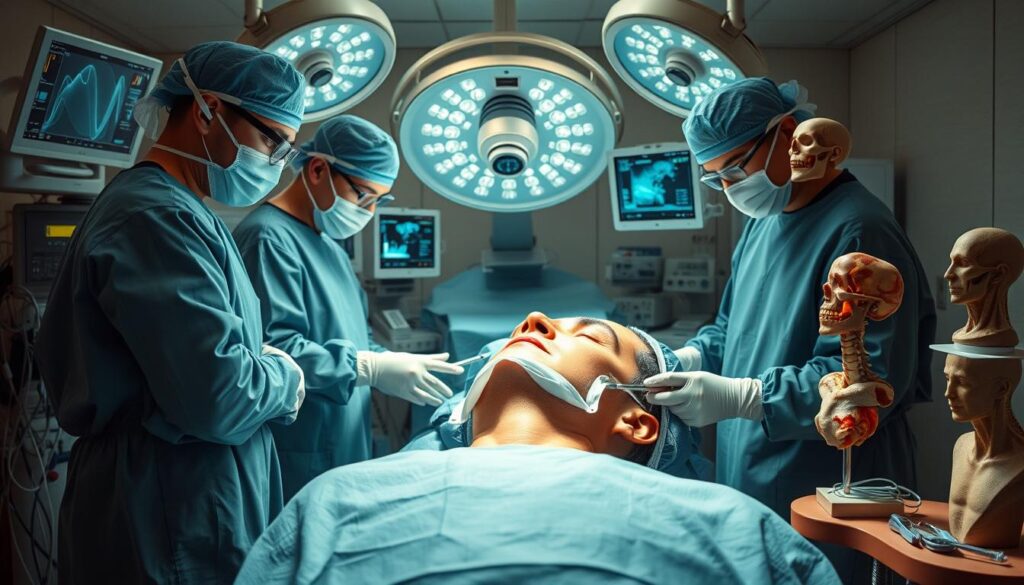
Face transplant surgery is a revolutionary approach to facial reconstruction. It offers hope to those with severe facial trauma or disfigurement. Since 2005, doctors have performed this complex procedure to restore appearance and function1.
These surgeries help patients regain facial abilities and improve their lives. The process involves extensive medical expertise and careful patient selection. Transplant immunology is crucial for the success of these transformative procedures2.
Face transplants replace all or part of a patient’s face with donor tissue. This requires advanced medical techniques and lifelong care. The surgery can greatly improve a person’s ability to eat, speak, and interact.
Key Takeaways
- Face transplant surgery helps restore facial function and appearance
- Rigorous medical evaluations are required for potential candidates
- Lifelong immunosuppressant medications are necessary
- Surgical risks include infection and tissue rejection
- The procedure can dramatically improve patient quality of life
Understanding Face Transplant Surgery and Its Purpose
Face transplant surgery offers hope for those with severe facial disfigurement. This complex procedure helps patients reclaim their identity and improve social interactions. It’s a groundbreaking advancement in reconstructive medicine.
The journey to a face transplant is complex and personal. Potential candidates must meet specific criteria for this transformative surgery3.
Candidate Requirements for Facial Transplantation
- Age range between 18 and 60 years old3
- Significant facial trauma or extensive disfigurement
- No active cancer history
- Ability to commit to lifelong immunosuppressive treatment
Comprehensive Evaluation Process
The face transplant evaluation is rigorous and multifaceted4. It can take several months to complete.
- Extensive physical examinations
- Psychological assessments
- Social compatibility screening
- Comprehensive medical history review
Critical Donor Matching Requirements
Donor selection goes beyond simple compatibility. Tissue engineering principles guide the matching process, considering multiple factors3.
- Skin color and tone matching
- Gender compatibility
- Ethnicity considerations
- Facial and head size alignment
The goal is not just surgical success, but a harmonious integration that minimizes graft rejection risks.
Patients must understand the long-term commitment involved. Daily medications and regular follow-ups are necessary to prevent complications. This ensures optimal recovery and transplant success4.
The Face Transplant Surgical Procedure and Recovery
Face transplant surgery is a groundbreaking advancement in microsurgery and craniofacial surgery. This complex procedure uses intricate techniques to transform patients’ lives5. Since 2021, over 45 patients worldwide have received full or partial face transplants5.
The face transplant journey starts with an extensive surgical process. The operation usually takes 12-36 hours, depending on the needed restoration5. Surgeons carefully connect multiple tissue systems during the procedure.
- Blood vessels
- Nerves
- Muscles
- Skin and soft tissues
After surgery, expect a thorough recovery process. Hospital stays typically last 3-4 weeks, starting with intensive care5. Rehabilitation follows and involves various medical professionals.
- Speech-language pathologists
- Physical therapists
- Occupational therapists
- Psychological support specialists
“Face transplantation is a testament to human resilience and medical innovation” – Dr. Maria Rodriguez, Craniofacial Surgery Expert
Managing potential tissue rejection is crucial during recovery. Patients must take immunosuppressive medications and watch for signs of rejection. These signs may appear as a painless rash on the transplanted area5.
| Recovery Stage | Duration | Key Focus |
|---|---|---|
| Hospital Stay | 3-4 weeks | Initial healing and monitoring |
| Rehabilitation | 4-6 months | Functional recovery and adaptation |
| Long-term Management | Lifelong | Immunosuppression and follow-up care |
Your commitment to recovery is vital for success in this life-changing surgical journey.
Conclusion
Face transplant surgery offers hope to those with severe facial disfigurements. The field has evolved dramatically since its early days. Surgical techniques and transplant immunology have made significant progress6.
Katie Stubblefield’s case showcases the transformative power of this innovative approach. Only a limited number of face transplants have been performed worldwide7. Patients must consider lifelong immunosuppressive treatments and potential medical challenges.
The selection process is rigorous. It ensures only those with critical need and best potential outcomes are considered8. Researchers are working to improve face transplant outcomes.
They aim to develop standardized metrics and reduce immunological risks. Each successful procedure brings new hope to patients seeking facial reconstruction. The goal is to restore both function and appearance after severe trauma.
FAQ
What exactly is a face transplant?
A face transplant replaces part or all of a patient’s face with donor tissue. It helps people with severe facial issues improve their looks and abilities. The surgery aims to enhance chewing, speaking, and breathing functions.
Who is eligible for a face transplant?
Candidates must be 18-60 years old with significant facial disfigurement. They need to be free from HIV, Hepatitis C, and recent cancer. Extensive evaluations determine if you’re suitable for the procedure.
How long does the surgery take?
Face transplant surgery usually lasts 16 hours or more. The time depends on how complex the transplant is. Surgeons carefully remove and reconnect facial structures during the operation.
What is the recovery process like?
After surgery, you’ll stay in the hospital for 1-4 weeks. This includes time in intensive care. Recovery involves 4-6 months of rehab to regain facial functions.
Will I need to take medication after the transplant?
You’ll need lifelong immunosuppressant medications to prevent rejection of the transplanted face. This commitment requires careful medical management throughout your life.
How are donor faces matched?
Donor matching involves blood type, tissue type, skin color, gender, age, and face size. It needs special consent from the donor’s family. This process isn’t part of standard organ donation registries.
How many face transplants have been performed?
Since 2005, over 40 people worldwide have had face transplant surgery. It remains a rare and highly specialized medical procedure.
What are the risks of a face transplant?
The procedure is high-risk with potential complications like graft rejection and infection. You’ll need lifelong immunosuppressive medications. Thorough evaluations ensure only suitable candidates undergo the surgery.
Can a face transplant completely restore my appearance?
Face transplants greatly improve looks and function, but results aren’t perfect. The new face will blend donor and recipient features. You’ll need ongoing care and rehab after the surgery.
How long has face transplant surgery been performed?
The first partial face transplant happened in 2005. It’s a new field in microsurgery and craniofacial reconstruction.
Source Links
- Face transplant – Mayo Clinic – https://www.mayoclinic.org/tests-procedures/face-transplant/about/pac-20394037
- Face Transplant: Surgery, How It Is Done & Rejection – https://my.clevelandclinic.org/health/treatments/23281-face-transplant
- Face Transplant – https://www.hopkinsmedicine.org/health/treatment-tests-and-therapies/face-transplant
- Face Transplant – Face transplant process – https://www.mayoclinic.org/departments-centers/face-transplant/sections/gnc-20564884
- Human Craniomaxillofacial Allotransplantation – https://www.hopkinsmedicine.org/transplant/programs/reconstructive-transplant/face-transplant
- Facial Transplantation: Complications, Outcomes, and Long-Term Management Strategies – https://pmc.ncbi.nlm.nih.gov/articles/PMC7759434/
- Face Transplant: Indications, Outcomes, and Ethical Issues—Where Do We Stand? – https://pmc.ncbi.nlm.nih.gov/articles/PMC9571096/
- Maximizing Function in Full Face Transplant Recipients – Brigham On a Mission – https://www.brighamhealthonamission.org/2019/12/12/maximizing-function-in-full-face-transplant-recipients/

