
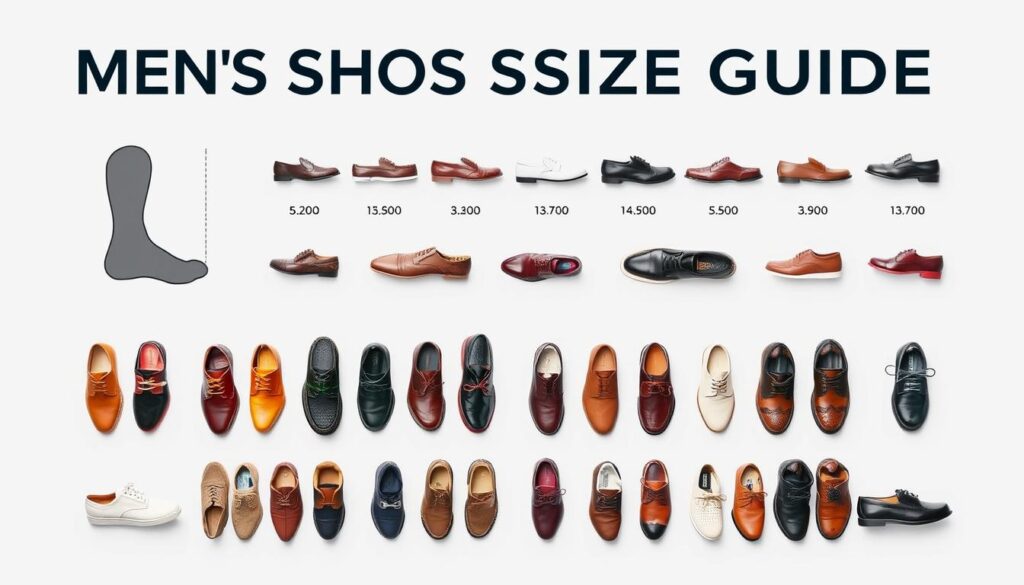
Curious about men’s average shoe size? It’s more complex than you’d think. Foot measurements offer insights into how sizes vary across heights and body types1.
In the U.S., men’s average shoe size is 10.5, typically medium width (D)1. Your shoe size isn’t random. It’s shaped by genetics, age, and height2.
Height significantly influences shoe size. Men under 5’9″ often wear smaller sizes. Taller guys usually need bigger footwear12.
Shoe sizes vary widely. Shorter men wear sizes 7-9. Men over 6’3″ might need sizes 13-20+1.
Key Takeaways
- Average men’s shoe size in the U.S. is 10.5
- Shoe size correlates closely with height
- Factors like genetics and age impact foot size
- Shoe sizes range from 7 to 20+ for men
- Medium width (D) is most common for men’s shoes
Understanding Average Shoe Size for Men
Men’s footwear sizing can be tricky. Your perfect fit depends on more than just a number. Multiple factors affect the right shoe size for you.
Factors Affecting Foot Size
Your foot size changes over time. Several key elements influence its growth and measurement:
- Genetics play a significant role in determining foot structure
- Age can cause feet to change shape and size
- Body weight impacts foot width and length
- Physical activities shape foot muscle and bone structure
In the U.S., the average male shoe size is 10.5. This matches an average height of 5 feet 9 inches1. Globally, shoe sizes usually range from 9 to 121.
How Shoe Sizing Works
Shoe sizing isn’t the same everywhere. Different regions use unique measurement approaches. The US and UK use a specific formula for sizing.
This formula is three times the foot length in inches, minus a constant3. When using a shoe fitting guide, keep these points in mind:
- Shoe cavity length is usually 1/2 to 2/3 inch longer than foot length3
- European sizing uses the Paris point system with 6.67 mm increments3
- Modern sports shoes include multiple sizing systems3
Regional Size Variations
Converting shoe sizes can be confusing. Countries use different measurement methods. Nutrition, population demographics, and genetic factors affect regional shoe sizes1.
“Understanding your precise shoe size is key to comfort and foot health.”
Pro tip: Measure both feet and pick sizes based on the larger one. This ensures the best comfort4.
The Science Behind Shoe Size and Height
Your shoe size and height are closely linked. Scientists have studied this connection through extensive research. The typical height-to-foot ratio is about 6.6:1, showing a clear mathematical relationship between these traits5.
Boys and girls have different foot growth patterns. Research shows girls’ feet grow fast about a year before puberty. Boys’ feet change about 2.5 years earlier6.
This info helps predict when kids might have growth spurts. It’s useful for parents and doctors to know.
- Peak shoe size increase for girls: Around 10.4 years6
- Peak shoe size increase for boys: Around 11.5 years6
- Average foot growth cessation: Approximately 12 years for girls, 13.7 years for boys6
Scientists have found ways to guess height from foot size. In 2005, a study in Forensic Science International shared an equation.
It uses left foot length to calculate height: Height = 47.33 + 1.139 (left foot length) + other measurements5.
Your feet are not just for walking—they’re a scientific blueprint of your physical characteristics!
| Population | Foot Length/Height Ratio |
|---|---|
| General Population | 15% |
| Rudolf Martin’s Research | 15% |
| Georges Olivier’s Recommendation | 15.5% |
These measurements offer interesting insights, but everyone is different. Your unique shoe size and height are shaped by genes, diet, and health7.
Conclusion
Shoe size matters more than just a number. The right fit prevents foot problems and ensures all-day comfort8. In the US, the average male shoe size is 10.6, but individual fit varies8.
Proper shoe fitting involves more than knowing your typical size. Nike and Adidas offer different size ranges9. It’s vital to try on shoes and assess their feel.
Your feet can change over time. Factors like weight, age, and lifestyle may affect your shoe size. Get professionally measured and shop later in the day.
A comprehensive shoe size study showed significant regional differences in foot measurements10. Focus on comfort and support rather than a specific number.
Finding the right shoe takes time but improves daily comfort. It also benefits long-term foot health. Explore various sizes, widths, and brands to find your perfect match.
FAQ
What is the average shoe size for men in the United States?
The average shoe size for American men is 10.5 with medium width. Factors like age, height, and body type can influence this.
How does height relate to shoe size?
Shoe size generally matches height in adult males. Men 5’5″ or shorter often wear sizes 7-9. Taller men around 6’3″ may need sizes 13-20+.
A 6-foot tall man typically wears about size 11.5.
What factors affect foot size?
Age, genetics, weight, and lifestyle all impact foot size. As men age, feet may flatten and lengthen due to activity.
Genetics play a big role in foot size inheritance. Excess weight can cause feet to spread or flatten.
At what age do feet stop growing?
Feet usually stop growing around age 16, when puberty ends. Shoe size might still change slightly with age.
Weight gain and decreased ligament elasticity can affect foot size over time.
How can I ensure I’m wearing the right shoe size?
Get professionally measured using a Brannock Device for accurate sizing. Shop later in the day when feet are slightly swollen.
Consider sock thickness and prioritize comfort over the size number. Remember, different brands may size differently.
Do shoe sizes vary by country?
Yes, shoe sizing systems differ globally. The main systems are UK, US, and European sizing.
Use conversion charts when buying shoes from international brands to ensure the right fit.
Why is proper shoe fitting important?
Well-fitted shoes are crucial for comfort and foot health. They prevent issues like corns, calluses, and bunions.
Proper fit contributes to better posture and helps avoid potential foot-related injuries.
How often should I measure my shoe size?
Measure your foot size regularly, as it can change over time. Factors like weight, aging, and lifestyle affect size.
Get measured yearly or when your current shoes feel uncomfortable.
Source Links
- Average Shoe Size for Men: Size, Height, and Other Facts – https://www.healthline.com/health/average-shoe-size-for-men
- Average Shoe Size for Men: How To Get Your Correct Shoe Size In America – https://www.libertyzeno.com/blogs/news/average-shoe-size-for-men
- Shoe size – https://en.wikipedia.org/wiki/Shoe_size
- Measure Your Shoe Size – https://www.2bigfeet.com/pages/measure-your-shoe-size?srsltid=AfmBOoqgE-U-nQosLboYuKwXhjs3Z5oSSnNJk24o9W2UML50ZpRMTzUp
- Height-to-Foot-Size Ratio | Livestrong.com – https://www.livestrong.com/article/491821-height-to-foot-size-ratio/
- The value of shoe size for prediction of the timing of the pubertal growth spurt – https://pmc.ncbi.nlm.nih.gov/articles/PMC3034705/
- Height Estimation from Foot and Shoeprint Length – https://www.dentalage.co.uk/wp-content/uploads/2014/09/giles_e_et_al_1990_foot_length__height.pdf
- PDF – https://www2.isye.gatech.edu/~yxie77/2028proj/AdityaSehgalProject.pdf
- The average shoe size of men is calculated – Sneakerjagers – https://www.sneakerjagers.com/en/n/the-average-shoe-size-of-men-is-calculated/28672?srsltid=AfmBOoo1GsQEISNK9Qxnhsb_LmfX8d7vwkkI0GQeE7dfDiCKd3m4_baZ
- Analysis of 1.2 million foot scans from North America, Europe and Asia – https://pmc.ncbi.nlm.nih.gov/articles/PMC6914786/

