
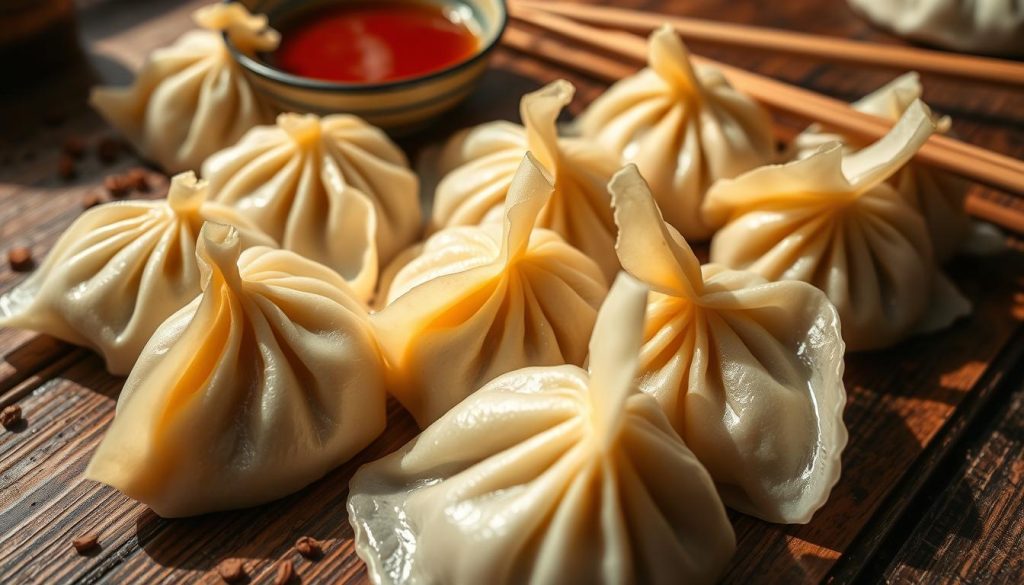
The most common Chinese word for dumplings is “jiaozi” (饺子). These tasty parcels are a big part of Chinese food culture. They’re especially popular in northern China, where people eat them all year round1.
Jiaozi can be written in both traditional (餃子) and simplified Chinese characters. This shows how important they are in Chinese language and food history1.
You can cook jiaozi in many ways. They can be boiled, steamed, pan-fried, or deep-fried. This makes them a flexible food choice1.
Jiaozi are more than just food. During Chinese New Year, they stand for wealth and good luck. This is because they look like old Chinese gold and silver coins1.
To make jiaozi, you wrap meat and veggies in thin dough. Common fillings include chicken, pork, beef, shrimp, and fish. Vegetables like cabbage, scallion, and spinach are often added too1.
The most common shape for jiaozi is a crescent. Cooks make this shape by carefully folding and pinching the edges together1.
Key Takeaways
- Jiaozi is the primary Chinese term for dumplings
- Dumplings have deep cultural significance in Chinese cuisine
- Multiple cooking methods exist for preparing dumplings
- Dumplings symbolize wealth during Chinese New Year
- Fillings can include various meats and vegetables
Understanding Chinese Dumpling Types
Chinese dumplings are a culinary art form with rich traditions. These tasty parcels come in many varieties, reflecting diverse regional cuisines across China2. Dumplings showcase a wide range of flavors and cooking techniques2.
Regional Dumpling Diversity
Chinese dumplings offer unique styles and preparations in each region. Here are some notable varieties:
- Shuijiao (水饺): Boiled dumplings with multiple filling options2
- Guotie (锅贴): Pan-fried potstickers with crispy bottoms3
- Zhengjiao (蒸饺): Delicate steamed dumplings3
- Huntun (馄饨): Soft soup dumplings with rich broths2
Traditional Dumpling Categories
Chinese dumplings feature a variety of fillings that show culinary creativity. Savory options often include ground pork, chicken, shrimp, and vegetables2.
Sweet variations might contain red bean paste, lotus seed paste, or black sesame2.
| Dumpling Type | Key Characteristics | Origin |
|---|---|---|
| Xiao Long Bao | Soup dumplings with gelatin-based broth | Shanghai |
| Har Gow | Translucent shrimp dumplings | Guangdong |
| Shen Jian Bao | Pan-fried with leavened dough | Shanghai |
Cultural Significance
Dumplings are more than just food in Chinese culture. They represent family unity and prosperity. These treats are essential during celebrations like the Lunar New Year.
The art of dumpling making is often a cherished family tradition passed through generations.
“Dumplings” in Chinese
Jiaozi (饺子) is the most common Chinese term for dumplings. These half-moon-shaped treats come from northern China. The term 员外 (yuanwai) also appears in traditional Chinese dumplings, showing a deeper cultural link45.
Dumplings date back to the Eastern Han period (AD 25–220). Zhang Zhongjing, a famous Chinese medicine expert, is said to have invented them. These tasty parcels mean more than just food; they stand for wealth and good luck4.
You can learn more about making dumplings on authentic Chinese cooking websites. These sites offer great tips for cooking traditional dumplings at home.
In 1972, archaeologists found ancient dumpling-like objects in Turpan’s Astana Tombs. These findings date back about 1,300 years. The modern dumpling shape came about during the Tang Dynasty5.
Dumpling restaurants became popular in the Qing Dynasty (1644–1911). Today, people enjoy jiaozi during the Spring Festival and other times. These tasty treats showcase Chinese culture and cooking skills45.
FAQ
What is the most common Chinese word for “dumplings”?
Jiaozi (饺子) is the most popular term for dumplings in Mandarin Chinese. It’s pronounced “jiao-zr” and is a crucial part of Chinese cuisine. Jiaozi are especially popular during festivals and family gatherings.
What are the different types of Chinese dumplings?
Chinese cuisine offers several types of dumplings. These include shuijiao (水饺, boiled dumplings) and guotie (锅贴, pot stickers). Huntun (馄饨, wontons) and zhengjiao (蒸饺, steamed dumplings) are also popular varieties.
Each type has its own unique preparation methods. Regional variations add to the diversity of Chinese dumplings.
How are dumplings significant in Chinese culture?
Dumplings are vital in Chinese traditions, especially during New Year celebrations. They symbolize wealth, togetherness, and good fortune. These tasty treats are more than just food in Chinese culture.
What are some traditional dumpling fillings?
Traditional dumpling fillings vary by region. They often include ground meat like pork, beef, or chicken. Vegetables such as cabbage and chives are common too.
Seasonings like ginger, garlic, and soy sauce add flavor to the fillings.
Are there any interesting historical stories about dumplings?
Legend credits Zhang Zhongjing, a famous Eastern Han Dynasty medical expert, with creating dumplings. He reportedly made them to help people stay warm and treat frostbite during winter.
What’s the difference between wontons and jiaozi?
Wontons (huntun) and jiaozi are both dumplings, but they have some differences. Wontons typically have thinner wrappers and are often served in soup. Jiaozi have thicker wrappers and can be boiled, steamed, or pan-fried.
How do I pronounce “jiaozi” correctly?
“Jiaozi” is pronounced like “jiao-zr” in Mandarin Chinese. The first syllable “jiao” sounds similar to “je-ow”. The second syllable “zi” is pronounced like “zr” with a quick, light sound.
What is the less common word for dumplings you mentioned?
Yuanwai (员外) is a less common term for dumplings. It has historical and literary origins. However, it’s not as widely used in everyday conversation as jiaozi.
Source Links
- Jiaozi – https://en.wikipedia.org/wiki/Jiaozi
- Exploring Different Types of Chinese Dumplings and Bao – https://eatmila.com/blogs/news/chinese-dumpling-types?srsltid=AfmBOoqsOxyYwKdAzu8Fz-zX83LvJCLwSNaRRYgHI4fM3Vw99QVKltV5
- The Guide to Chinese Dumplings: Steamed, Boiled, or Fried – https://www.driveontheleft.com/guide-chinese-dumplings/
- 17 Chinese Dumplings Every Dumpling Fan Needs to Try – https://ltl-xian.com/chinese-dumplings/
- Chinese Dumplings, How to Make Dumplings in China – https://www.chinahighlights.com/travelguide/chinese-food/chinese-dumplings.htm

