
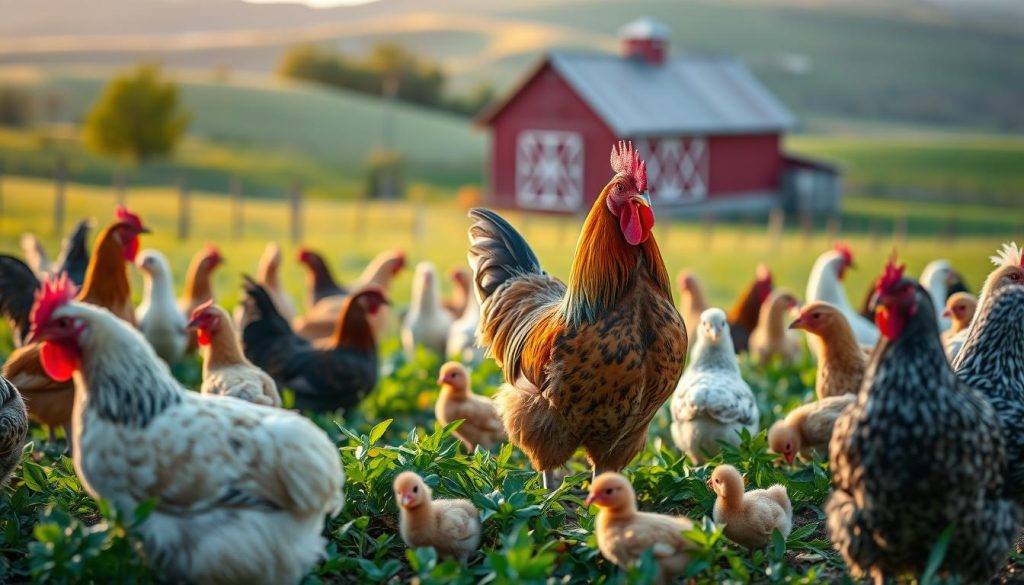
Chickens are a diverse group of domesticated birds. Many people find the terms chicken, hen, and rooster confusing1. These birds have a rich history dating back thousands of years.
Chickens are the broad species. Hens and roosters are specific gender classifications within this group. Fertile eggs have about a 50/50 chance of hatching into males or females1.
Poultry farmers use advanced methods to identify chicken genders. Experts can determine a chick’s sex with up to 90% accuracy1. They use techniques like vent sexing and examining physical traits.
Key Takeaways
- Chickens are a complex domesticated avian species
- Gender identification in chicks can be up to 90% accurate
- Fertile eggs have an equal chance of producing roosters or hens
- Poultry farming requires specialized knowledge of chicken classification
- Different breeds have unique gender-identifying characteristics
Understanding Basic Terminology of Poultry Species
Chickens are a fascinating part of agricultural diversity. They play crucial roles in backyard coops and commercial farms. Through careful breeding, these birds have evolved into specialized breeds for various purposes2.
https://www.youtube.com/watch?v=lHed0VjrLps
The global chicken population is incredibly diverse. There are over 25 billion birds worldwide2. Understanding their classifications helps farmers and enthusiasts appreciate their unique traits.
Origins of Domestic Chickens
Domestic chickens came from wild jungle fowl. Selective breeding has transformed them over time. Their anatomy has been developed to optimize egg and meat production.
Different Age Classifications
- Chicks: Newly hatched birds less than 7 days old
- Pullets: Female chickens under 1 year old not yet laying eggs3
- Cockerels: Young male chickens before sexual maturity
- Hens: Mature female chickens capable of egg production2
- Roosters: Mature male chickens used for breeding
Purpose and Uses in Modern Farming
Modern chicken farming focuses on specialized breeds for specific purposes. Broilers are raised for meat, while laying hens produce eggs. The global egg industry produces about 76 million metric tons annually2.
Dual-purpose breeds offer both meat and egg production capabilities3. These chickens are essential for sustainable farming. They support local and global food systems.
Chicken vs Hen vs Rooster: Key Physical Differences
Physical distinctions between chickens, hens, and roosters are vital for poultry enthusiasts and farmers. Bird anatomy shows fascinating differences across chicken breeds4.
Roosters have striking features that set them apart. They often have brighter plumage and larger combs and wattles.
Roosters also boast longer tail feathers and thicker legs with visible spurs.
- More vibrant and colorful plumage4
- Larger and more pronounced combs and wattles4
- Longer tail feathers
- Thicker legs with visible spurs
Hens have a more subtle look. They typically have subdued colors and smaller combs and wattles.
Their bodies are more compact, with shorter, rounder feathers.
- Subdued coloration
- Smaller combs and wattles4
- Shorter, rounder feathers
- More compact body shape
Chicken breeds show unique variations in these traits. Rhode Island Red roosters have large bodies and bright red combs.
Plymouth Rock roosters display distinctive black and white barred feather patterns4.
| Breed | Rooster Characteristics | Hen Characteristics |
|---|---|---|
| Leghorn | Large, flamboyant combs | Smaller combs, compact build |
| Orpington | Broad bodies, pronounced feathering | Plump, soft appearance |
Roosters start developing their unique features around four to five months old5. Experts can determine chick sex through vent sexing and feather sexing.
These methods require professional skills to perform accurately4.
The physical differences between roosters and hens are not just cosmetic but serve important biological functions in chicken breeds.
Behavioral Traits and Gender-Specific Characteristics
Chickens are complex social creatures with unique behaviors. Understanding these traits is key for successful poultry raising. The chicken vs hen vs rooster dynamic reveals fascinating patterns beyond biological differences6.
Roosters are crucial for flock protection and social structure. They start crowing at 10-12 weeks, warning the flock of potential predators7. Roosters tend to be more aggressive during conflicts, establishing the flock’s hierarchy6.
These male birds produce distinctive warning sounds for protection. They keep a watchful eye over their group, ensuring safety6.
Hens show fascinating traits focused on survival and reproduction. They communicate through over 30 distinct vocalizations, especially with their chicks6. Hens establish a complex pecking order for access to food and nesting areas6.
Their natural instincts prioritize foraging, nesting, and offspring survival. These behaviors are crucial in both backyard and commercial settings.
The intricate social interactions in a chicken flock are remarkable. Each member plays a specific role, working together for the group’s survival and success6.
FAQ
What’s the difference between a chicken, a hen, and a rooster?
Chickens are a domestic bird species. Hens are female chickens that lay eggs. Roosters are male chickens with larger combs and more colorful feathers.
When were domestic chickens first domesticated?
Domestic chickens originated around 4,000 B.C. in the Indus plain. They came from wild jungle fowl species. People have bred them for meat, eggs, and even cockfighting.
What are the different age classifications of chickens?
Chickens have several age-specific classifications. Chicks are newly hatched birds. Pullets are young female chickens before they lay eggs.
Cockerels are young male chickens. Hens are mature female chickens. Roosters are mature male chickens.
How do roosters and hens differ physically?
Roosters have larger combs and wattles. They sport colorful plumage and spurs on their legs. Roosters also have a more muscular build.
Hens have smaller combs and wattles. Their coloration is more subdued. Hens lack spurs and have smaller, compact bodies.
What is the primary purpose of roosters in a flock?
Roosters protect the flock from predators. They fertilize eggs for breeding and maintain social hierarchy. Roosters also warn of danger through crowing.
They guide the flock during foraging activities.
How many eggs can a hen lay in a week?
A healthy hen usually lays 4-6 eggs per week. This depends on breed, age, and environment. Some breeds can produce up to 300 eggs yearly.
Can you keep chickens in a backyard?
Yes, backyard chicken keeping is popular. Check local rules and provide proper housing. Consider noise, predator protection, and space needs.
What do chickens eat?
Chickens are omnivores with a varied diet. They eat commercial feed, grains, insects, and vegetable scraps. Seeds and occasional protein sources like mealworms are also good.
Chickens need grit for digestion.
How long do chickens typically live?
Chicken lifespans vary by breed and purpose. Backyard or pet chickens live 5-10 years. Commercial laying hens are productive for 2-3 years.
Some heritage breeds can reach 12-15 years with good care.
How do chickens communicate?
Chickens use various vocalizations for warnings and mating calls. They communicate through body language and pecking order. Specific calls alert flock members about food or danger.
Source Links
- How to Identify a Rooster vs Hen – https://grubblyfarms.com/blogs/the-flyer/how-to-identify-a-rooster-vs-hen?srsltid=AfmBOoo7LLOe2MNpCqaQp9gW0E03FEJe_9mOXzcX7zkzq1JeIyqoRw_1
- Hen vs Chicken: What Are the Differences and Similarities? – https://www.cookist.com/hen-vs-chicken-what-are-the-differences-and-similarities/
- The Chicktionary: The Ultimate Chicken Terminology Guide – https://www.backyardchickencoops.com.au/blogs/learning-centre/the-chicktionary-the-ultimate-chicken-terminology-guide
- Rooster vs. Hen: How Do They Differ? – https://www.kalmbachfeeds.com/blogs/chickens/rooster-vs-hen-how-do-they-differ?srsltid=AfmBOorC3T4FlX5VWewoxin5r4IQx86aQZzGITc_ftexX0fthWCT8Jnx
- How to Identify a Rooster vs Hen – https://grubblyfarms.com/blogs/the-flyer/how-to-identify-a-rooster-vs-hen?srsltid=AfmBOoo2cD4p6hsBPStMheDlNYXhx2fQjYzWvF86mpw-U6H5XICW8rBW
- Characteristics of a Rooster vs. Hen – https://animals.mom.com/characteristics-rooster-vs-hen-7813.html
- Chicken Sexing: Who Is Who? – https://www.backyardchickencoops.com.au/blogs/learning-centre/chicken-sexing-who-is-who

