
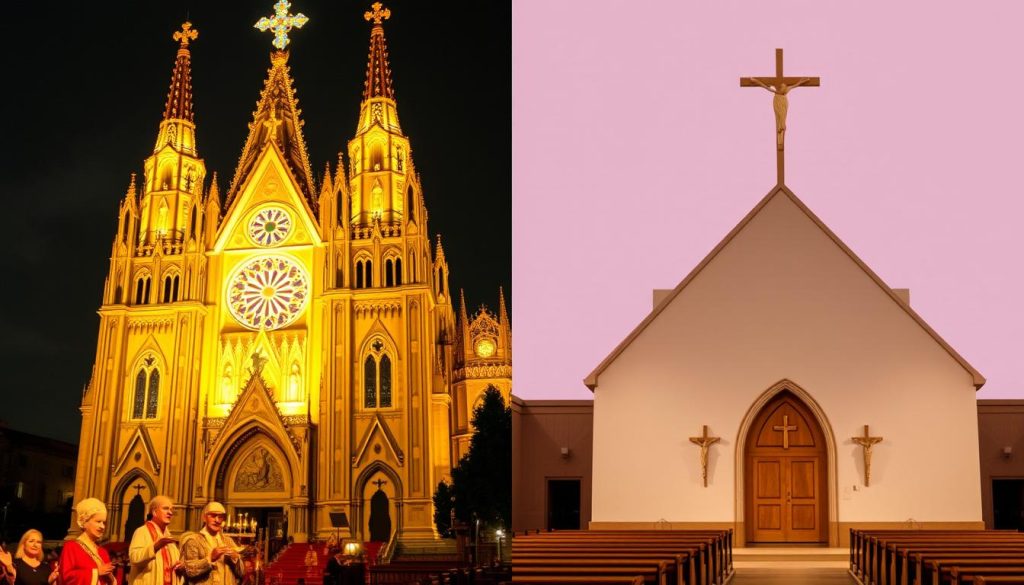
Christianity is a global religion based on Jesus Christ’s life and teachings. Roman Catholicism is a major branch that shapes Christian beliefs and practices12. It has over 1.33 billion followers worldwide, making up a large part of the Christian population1.
All Catholics are Christians, but not all Christians are Catholic. The Catholic Church has unique doctrines and traditions3. It’s the largest Christian tradition globally, with over 60% of Christians identifying as Catholic3.
Catholic beliefs mix spiritual practices and personal actions. They think both faith and works are key for spiritual growth23. This view sets Roman Catholicism apart from other Christian traditions.
Key Takeaways
- Roman Catholicism is the largest branch of Christianity
- Catholics represent over 1.3 billion people worldwide
- Catholic doctrine emphasizes faith and works
- Not all Christians are Catholics, but all Catholics are Christians
- Unique Catholic practices include seven sacraments and papal leadership
Understanding the Historical Development of Christianity
Christianity’s journey through history is marked by pivotal moments that shaped its evolution. From its humble beginnings, the religion underwent significant transformations. These changes define its current landscape and reveal a complex narrative of spiritual growth4.
Early Christian communities spread rapidly across the Roman Empire. By 100 AD, over 40 Christian communities had been established. This quick spread laid the foundation for future growth4.
The Great Schism of 1054
In 1054, the Great Schism split Christianity into two primary branches5. This division created fundamental differences between the Eastern Orthodox and Roman Catholic churches.
- Theological interpretation variations
- Liturgical practice differences
- Leadership structure distinctions
The Protestant Reformation Movement
The Reformation sparked a radical transformation in Christian practice. In 1517, Martin Luther challenged existing church structures. This movement led to the creation of numerous Protestant denominations5.
Key figures like Luther and John Calvin questioned church practices. Their actions resulted in significant religious restructuring across Europe and beyond.
Evolution of the Roman Catholic Church
The Roman Catholic Church responded through internal reforms and the Counter-Reformation. Institutional adaptability became crucial in maintaining its global spiritual influence.
The church continued to develop theological interpretations and organizational strategies. These efforts aimed to address emerging theological debates and maintain relevance.
Roman Catholic vs Christianity: Key Differences in Beliefs and Practices
Roman Catholicism and other Christian denominations have significant theological differences. These distinctions stem from varying approaches to Scripture interpretation and spiritual understanding6.
Key differences exist in several crucial areas:
- Salvation Perspective: Most Catholics see salvation as an ongoing process. It involves good works and sacraments6. Protestant traditions, however, focus on salvation by faith alone7.
- Biblical Authority: Many Catholics give equal weight to Bible and Church tradition. Protestants often follow Sola Scriptura, viewing the Bible as the main spiritual guide7.
- Sacramental Understanding: Catholics recognize seven sacraments. Many Protestant groups only acknowledge baptism and communion8.
Papal authority is another major theological difference. Catholics have a hierarchical structure with the Pope as leader. Other Christian denominations don’t share this concept8.
Religious practices also differ in saint veneration and spiritual communication. Most Protestants believe in direct communication with God. Only a small portion of Catholics share this view6.
These differences have deep historical roots. The Catholic Church claims direct lineage from Christ. In contrast, about 20,000 Protestant denominations emerged later8.
Conclusion
Christianity’s landscape reveals a complex tapestry of beliefs and practices. Roman Catholic vs Christianity perspectives show shared roots yet distinct faith interpretations9. Roman Catholicism is the largest Christian denomination, with over 1.3 billion followers worldwide9.
Theological differences appear in core doctrinal views like salvation, sacraments, and church authority. Catholics believe salvation comes through faith and good works9. Protestant denominations often stress salvation by faith alone.
The Catholic Church recognizes seven sacraments9. About 70% of Catholics believe in transubstantiation during mass10. These nuances highlight diverse interpretations within Christian traditions.
Christianity remains united by fundamental beliefs in Jesus Christ’s teachings. Ongoing dialogue between Christian groups fosters mutual understanding and respect. Ecumenical efforts bridge theological gaps, showing diversity can exist within a shared spiritual framework.
As Christianity evolves, Catholic and other Christian traditions shape global religious discourse. While differences exist, the core message of love and compassion unites all denominations. This spiritual growth remains a powerful force across Christian faith.
FAQ
Is Roman Catholicism a type of Christianity?
Yes, Roman Catholicism is the largest Christian denomination. Catholics follow the Roman Catholic Church’s teachings. They share the belief in Jesus Christ as God’s Son.
What makes Roman Catholicism different from other Christian denominations?
Key differences include papal authority and seven sacraments. Catholics venerate saints and Mary. They believe in transubstantiation during the Eucharist.
The Catholic Church has a structured hierarchy. Catholics value church tradition and theological interpretations. Protestant denominations often focus solely on Scripture.
When did the major splits in Christianity occur?
Two significant splits shaped modern Christianity. The Great Schism of 1054 separated Eastern Orthodox and Roman Catholic churches.
The Protestant Reformation in the 16th century led to new denominations. These challenged Catholic doctrines and practices.
Do Catholics believe the Bible is the only source of religious guidance?
Catholics don’t follow sola scriptura (Scripture alone) like many Protestant denominations. They believe in combining biblical teachings and church tradition.
Church teachings, papal encyclicals, and theological interpretations complement biblical guidance for Catholics.
How do Catholic sacraments differ from other Christian practices?
Catholics recognize seven sacraments. These are Baptism, Confirmation, Eucharist, Penance, Anointing of the Sick, Holy Orders, and Matrimony.
Many Protestant denominations practice only Baptism and Communion. They typically view these as symbolic rather than transformative spiritual events.
What is the role of the Pope in Roman Catholicism?
The Pope is the Catholic Church’s spiritual leader and supreme pontiff. Catholics believe he’s a direct successor of Saint Peter.
They view the Pope as infallible when speaking ex cathedra on faith and morals. Other Christian denominations don’t share this concept.
Are there similarities between Roman Catholicism and other Christian denominations?
Yes! All Christian denominations share core beliefs. These include faith in Jesus Christ and belief in the Holy Trinity.
The importance of salvation and Bible guidance are also common. Love, redemption, and spiritual growth remain consistent across these traditions.
Source Links
- Catholicism vs Christianity – Difference and Comparison – https://www.diffen.com/difference/Catholicism_vs_Christianity
- What Is The Difference Between Catholic And Christian? – https://www.worldatlas.com/religion/what-is-the-difference-between-catholic-and-christian.html
- The Difference Between Catholic and Christian – Scripture Catholic – https://www.scripturecatholic.com/the-difference-between-catholic-and-christian/
- History of the Catholic Church – https://en.wikipedia.org/wiki/History_of_the_Catholic_Church
- Christianity ‑ Dogma, Definition & Beliefs | HISTORY – https://www.history.com/topics/religion/history-of-christianity
- I am a Catholic. Why should I consider becoming a Christian? – https://www.gotquestions.org/Catholic-Christian.html
- Christian Vs Catholic Beliefs: (10 Epic Differences To Know) – https://biblereasons.com/christian-vs-catholic/
- Christian, Yes…But Why Be Catholic? – https://www.catholic.com/magazine/print-edition/christian-yesbut-why-catholic
- Roman Catholic vs. Christian – Catholicism – https://catholicism.website/uncategorized/roman-catholic-vs-christian/
- Catholic vs. Christian: Overlap and Differences in the Religions – https://people.howstuffworks.com/catholic-vs-christian.htm

