
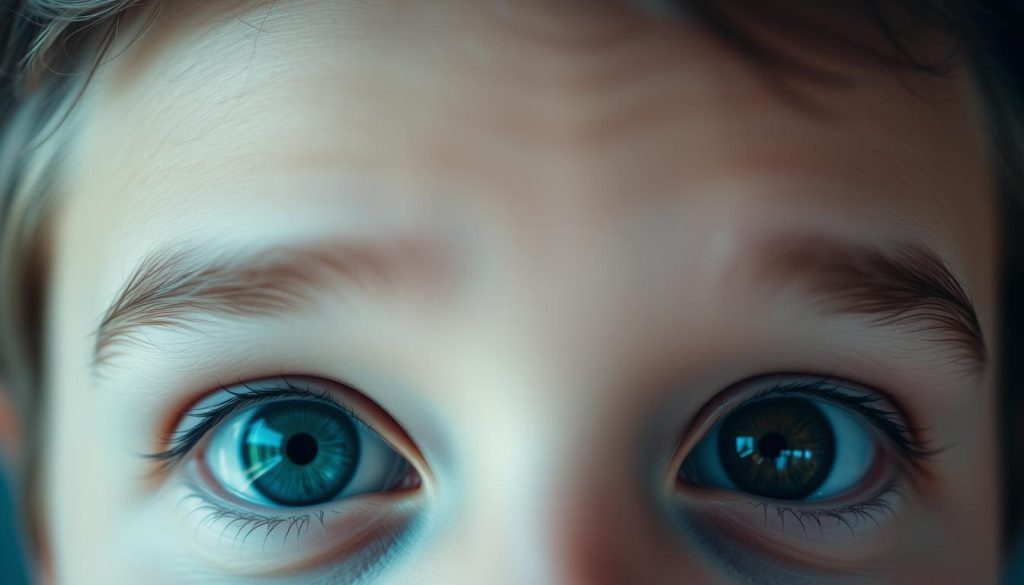
Eye color is a fascinating genetic puzzle. It’s more complex than simple inheritance patterns. The world of eye color meaning shows how genes work together to create unique iris hues1.
Eye color symbolism has sparked interest in researchers and individuals. They explore the genetic roots behind our visual traits2.
Studies show that eye color isn’t determined by one gene. Over 50 genes contribute to the wide range of eye colors1. The OCA2 gene is crucial, accounting for 75% of blue-brown color variations2.
Blue and green eyes are rarer than brown eyes. Most people have brown irises with more melanin1. Eye color can change in early childhood.
Blue eyes have a 27% chance of turning brown. There’s a 7.5% chance they’ll change to hazel in the first two years3.
Key Takeaways
- Eye color is influenced by multiple genes, not just simple inheritance
- Brown eyes are the most common globally
- Genetic variations can produce unexpected eye color combinations
- Eye color typically stabilizes by age 6
- Melanin levels determine iris pigmentation
Understanding Heterochromia: A Unique Eye Color Phenomenon
Heterochromia is a rare genetic quirk that results in two differently colored eyes. This captivating condition affects about 1 in 1,000 people worldwide. It challenges traditional ideas about eye color and sparks scientific and cultural interest4.
This unique trait can appear in several interesting ways. Each type has its own features and possible spiritual meaning.
Types of Heterochromia Explained
Scientists have found three main types of heterochromia:
- Complete Heterochromia: Where each eye is an entirely different color4
- Sectoral Heterochromia: Featuring a distinct color “slice” within a single eye4
- Central Heterochromia: Displaying different colors near the pupil4
Genetic and Medical Insights
Most heterochromia cases are present at birth due to genetic changes. These changes affect the levels of melanin in the eyes. The condition is more common in females and can link to various genetic syndromes4.
Cultural Perspectives on Different Colored Eyes
Blue and green eyes have long held cultural and spiritual significance. Heterochromia adds a new layer to these beliefs. Some see it as mystical, while others view it as a unique genetic trait5.
Eye color is more than just a physical characteristic—it’s a window into genetic complexity and individual uniqueness.
Blue and Green Eyes Significance: Evolution and Genetic Heritage
Eye color reveals a complex genetic landscape beyond simple inheritance patterns. Our iris colors are more than just random genetic traits6. Blue and green eyes have intrigued researchers for decades7.
Scientists have uncovered an impressive network of genes responsible for eye color variation. A study from King’s College London identified 61 genes associated with eye color7. The OCA2 and HERC2 genes play a crucial role in determining iris pigmentation6.
About 10,000 years ago, all humans had brown eyes before genetic mutations introduced diversity7. The distribution of eye colors tells a story of human migration and adaptation.
Brown remains the most common eye color, while blue eyes concentrate around the Baltic Sea region6. Green eyes are particularly unique, representing only 9% of the US population7.
This genetic rarity continues to spark imagination and scientific curiosity. It reveals the intricate mechanisms of human variation in eye color.
FAQ
How is eye color determined genetically?
Eye color isn’t just a simple inherited trait. Multiple genes work together to create the final eye color. This can result in various hues like blue, brown, green, or even mixed colors.
Can eye color change over time?
Eye color can indeed change, especially in babies. Many infants are born with light-colored eyes. These may darken or shift in the first few months or years as melanin production increases.
What is heterochromia?
Heterochromia is when someone has two different colored eyes. It can also mean different colors within the same iris. There are three types: complete, sectoral, and central heterochromia.
Are there health implications associated with heterochromia?
Heterochromia is often harmless but can sometimes signal health issues. It’s best to see an eye doctor if you notice it. This is especially important if the color change is sudden or comes with other symptoms.
Why are blue eyes more common in certain geographical regions?
Blue eyes are most common around the Baltic Sea. This suggests a genetic adaptation linked to human migration and environment. The high number of blue-eyed people there stems from ancient genetic mutations.
Do environmental factors influence eye color?
Genetics mainly determine eye color, but environment can cause subtle changes. Sunlight exposure and aging may affect eye color. Some medications, diseases, and even emotions can temporarily change how eye color looks.
What is the rarity of having blue and brown eyes simultaneously?
Having both blue and brown in one eye is extremely rare. This condition, called sectoral heterochromia, results from complex genetic interactions. It’s considered a fascinating genetic anomaly.
Are there cultural meanings associated with different eye colors?
Many cultures have unique beliefs about eye colors. Green eyes often symbolize mystery and uniqueness. Blue eyes have various cultural myths and interpretations across different societies.
How many genes are involved in determining eye color?
At least 16 different genes contribute to eye color inheritance. The most important gene is OCA2. It plays a crucial role in melanin production and eye pigmentation.
Can eye color predict any genetic traits?
Eye color alone can’t predict specific genetic traits. However, it can offer insights into genetic heritage. Some eye colors are more common in certain populations, reflecting migration patterns and genetic diversity.
Source Links
- How Do Genetics Determine Eye Color? – https://www.verywellhealth.com/genetics-of-eye-color-3421603
- The Genetics of Eye Color – HudsonAlpha Institute for Biotechnology – https://www.hudsonalpha.org/the-genetics-of-eye-color/
- What colour are your eyes? Teaching the genetics of eye colour & colour vision. Edridge Green Lecture RCOphth Annual Congress Glasgow May 2019 – Eye – https://www.nature.com/articles/s41433-021-01749-x
- Heterochromia (Different-Colored Eyes): Causes and Types – https://www.allaboutvision.com/conditions/heterochromia/overview-of-heterochromia/
- Unlocking the Enigma: Understanding Heterochromia – A Comprehensive Exploration – https://www.eyeweb.com/unlocking-the-enigma-understanding-heterochromia-a-comprehensive-exploration
- Is eye color determined by genetics?: MedlinePlus Genetics – https://medlineplus.gov/genetics/understanding/traits/eyecolor/
- Your Eye Color, Explained – https://www.discovermagazine.com/health/your-eye-color-explained

