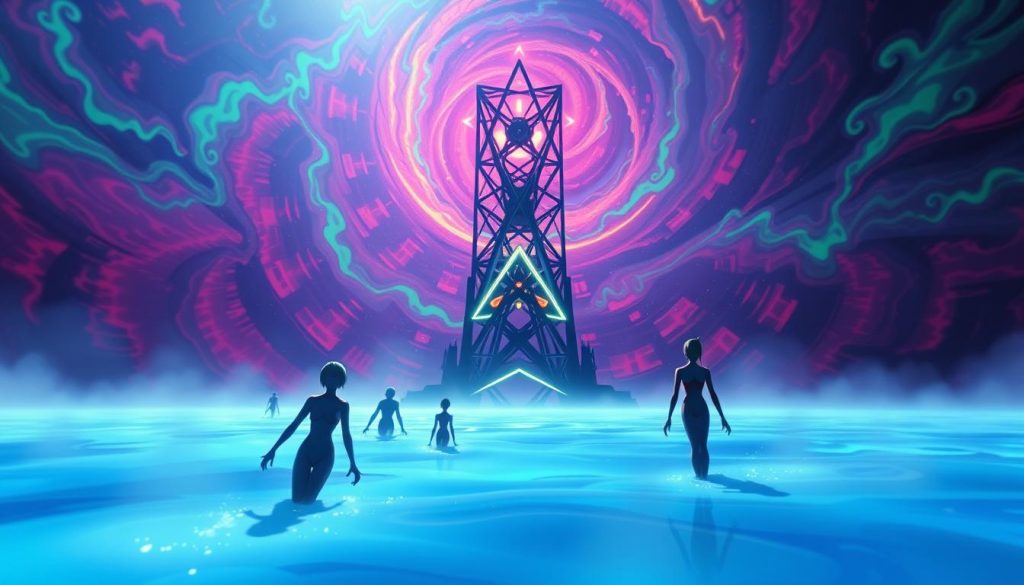
Neon Genesis Evangelion breaks new ground in anime storytelling with its mind-bending conclusion. The series challenges expectations, especially in its final episodes1. Its ending has sparked intense debates among fans and critics alike2.
The last episodes take a shocking turn, focusing on Shinji’s inner world. Director Hideaki Anno created a unique experience that stunned audiences1. This approach transformed the series from mecha anime to a deep psychological study.
The finale aired in early 1996, marking a pivotal moment in anime history1. It sparked controversy by prioritizing mental exploration over traditional plot progression. This bold move challenged viewers’ ideas about anime storytelling.
Key Takeaways
- Neon Genesis Evangelion defies traditional anime storytelling
- The series finale focuses on psychological exploration
- Director Hideaki Anno created a unique and controversial ending
- The finale challenges viewers’ understanding of narrative structure
- The series blends complex psychological themes with sci-fi elements
Neon Genesis Evangelion ending explained
Neon Genesis Evangelion’s finale is a deep psychological journey that breaks anime storytelling norms. It reveals a complex narrative exploring human consciousness and emotions. The series shifts from action-packed scenes to introspective psychological exploration in its final episodes.
Understanding the Human Instrumentality Project
The Human Instrumentality Project is the series’ central philosophical concept. It aims to unite humanity at a transcendental level. This experiment breaks down individual barriers and merges human consciousness.
Understanding Evangelion’s themes is key to grasping this radical concept of collective human experience.
- Unites all human consciousness
- Eliminates individual psychological boundaries
- Represents a radical approach to human connection
Psychological Breakdown in Episodes 25-26
The final two episodes break from traditional narrative structure. They focus on Shinji Ikari’s internal psychological landscape. These episodes use abstract imagery and unconventional animation techniques.
Evangelion’s symbolic ending unfolds through introspective scenes that challenge viewers’ expectations3.
Key Symbolic Elements in the Finale
The series ends with a powerful moment of self-acceptance. Shinji experiences a breakthrough where his friends congratulate him. This scene symbolizes personal growth and emotional liberation.
The ending reflects the series’ deeper exploration of mental health and human connection3.
“Thank you all” – Shinji’s final words, encapsulating his journey of self-discovery3.
The End of Evangelion Movie’s Alternative Perspective
The End of Evangelion offers a bold new take on the original series’ ending. It dives deep into Evangelion’s psychoanalytic themes4. The 1997 film runs for 1 hour and 47 minutes, showing the Third Impact and Instrumentality5.
The movie is split into two episodes, presenting a darker version of the series’ finale. It explores Evangelion’s big questions through a raw, visual approach6. Director Kazuya Tsurumaki crafted an unusual story, breaking from normal storytelling methods.
- Explores the psychological breakdown of characters
- Presents a more graphic representation of Instrumentality
- Challenges viewers’ interpretations of the original series
The film’s style is very different from the TV ending. Key symbolic elements appear through complex visual metaphors5. Shinji’s choice to reject Instrumentality represents human connection and growth.
| Aspect | TV Series Ending | Movie Ending |
|---|---|---|
| Narrative Style | Psychological introspection | Explicit apocalyptic events |
| Emotional Tone | Ambiguous resolution | Dark and confrontational |
| Character Focus | Internal psychological states | External traumatic experiences |
The final scene with Shinji and Asuka remains hotly debated. It has sparked years of fan theories and academic studies6.
By avoiding a typical ending, the film cements its place in anime history4. It continues to challenge and inspire viewers today.
The Production Context Behind Both Endings
Evangelion’s complex story reflects creator Hideaki Anno’s personal journey. His depression in the early ’90s shaped the anime’s psychological themes. The series became a raw exploration of mental health through Anno’s innovative storytelling7.
Production challenges directly impacted the final episodes. The series faced schedule delays and budget issues8. These led to unique creative choices, like reusing animation and developing an abstract narrative approach7.
Evangelion’s philosophical depth sparked extreme fan reactions. Anno received death threats after the controversial finale aired8. Viewers were shocked by the introspective and psychologically challenging conclusion6.
The production hurdles and Anno’s personal struggles merged to create a groundbreaking ending. It redefined anime storytelling with its unexpected approach. Decades later, Evangelion still sparks passionate discussions among fans7.
FAQ
What exactly happens in the Neon Genesis Evangelion ending?
The ending focuses on the Human Instrumentality Project. It merges all human souls into a collective consciousness. The final episodes explore Shinji Ikari’s inner world, blurring reality and internal experience.
Characters face their deepest fears and insecurities. The finale is surreal and minimalist. It challenges traditional storytelling methods in a unique way.
Why is the Evangelion ending so confusing?
Director Hideaki Anno’s personal struggles with depression influenced the complex ending. He wanted to explore deep psychological themes. The finale breaks from typical anime storytelling.
It focuses on characters’ inner psychological landscapes. Instead of a normal plot resolution, it uses metaphors and symbols.
What is the Human Instrumentality Project?
The Human Instrumentality Project is an apocalyptic scenario. It merges all human souls into one collective consciousness. This eliminates individual barriers and psychological isolation.
It aims to overcome human loneliness. By dissolving individual identities, it creates a unified human experience. Everyone can truly understand each other’s feelings.
How does The End of Evangelion differ from the TV series ending?
The TV series ending explores Shinji’s mind abstractly. The End of Evangelion shows apocalyptic events more explicitly. The movie provides a concrete narrative of Instrumentality.
It includes dramatic action sequences. The film offers a more literal interpretation of the series’ climax.
Why did Hideaki Anno create such a controversial ending?
Anno’s ending reflected his personal struggles. He faced depression, isolation, and existential questions. Production challenges and budget constraints also influenced the finale.
He used it for psychological self-exploration. The anime became a deep meditation on human connection. It explored self-acceptance and individual identity.
What do the final scenes symbolize?
The final scenes represent self-acceptance and human connection. They show the possibility of individual growth. The “congratulations” sequence and coral reef imagery are key symbols.
These scenes depict Shinji’s journey of self-understanding. He overcomes deep insecurities. Ultimately, he chooses to exist as an individual.
Was the ending planned from the beginning?
The ending evolved through Anno’s experiences and production challenges. Core themes were likely planned early on. The specific psychological deconstruction emerged later.
Anno’s mental health journey influenced the conclusion. Limited resources shaped the final episodes. This made the ending both a creative limitation and an artistic choice.
Source Links
- Neon Genesis Evangelion Explained: Ending Differences and Reasons – IGN – https://www.ign.com/articles/2019/06/28/evangelion-neon-genesis-ending-explained
- Every Neon Genesis Evangelion Ending Explained – https://screenrant.com/every-neon-genesis-evangelion-ending-explained-rebuild/
- The Neon Genesis Evangelion Ending, Explained – https://www.themarysue.com/the-neon-genesis-evangelion-ending-explained/
- Neon Genesis Evangelion’s Controversial Original Ending Isn’t Just Underrated, It’s Absolutely Perfect & I Couldn’t Imagine Changing It – https://screenrant.com/neon-genesis-evangelion-original-ending-underrated-absolutely-perfect/
- What Does The End of Evangelion’s Ending Mean? – https://www.cbr.com/end-of-evangelion-ending-meaning/
- Theory and Analysis:Final Scene in End of Evangelion – EvaWiki – An Evangelion Wiki – https://wiki.evageeks.org/Theory_and_Analysis:Final_Scene_in_End_of_Evangelion
- The Very, Very, Very Confusing End of ‘Neon Genesis Evangelion,’ Explained – https://www.thrillist.com/entertainment/nation/neon-genesis-evangelion-ending-explained-netflix
- Exploring Neon Genesis Evangelion’s Different Endings – https://www.thecompanion.app/neon-genesis-evangelion-endings/