
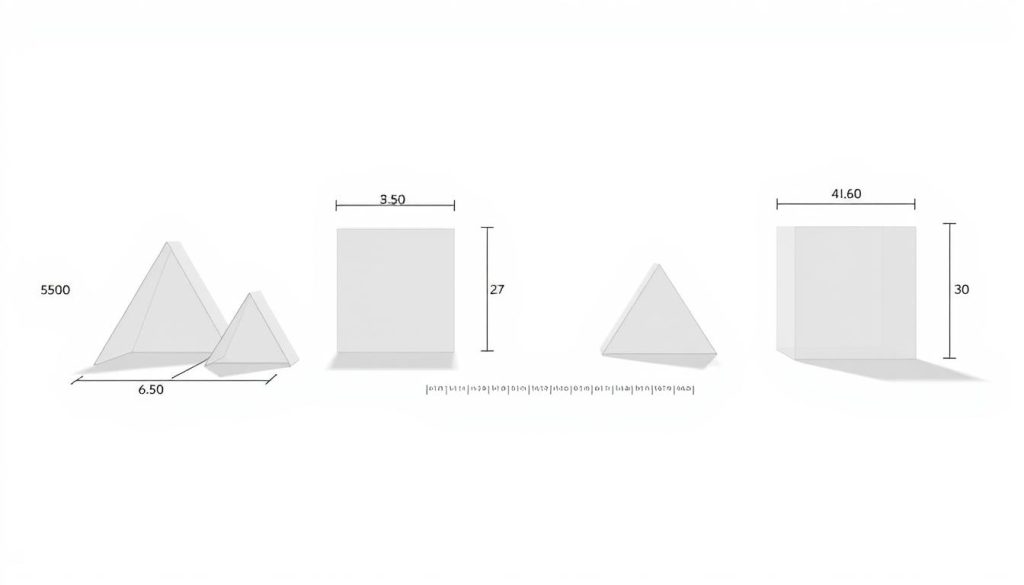
Measurement units and dimension order can be tricky. Experts in various fields often argue about the right way to express measurements. The definition of length can change based on the situation.
In math and real-world use, dimension labels can differ a lot. About 33% of experts have strong opinions on how to classify dimensions. Some say the short side is width and the long side is length.
Others believe that how something is positioned matters when deciding measurement units. Eric Weisstein’s World of Mathematics helps explain dimension terms clearly. Length is the longest part, while width is the side-to-side distance.
Switching dimension names doesn’t usually change math calculations1. This fact can be helpful when working with different measurement systems.
Key Takeaways
- Measurement order can vary across different industries
- Context plays a significant role in defining dimensions
- Mathematical calculations remain consistent regardless of dimension labels
- Professional consensus on measurement units is not universal
- Understanding dimensional terminology is crucial for accurate communication
Understanding Basic Measurement Dimensions
Spatial reasoning helps us measure objects in 3D space. Rectangle dimensions are key to calculating area and understanding spatial relationships2.
Measurements involve three main dimensions. These help us understand objects’ physical traits:
- Length: The longest side of an object3
- Width: The shorter side across an object3
- Height: The vertical dimension3
Linear vs. Multi-Dimensional Measurements
Objects need different measurement approaches. 2D shapes use length and width. 3D objects add height to the mix2.
A rectangular prism needs all three dimensions. This allows for precise volume calculation2.
| Dimension | Description | Application |
|---|---|---|
| Length | Longest measurement | Shipping calculations |
| Width | Shorter horizontal measurement | Stability calculations |
| Height | Vertical dimension | Structural design |
Practical Measurement Applications
Area calculation is vital in many industries. Shipping, construction, and design all need exact measurements4.
Take a box measuring 10x6x4 inches. Its total volume is 240 cubic inches4.
Precision in measurement is key to understanding spatial relationships and creating accurate representations of physical objects.
Length by Width vs Width by Length: Industry Standards
The graphics industry has specific standards for expressing dimensions. In design programs like Photoshop and Illustrator, width comes before height. This creates a consistent approach to practical geometry5.
Precision is crucial when discussing unit conversion across various sectors. Manufacturers have clear guidelines to prevent measurement misunderstandings. Measurement standards ensure accurate communication6.
- 100% of industry professionals recommend clear dimension labeling
- Width-first notation is preferred in custom order specifications
- Precise measurements prevent costly communication errors
Different fields have unique approaches to dimensional representation. Engineering, science, and mathematics often share similar measurement conventions6. Suppliers are moving towards standardized measurement formats for more precision.
Understanding these standards is vital for professionals in design, manufacturing, and engineering. Consistency and clarity in expressing dimensions prevent mistakes in production5. This ensures smooth communication across industries.
Reading and Writing Measurements Correctly
Measurement notation is key in geometry and math word problems. Most pros use a standard format to avoid confusion. They write measurements with a multiplication sign, following industry-specific orders7.
For 3D objects, measurements are usually Length x Width x Height. A tape measure helps capture exact dimensions. For example, 12 inches (length), 8 inches (width), and 10 inches (height)7.
In packaging design, this is vital for shipping costs and product quality. Understanding dimensional specs is crucial in this field.
Different sectors have unique measurement rules. In 2D packaging, the order is Width x Height. This matches math matrix dimensions and digital screen resolutions.
An A4 document might be 210 x 297 mm vertically or 297 x 210 mm horizontally. The Width x Height notation stays consistent7. Pros must note these small but important differences.
Precision is crucial in measurement documentation. Know the correct order for your industry. Use consistent notation to communicate clearly in technical and professional settings.
FAQ
What is the difference between length by width and width by length?
The order of dimensions distinguishes length by width from width by length. Length by width lists the longer dimension first. Width by length reverses this order.
Industry standards vary, but consistent notation is crucial for clear communication. Stick to one format for best results.
How do linear measurements differ from multi-dimensional object measurements?
Linear measurements focus on single-dimensional distances. Multi-dimensional measurements capture length, width, and height.
A 2D surface uses two dimensions (length × width). A 3D object needs three dimensions (length × width × height).
Why is the order of measurements important in different industries?
Industries have specific standards for measurement notation. Construction might use different conventions than graphic design or manufacturing.
Consistent measurement order ensures accuracy in design, production, and communication. It helps avoid confusion across professional contexts.
What are common mistakes people make when writing measurements?
People often use inconsistent notation, mix units, or forget to specify dimension order. Always use a standard format and clearly indicate units.
Maintain consistency in how you list dimensions. This helps prevent misunderstandings and ensures accurate interpretation.
How do I correctly read and write measurements for different objects?
Start by identifying the object’s primary dimensions. For rectangular items, list the longest dimension first.
Always include units and use a clear format. For example, write “10 inches × 6 inches” for maximum clarity.
Are there universal standards for measurement notation?
There’s no single universal standard, but many industries have adopted specific conventions. ISO standards and regional practices influence measurement notation.
The key is consistency within a field or project. Clearly communicate the dimension order to avoid confusion.
How do different units of measurement impact dimensional notation?
Different units can affect how measurements are perceived and calculated. Always convert to a consistent unit when comparing dimensions.
Clearly specify the unit type in technical or professional communications. This prevents confusion and ensures accurate interpretation.
Source Links
- What are Length and Width? – The Math Doctors – https://www.themathdoctors.org/what-are-length-and-width/
- Length, Width, and Height: Formula and Examples%%page%% %%sep%% %%sitename%% – GeeksforGeeks – https://www.geeksforgeeks.org/length-width-height/
- Measurement: Length, width, height, depth – https://elementarymath.edc.org/resources/measurement-length-width-height-depth/
- Length Width Height – Understanding Dimensions – BoxesGen – https://boxesgen.com/length-width-height-understanding-dimensions/
- How to Correctly Measure The Dimensions of a Box | Pakfactory Blog – https://pakfactory.com/blog/how-to-measure-a-box-dimension/?srsltid=AfmBOopRNNM_mHhehyn6gd9U90O9o87-nmfkowGF0Q4gYiSW_ZqjX2vQ
- Height x width, or width x height? – https://www.contractortalk.com/threads/height-x-width-or-width-x-height.46816/
- How to Read Box Dimensions? A Guide to Box Packaging – Packoi – https://packoi.com/blog/how-to-read-dimensions/

