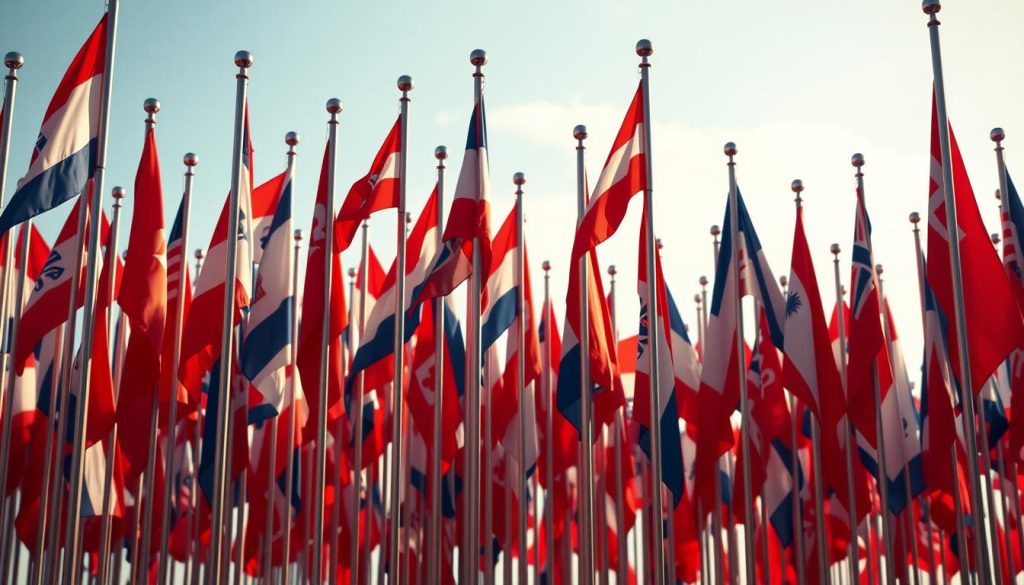
Red, white, and blue flags are instantly recognizable worldwide. These colors represent freedom, democracy, and national pride for many countries1. The tricolor design has become a powerful symbol of national identity.
These flags span continents, telling diverse cultural stories. Countries like the USA, UK, France, and Russia use these colors to show their heritage. The popularity of this color scheme shows its deep symbolic meaning globally.
From national to territorial banners, red, white, and blue flags catch the eye. They tell unique stories of struggle, independence, and unity. Each flag’s design carefully chosen to represent its country’s history.
Key Takeaways
- Red, white, and blue flags represent over 50 countries globally
- Colors symbolize freedom, democracy, and national identity
- Tricolor designs have deep historical and cultural significance
- Flag colors communicate complex national narratives
- International flags use color to express cultural pride
Understanding the Significance of Red, White, and Blue in National Flags
Tricolor flags have a rich history spanning centuries of global development. These colors represent powerful symbols of identity and shared values. Over two dozen countries use red, white, and blue as their primary flag colors.
The Netherlands, a maritime nation, played a key role in spreading these colors. Their seafaring influence shaped flag designs worldwide. Red, white, and blue were chosen for their durability as pigments in historical dye technology.
Symbolic Meanings Behind the Colors
Each color in tricolor flags carries deep symbolic significance:
- Red: Represents bravery and sacrifice2
- White: Symbolizes peace and purity2
- Blue: Signifies truth, tranquility, and connection to elements like water and sky2
The Dutch flag pioneered the tricolor design, initially using orange instead of red. This change happened because orange dye faded easily. It shows how practical issues can reshape national symbols.
The flag is more than just a piece of fabric—it’s a visual language that speaks volumes about a nation’s history and identity.
The red, white, and blue palette has become a powerful symbol. It represents national pride and historical change in many countries around the world.
Most Recognizable Red, White, and Blue National Flags
Famous flags often feature iconic red, white, and blue designs. These colors represent national identity and cultural significance in over 50 countries. They’ve become powerful symbols of pride and heritage.
- United States Flag: Featuring 13 stripes and 50 stars representing the original colonies and current states3
- United Kingdom’s Union Jack: A complex design with historical importance3
- French Tricolor: Representing liberty, equality, and fraternity
- Australian Flag: Incorporating the Union Jack and Southern Cross stars3
Red appears in almost 75% of national flags worldwide4. Blue often symbolizes loyalty and freedom. Together, these colors powerfully represent national spirit4.
Flag designs show how colors can tell complex national stories. Each design, from the stars and stripes to European patterns, tells a unique tale5.
Colors are more than visual elements – they are powerful symbols of national pride and historical journey.
Red, Yellow, Green Flags and Their Global Distribution
National flags display a vibrant mix of red, yellow, and green colors. These hues carry deep cultural meaning across various regions. They serve as powerful symbols of national identity6.
African nations embrace these colors in their flag color combinations. The Pan-African palette represents continental unity and historical struggle6.
Exploring Color Symbolism in National Flags
- Red often symbolizes courage and revolution
- Yellow typically represents wealth and prosperity
- Green frequently signifies hope and agricultural abundance
Green appears in 45.31% of national flags worldwide. This shows its importance in global flag design6.
Countries like Ethiopia, Mali, and Guinea prominently display these colors. Each nation interprets them through unique cultural lenses5.
Color and national identity create a rich tapestry of visual storytelling. Red, yellow, and green flags continue to inspire audiences globally6.
Conclusion
Flag symbolism reveals the deep link between national identity and cultural heritage. Flags are powerful visual symbols of a nation’s spirit. They showcase vibrant designs and hold nuanced meanings behind each color combination7.
Understanding these symbols goes beyond visual appreciation. It opens doors to global awareness and deeper cultural insights8.
Vexillology offers a unique view into national pride and historical struggles. Each flag tells a story through its colors and designs. These symbols reflect complex national narratives7.
Flags are living documents of human experience. They invite us to explore the rich tapestry of human culture. The red flags of history and vibrant national banners all hold significance8.
Our flag journey shows that national identity is complex and beautiful. It urges us to look past surface differences. We can appreciate the rich stories in each national emblem7.
As global citizens, we can keep exploring and learning. Let’s celebrate how humans express their spirit through these powerful symbols.
FAQ
Why are red, white, and blue such common colors in national flags?
Red, white, and blue gained popularity during the Age of Enlightenment. They symbolize powerful concepts like liberty, equality, and national identity. These colors represent democratic ideals and national pride across many countries.
Which are the most famous red, white, and blue flags in the world?
The United States flag, with its stars and stripes, is instantly recognizable. The United Kingdom’s Union Jack and France’s vertical tricolor are also well-known. These flags symbolize significant historical and cultural moments for their nations.
What is the historical origin of the red, white, and blue tricolor design?
The Dutch flag introduced the tricolor design in the late 16th century. It gained global fame during the French Revolution. The design represented a shift from monarchical traditions to democratic values.
This pattern quickly spread across Europe and then worldwide. It became a symbol of modern national identity for many countries.
How do red, yellow, and green flags differ from red, white, and blue flags?
Red, yellow, and green flags are common in African countries. They carry different cultural meanings than red, white, and blue flags. These colors typically represent regional independence, natural resources, and African cultural heritage.
What do the colors in national flags typically represent?
Flag colors often have deep symbolic meanings. Red can represent courage or revolution. White often symbolizes peace or purity. Blue might represent freedom or the sky.
Yellow can signify wealth or prosperity. Green frequently represents nature or hope. These meanings can vary across different cultures and historical contexts.
Source Links
- Flags That Look Alike | Britannica – https://www.britannica.com/list/flags-that-look-alike
- Why are so many country flags red, white and blue? – https://www.nbcwashington.com/news/national-international/why-are-so-many-country-flags-red-white-and-blue/3387665/
- Countries with Red, White, and Blue Flags 2024 – https://worldpopulationreview.com/country-rankings/countries-with-red-white-and-blue-flags
- Most & least used national flag colours | Harrison Flagpoles – https://flagpoles.co.uk/the-most-and-least-commonly-used-colours-in-national-flags/
- List of flags by color combination – https://en.wikipedia.org/wiki/List_of_flags_by_color_combination
- Statistics on flag colors – https://www.crwflags.com/fotw/flags/xf-csts.html
- Green, Yellow and Red flags – https://partners.imentor.org/help/green-yellow-and-red-flags
- Red Flags, Green Flags And Healthy Relationships – https://www.zellalife.com/blog/red-and-green-flag/