
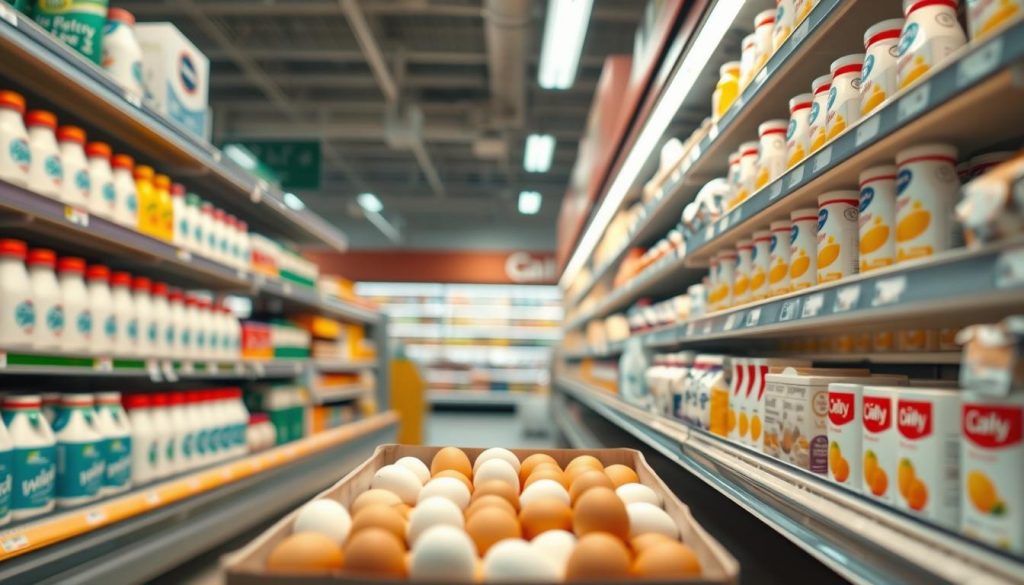
Ever wondered why eggs are next to milk and butter? It’s puzzling since eggs aren’t dairy. The USDA classifies eggs as poultry, which includes chickens and turkeys1.
Grocery stores put eggs in the dairy section for practical reasons. Farms used to sell milk and eggs together2. Both need refrigeration and are common household items2.
This setup makes shopping easier for people buying fresh, cold ingredients. Proper egg storage is vital for food safety. The USDA says to keep eggs at 40°F or below2.
Eggs can stay fresh for over a month when stored at 45°F or lower1. This cool temperature helps maintain their quality and safety.
Key Takeaways
- Eggs are classified as poultry, not dairy
- Grocery stores place eggs in the dairy section for convenience
- Eggs require specific refrigeration temperatures
- Fresh eggs can be stored safely for several weeks
- Historical farming practices influence modern store layouts
Understanding the Classification of Eggs
Eggs are part of the protein food group, not dairy. This often surprises shoppers. Learning about egg production and classification can help you make better choices.
Distinguishing Poultry from Dairy Products
The USDA clearly separates eggs from dairy products. Eggs come from chickens, while dairy comes from milk-producing animals like cows. They’re different food categories, despite being near each other in stores.
USDA Classification Standards
Eggs are graded based on quality and appearance. The USDA uses three main grades:
- Grade AA: Highest quality with thick, firm whites and round yolks3
- Grade A: Slightly lower quality but still excellent for most uses3
- Grade B: Acceptable for processed foods and baking3
Common Misconceptions About Eggs
Many people misunderstand egg farming and nutrition. Eggs are high in protein. A large hard-boiled egg has 6.3 grams of protein4.
A 2020 study found no major heart risks from eating eggs daily4. This challenges some common beliefs about eggs and health.
| Egg Characteristic | Nutritional Detail |
|---|---|
| Protein Content | 6.3 grams per large egg4 |
| Egg White Composition | 88% water4 |
| Choline in Egg Yolk | 147 mg4 |
Knowing these facts helps us understand the variety of eggs and farming practices. It shows how complex egg production really is.
Eggs in the Dairy Section: Strategic Store Placement
Grocery stores use smart product placement to boost sales. Eggs are put in the dairy section for a reason. This setup helps shoppers and benefits retailers5.
Eggs and milk are placed far from the entrance. This makes shoppers walk through many aisles. As a result, two-thirds of supermarket buys are unplanned65.
- Temperature control is crucial for egg safety
- Dairy sections provide optimal storage conditions
- Proximity to refrigeration helps maintain egg quality
Egg recipes and substitutes are important to many shoppers. The store layout considers different shopping needs. Fresh ingredients are easy to find7.
Eggs in the dairy section reveal grocery store marketing strategies. This placement improves the shopping experience. It also increases store revenue6.
The art of grocery store layout is a sophisticated dance of psychology and strategic marketing.
The Business Strategy Behind Product Placement
Grocery stores use smart strategies to boost sales and improve shopping experiences. They place products strategically to influence how customers shop. This is especially important for items like eggs and dairy that need specific temperatures.
Store layouts are designed to encourage more purchases. Shoppers are guided through aisles in a way that promotes buying. Egg safety and potential allergies are key factors in these layout designs.
Retailers put products where they’re easy to see and reach. The “strike zone” is the shelf space just below eye level. It’s the best spot for top-selling items. Brands spend a lot to get their products in these prime positions.
Data analytics now shape how products are placed in stores. Adjacency mapping is used to boost efficiency and impulse buys. Stores study how shoppers move to create layouts that increase sales.
Temperature control is crucial for perishable items. Eggs and dairy are often placed at eye level. This keeps them at the right temperature and easy for customers to see8910.
FAQ
Why are eggs placed in the dairy section of grocery stores?
Eggs share storage needs with dairy products. They need constant cold temperatures. Stores group them for efficiency and food safety.
This setup helps shoppers find cold items easily. It’s a smart way to keep perishables fresh.
Are eggs considered a dairy product?
Eggs are not dairy. They come from chickens, not milk-producing animals. The USDA classifies eggs as poultry products.
Dairy refers to milk-based items from cows, goats, or sheep. Eggs are a separate food group, packed with protein and nutrients.
Do eggs need to be refrigerated?
In the U.S., eggs must be refrigerated. Commercial washing removes their natural protective coating. Cold storage prevents bacteria growth and extends shelf life.
American eggs stay cold from farm to store. This practice maintains food safety standards for consumers.
How long can eggs be stored in the refrigerator?
Fresh, refrigerated eggs usually last 3-5 weeks after purchase. Always check the carton’s expiration date. Store eggs in their original container on an interior shelf.
Avoid placing eggs in the refrigerator door. Temperature changes there can affect egg quality.
What are some common egg substitutes?
For those with egg allergies or dietary needs, several substitutes exist. Mashed banana, applesauce, and ground flaxseed work well in recipes.
Chia seeds, commercial egg replacers, and silken tofu are also good options. These can bind ingredients or add moisture in cooking.
Are farm-fresh eggs different from store-bought eggs?
Farm-fresh eggs often have brighter yolks and may be more nutritious. They can come from chickens with varied diets and living conditions.
Store-bought eggs follow strict safety rules. They undergo careful screening to ensure quality and prevent contamination.
How can I tell if an egg is fresh?
Try the water test: place an egg in a bowl of water. Fresh eggs sink and lay flat. Older eggs stand up or float.
Check the Julian date on the carton. This number (1-365) shows when the eggs were packed.
Do different egg colors mean different nutritional values?
Egg color doesn’t affect nutrition. It’s determined by chicken breed. White-feathered hens lay white eggs, red-feathered hens lay brown eggs.
The nutritional content stays the same across egg colors. All eggs provide similar health benefits.
Source Links
- Wait … are eggs considered dairy? – https://www.today.com/food/groceries/are-eggs-dairy-rcna101097
- Are Eggs Dairy? – https://www.mentalfloss.com/are-eggs-dairy
- Shell Egg Grades and Standards – https://www.ams.usda.gov/grades-standards/shell-egg-grades-and-standards
- Are eggs dairy? Why people might think so – https://www.medicalnewstoday.com/articles/are-eggs-dairy
- Why Is Milk Always at the Back of the Grocery Store? – https://www.tasteofhome.com/article/the-real-reason-your-grocery-store-milk-gets-put-in-the-back/?srsltid=AfmBOoo-1mGU6GjXuVz66IF8HaA1PQpFiZ3Py4ERVwkgrf9XAyJX7jw8
- How Your Grocery Store’s Layout Is Costing You Money – https://www.realsimple.com/food-recipes/shopping-storing/food/grocery-store-layout
- How to safely store eggs and find alternatives amid rising prices – Farm and Dairy – https://www.farmanddairy.com/news/how-to-safely-store-eggs-and-find-alternatives-amid-rising-prices/859722.html
- The Sneaky Reason Eggs & Milk Are at the Back of the Grocery Store – https://www.eatingwell.com/why-eggs-and-milk-are-at-the-back-of-the-grocery-store-8675983
- Secrets Behind Supermarket Layouts: Psychology of Shopping Explained – Naperville Fresh Market – https://napervillefreshmarket.com/supermarket/secrets-behind-supermarket-layouts-psychology-of-shopping-explained/
- Product placement: The shelving strategy of supermarkets – ET BrandEquity – https://brandequity.economictimes.indiatimes.com/news/marketing/product-placement-the-shelving-strategy-of-supermarkets/101673658

