
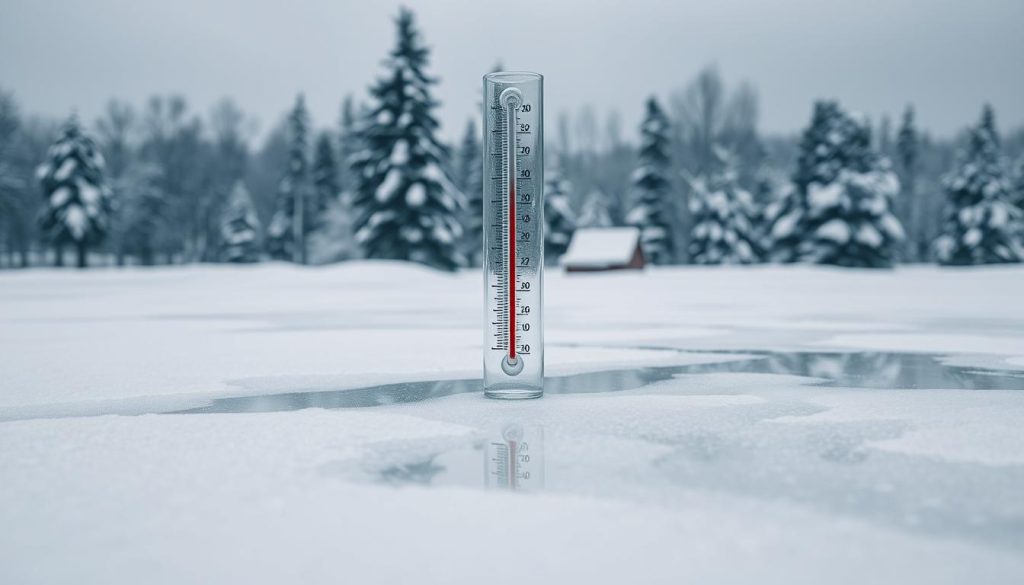
Daniel Gabriel Fahrenheit’s temperature scale has an intriguing scientific origin. He used unique reference points and innovative experiments to develop his scale1. The 32°F freezing point is more complex than most people realize2.
Fahrenheit didn’t start with water’s freezing point. He used an ice, water, and salt mixture as his lowest reproducible temperature1. He then applied math to Ole Romer’s measurements, reaching 32 degrees Fahrenheit1.
The 32°F freezing point is a carefully calculated part of Fahrenheit’s scale. It’s now standard in the U.S. for weather, cooking, and understanding temperatures2.
Key Takeaways
- 32°F represents the freezing point of water in the Fahrenheit scale
- The scale was developed through precise scientific calculations
- Fahrenheit’s method was not initially based on water’s freezing point
- The temperature scale reflects innovative 18th-century scientific thinking
- 32°F remains the standard freezing point in the United States
The Historical Development of the Fahrenheit Scale
Daniel Gabriel Fahrenheit transformed scientific temperature tracking in the early 18th century3. His groundbreaking work created a precise method for measuring temperature. This innovation influenced scientific understanding for generations4.
Fahrenheit’s original measurements were remarkably innovative for his time. He carefully selected key reference points to establish his temperature scales. These included:
- Zero point based on an ice-salt mixture temperature
- Initial body temperature marked at 90°F
- Freezing point of water set at 32°F
The Scientific Methodology
Fahrenheit’s scale development involved complex scientific reasoning. He multiplied his initial scale from 0 to 12 by eight3. This resulted in precise temperature points.
His liquid thermometer showed how liquids expand and contract with temperature changes3. The Fahrenheit to Celsius conversion is crucial for understanding temperature scales.
The conversion formula involves subtracting 32, multiplying by 5, and dividing by 95. This method helps translate between different temperature measurement systems.
| Temperature Scale | Freezing Point | Boiling Point |
|---|---|---|
| Fahrenheit | 32°F | 212°F |
| Celsius | 0°C | 100°C |
The United States still mainly uses the Fahrenheit scale35. This fact highlights the lasting impact of Fahrenheit’s temperature measurement system.
Understanding the Fahrenheit Freezing Point
The Fahrenheit scale offers a unique view on temperature. Water freezes at exactly 32°F, a key point for many uses. This matters in weather forecasting and cooking in the U.S.
At 32°F, water changes from liquid to solid. This moment is vital in thermodynamic understanding. The Fahrenheit scale splits the range between freezing and boiling into 180 degrees.
Most countries use Celsius, but the U.S. sticks with Fahrenheit. To convert, use this formula: °F = (9/5 × °C) + 32. This shows how different systems relate.
The 32°F freezing point has many real-world uses. Weather experts use it to predict patterns. Chefs rely on it for cooking times.
Engineers design temperature-sensitive gear with this point in mind. Understanding Fahrenheit helps us see how temperature affects our lives26.
FAQ
Who created the Fahrenheit temperature scale?
Daniel Gabriel Fahrenheit invented the Fahrenheit temperature scale in the early 1700s. He was a German-Dutch physicist and engineer. Fahrenheit’s system became widely used, especially in the United States.
Why is 32°F specifically chosen as the freezing point of water?
Fahrenheit chose 32°F as part of his method for creating a temperature scale. He based his measurements on three key points. These included a salt-ice mixture (0°F), body temperature (96°F), and water’s freezing point (32°F).
How does the Fahrenheit scale compare to Celsius?
In Fahrenheit, water freezes at 32°F and boils at 212°F. In Celsius, water freezes at 0°C and boils at 100°C. The conversion formula is: °F = (°C × 9/5) + 32.
This means that 32°F equals 0°C, the standard freezing point for water in both scales.
What makes the 32°F freezing point scientifically significant?
At 32°F, liquid water changes to solid ice. Water molecules slow down and form a crystal structure. This change is key in understanding thermodynamics, weather patterns, and many scientific processes.
How does understanding the 32°F freezing point help in everyday life?
Knowing the 32°F freezing point helps with daily activities. It’s useful for weather forecasts, winter driving, and food preservation. This knowledge helps people prepare for temperature-related challenges.
Are there any interesting historical facts about the development of the Fahrenheit scale?
Fahrenheit first used an ice-salt mixture as his zero point. He based his measurements on observable events. Over time, he made his scale more precise and standardized.
His original scale was designed to be more practical than earlier temperature measurement attempts.
Why do Americans still predominantly use the Fahrenheit scale?
The U.S. uses Fahrenheit due to historical momentum and cultural familiarity. Most of the world uses Celsius. The U.S. keeps Fahrenheit for everyday use, including weather reports and cooking.
This persistence is due to historical adoption and the cost of widespread conversion.
Source Links
- On the Fahrenheit scale, why is 32 freezing and 212 boiling? What do 0 and 100 mean? – https://www.straightdope.com/21342022/on-the-fahrenheit-scale-why-is-32-freezing-and-212-boiling-what-do-0-and-100-mean
- Fahrenheit – https://en.wikipedia.org/wiki/Fahrenheit
- Ask a Scientist: Why was the Fahrenheit system devised the way it has been, in a historic and logical sense? – https://www.utdailybeacon.com/opinion/ask-a-scientist-why-was-the-fahrenheit-system-devised-the-way-it-has-been-in/article_aef03bca-7858-11e7-a513-b774dcfc4bee.html
- Why Americans still use Fahrenheit long after everyone else switched to Celsius – https://www.vox.com/2015/2/16/8031177/america-fahrenheit
- PDF – https://www.earthdate.org/files/000/002/509/EarthDate_243_C.pdf
- What is the Freezing Point in Fahrenheit? – https://www.worldatlas.com/articles/what-is-the-freezing-point-in-fahrenheit.html

