
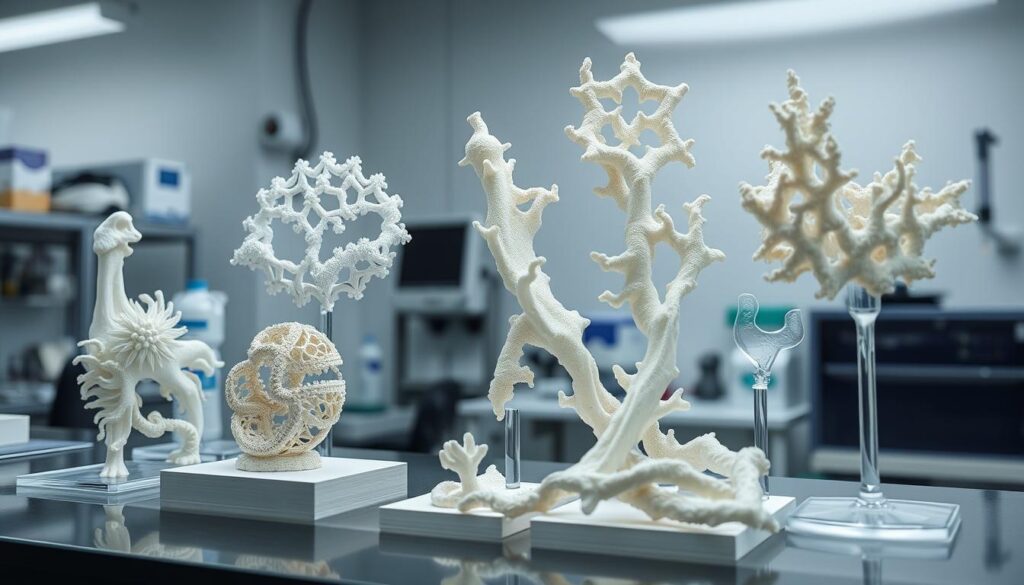
3D-printed tissue scaffolds are transforming bioengineering and medical innovation. These advanced structures are changing how doctors tackle complex healing issues1. Tissue engineering and regenerative medicine have seen amazing progress with new biofabrication tech.
Picture a tech that builds complex biological structures just for your body. 3D printing now lets researchers create custom tissue scaffolds with incredible accuracy1. Scientists use methods like stereolithography to design scaffolds that copy natural tissue shapes.
3D-printed tissue scaffolds do more than just traditional treatments. They’re changing practices in surgery simulation, implants, and custom prosthetics1. These scaffolds can be tweaked to boost tissue growth and healing.
By using special materials, the scaffolds help tissues integrate better. This opens up new ways to treat patients and improve their recovery.
Key Takeaways
- 3D printing enables precise tissue scaffold fabrication
- Advanced biofabrication supports personalized medical solutions
- Tissue scaffolds can be customized for specific medical needs
- Multiple clinical applications exist for 3D-printed scaffolds
- Biocompatible materials enhance tissue integration
Introduction to 3D-Printed Tissue Scaffolds
Tissue scaffolds are reshaping regenerative medicine. These 3D structures support cell growth and tissue formation. Additive manufacturing has revolutionized scaffold design, offering unmatched precision in bioengineering.
What are Tissue Scaffolds?
Tissue scaffolds are biocompatible structures that foster cell growth. They imitate the natural extracellular matrix, helping cells form functional tissues.
Key features of these scaffolds include precise architecture and controlled porosity. They also support cell infiltration and have customizable material properties.
- Precise spatial architecture
- Controlled porosity for nutrient transportation
- Support for cellular infiltration
- Customizable material properties
The Role of 3D Printing in Biomedicine
3D printing has changed how we develop scaffold materials. It allows for precise control over structural parameters2. Researchers can now create complex, patient-specific scaffolds with amazing accuracy.
Over 40 years, many biodegradable polymers have been created for tissue engineering2. These advancements have greatly expanded the possibilities in this field.
3D printing represents a paradigm shift in biomedical engineering, offering unprecedented capabilities in tissue scaffold design and production.
| Scaffold Characteristic | Importance in Tissue Engineering |
|---|---|
| Porosity | Enables nutrient transfer and cell migration |
| Material Composition | Determines biocompatibility and mechanical properties |
| Structural Geometry | Influences cell behavior and tissue formation |
3D-printed tissue scaffolds have vast potential in various clinical settings. They can be used in surgical simulation and implant production3. These innovative materials are set to transform personalized medical care.
Advantages of 3D-Printed Tissue Scaffolds
3D printing is revolutionizing tissue regeneration in healthcare. It offers new opportunities for personalized medicine. This technology is transforming tissue engineering and repair approaches4.
3D printing creates complex tissue scaffolds with incredible precision. It allows for patient-specific solutions that weren’t possible before. Researchers can now develop customized treatments for individual needs5.
Customization for Patient-Specific Needs
Medical treatments can now be tailored to your unique anatomy. 3D printing tech designs scaffolds that perfectly match individual needs.
- Precise geometric structures matching patient anatomy4
- Customized mechanical properties
- Personalized scaffold designs
Enhanced Biocompatibility and Integration
Advanced material selection is key to this tissue regeneration breakthrough. Biocompatible materials can be printed with cells and bioactive molecules. This creates scaffolds that blend seamlessly with existing tissues4.
| Printing Method | Key Advantages |
|---|---|
| Fused Deposition Modeling (FDM) | Wide range of biodegradable materials4 |
| Stereolithography (SLA) | High-resolution precise structures4 |
| 3D Plotting | Enables cell-seeded scaffolds4 |
Efficient Production and Cost-Effectiveness
3D printing cuts production time and costs for tissue scaffold manufacturing. You can expect cheaper and faster medical solutions. These solutions still maintain high-quality standards5.
“3D printing transforms personalized medicine by enabling patient-specific scaffold designs with unprecedented precision.” – Biomedical Engineering Research Team
These advanced technologies allow for truly personalized medical solutions. Such solutions were unthinkable just ten years ago45.
Applications in Regenerative Medicine
Regenerative medicine has transformed tissue repair and healing. 3D-printed tissue scaffolds offer innovative solutions for complex medical challenges. These advanced materials enable precise reconstruction of damaged tissues6.
Cartilage and Bone Regeneration
3D printing allows custom tissue engineering for bone and cartilage reconstruction. Researchers can design scaffolds that match patient-specific anatomical needs7.
The process enables precise geometric structures mimicking natural tissue. It also enhances cellular integration and improves mechanical properties.
- Precise geometric structures mimicking natural tissue
- Enhanced cellular integration
- Improved mechanical properties
Skin Repair and Wound Healing
Tissue engineering has advanced skin regeneration significantly. 3D-printed scaffolds create complex skin structures that promote faster healing and reduce scarring8.
Key benefits include customized wound coverage and accelerated tissue regeneration. These scaffolds also help reduce infection risks.
- Customized wound coverage
- Accelerated tissue regeneration
- Reduced infection risks
Vascular Tissue Engineering
Creating functional blood vessels is a critical challenge in regenerative medicine. 3D printing offers new ways to create intricate vascular networks. These networks support complex tissue reconstruction6.
| Tissue Type | 3D Printing Potential | Clinical Significance |
|---|---|---|
| Cartilage | High-precision scaffold design | Joint reconstruction |
| Bone | Custom geometric structures | Trauma repair |
| Skin | Multilayered tissue printing | Wound healing |
| Vascular | Complex network generation | Circulatory system restoration |
The future of regenerative medicine lies in our ability to create personalized, living tissue solutions that adapt to individual patient needs.
Materials Used in 3D Printing for Scaffolds
Biofabrication relies on carefully selected scaffold materials for innovative tissue engineering solutions. Additive manufacturing has revolutionized the creation of complex biological structures. It offers precision and customization in crafting these intricate designs9.
Biodegradable Polymers in Tissue Engineering
Synthetic biodegradable polymers are crucial in developing tissue scaffolds. Poly-l-lactide (PLLA) and polylactide-co-glycolide (PLGA) stand out in creating advanced tissue engineering constructs10.
These materials offer controlled degradation rates and excellent biocompatibility. They also provide customizable mechanical properties to suit various applications.
- Controlled degradation rates
- Excellent biocompatibility
- Customizable mechanical properties
Natural Hydrogel Materials
Hydrogel materials offer exceptional versatility in scaffold design. They mimic natural tissue environments, supporting cell growth and differentiation9.
Nanomaterials within these hydrogels boost cell adhesion and proliferation rates9. This combination creates an ideal environment for tissue development.
Metal and Ceramic Composites
Advanced tissue engineering uses metal and ceramic composites for robust structural support. These materials excel in hard tissue applications, offering numerous benefits.
- High mechanical strength
- Precise structural control
- Improved biological integration
| Material Type | Key Characteristics | Primary Applications |
|---|---|---|
| Biodegradable Polymers | Controlled degradation | Soft tissue scaffolds |
| Hydrogels | Cell-friendly environment | Regenerative medicine |
| Metal Composites | High mechanical strength | Bone and cartilage reconstruction |
The future of tissue engineering lies in our ability to precisely engineer materials that seamlessly integrate with human biology.
Researchers continue to push the boundaries of regenerative medicine. They do this by carefully selecting and combining innovative scaffold materials9.
Design Considerations for Tissue Scaffolds
Tissue scaffolds are crucial in tissue engineering. Their success depends on key factors that impact performance in regenerative medicine. Careful planning and precision are essential for effective scaffold design.
Researchers must consider crucial design elements for scaffold materials. These elements determine how well the scaffold supports tissue regeneration. Effective design is key to successful biofabrication.
Porosity and Mechanical Properties
Porosity is fundamental in tissue scaffold design. The ideal scaffold needs a carefully engineered pore structure. This structure should enable efficient nutrient transport and cell growth.
- Efficient nutrient transportation
- Cellular attachment and proliferation
- Optimal mechanical strength
Bone tissue replacement requires about 90% porosity. Pore sizes between 0.2-0.35 mm optimize cell growth11. Stretch-dominated lattice structures offer higher elastic modulus at lower densities12.
Surface Topography
Surface characteristics are vital in tissue engineering. The scaffold’s surface topography affects several important factors:
- Cell recruitment
- Tissue integration
- Potential anti-inflammatory responses
Scaffolding Geometry and Structure
The overall geometry must mimic natural extracellular matrix. Advanced 3D printing now allows for complex beam-based lattices. These lattices can have precisely tailored structures12.
Precision in scaffold design can transform regenerative medicine approaches.
Careful consideration of design elements is crucial. It helps tissue engineers develop effective scaffold materials. These materials can better support tissue regeneration and improve patient outcomes.
Challenges in 3D-Printed Tissue Scaffolds
Regenerative medicine is advancing tissue engineering rapidly. However, 3D-printed tissue scaffolds face major obstacles. Researchers are working hard to solve these complex issues.
Biocompatibility and Immune Response
3D-printed scaffolds must be safe for the body. Scientists need to prevent adverse immune reactions. Minimizing inflammatory responses is crucial in tissue engineering13.
- Reducing potential immune rejection
- Designing materials that mimic natural tissue
- Developing surface modifications to improve integration
Scale-Up from Lab to Clinic
Moving from research to real treatments is tough. This process involves many complex steps. Large tissue repairs often fail, showing the need for better solutions14.
The ultimate goal is to create tissue scaffolds that seamlessly integrate with patient-specific needs.
Long-Term Stability and Functionality
Long-term performance of 3D-printed scaffolds is vital. Scientists must solve issues with material breakdown, structure, and cell survival15.
- Developing more stable biomaterials
- Improving printing technologies
- Enhancing cellular integration
Overcoming these challenges will shape the future of biomedical applications. It will push the limits of tissue engineering and regenerative medicine.
Advances in 3D Printing Technologies
3D printing is changing healthcare through biofabrication. It’s revolutionizing tissue engineering and regenerative medicine. These innovations are reshaping how medical professionals approach patient care16.
Stereolithography and Selective Laser Sintering
Stereolithography (SLA) and selective laser sintering (SLS) are cutting-edge 3D printing techniques. SLA uses photopolymerization for detailed prints. SLS uses lasers to fuse powdered materials precisely16.
- High-resolution print capabilities
- Precise material fusion techniques
- Advanced digital manufacturing processes
Bioink Innovations
New bioinks have improved cell viability during printing. Researchers are creating materials that maintain cellular integrity. These materials help in forming complex tissue structures16.
“The future of tissue engineering lies in our ability to create living, functional structures through innovative printing technologies.”
Multi-material and Hybrid Printing Techniques
Multi-material printing creates intricate scaffolds with varying properties. These methods develop complex tissue engineering solutions. They can mimic natural biological structures effectively17.
| Printing Technique | Key Advantages |
|---|---|
| Stereolithography | High-precision printing |
| Selective Laser Sintering | Material versatility |
| Hybrid Printing | Complex structural design |
3D printing technologies keep evolving rapidly. They offer unmatched precision in tissue engineering. These advances promise to transform regenerative medicine significantly16.
Regulatory Landscape and Standards
3D printing in healthcare requires understanding complex regulations. Regulatory bodies have developed guidelines for innovative medical devices. These guidelines are crucial for regenerative medicine technologies.
FDA Guidelines for 3D-Printed Medical Devices
The FDA tackles unique challenges of 3D-printed medical devices. These devices are a breakthrough in personalized medical technologies. They need special evaluation protocols.
- Personalized product design and manufacturing
- Precise microstructure fabrication
- Rapid development cycles
International Regulatory Considerations
Global agencies are working on unified standards for 3D-printed medical innovations. The European Medicines Agency (EMA) and Pharmaceuticals and Medical Devices Agency are key players. They aim to create comprehensive evaluation frameworks.
| Regulatory Body | Key Focus Areas |
|---|---|
| FDA | Device safety and performance |
| EMA | Cross-border medical device standardization |
| PMDA | Advanced medical technology assessment |
Challenges in Standardization
The main regulatory challenge is addressing personalization and decentralization in 3D-printed medical devices. Authorities must create flexible yet strict standards. These standards should accommodate innovative manufacturing approaches.
The future of medical device regulation demands adaptive and forward-thinking frameworks that can keep pace with technological innovation.
Clear guidelines are vital for 3D printing in healthcare. They ensure patient safety and promote technological progress. Successful integration depends on these comprehensive guidelines181920.
Future Trends in 3D-Printed Tissue Scaffolds
Biofabrication is evolving rapidly, pushing tissue engineering and personalized medicine boundaries. Cutting-edge technologies are transforming regenerative medical solutions through advanced 3D printing techniques. These innovations promise groundbreaking treatments for various health conditions.
Integration with Bioprinting
Bioprinting technologies are revolutionizing tissue engineering by enabling more sophisticated scaffold designs. Researchers are developing innovative methods that combine multiple printing techniques. These advancements create complex tissue constructs with unprecedented precision15.
The latest developments include:
- Simultaneous production of extrusion-based and electrospun bioinks15
- Advanced printing methods with resolutions ranging from 10 to 200 μm15
- Incorporation of diverse materials like polycaprolactone and hydrogels15
Personalized Medicine and Tissue Engineering
The future of personalized medicine lies in creating patient-specific tissue scaffolds. Customized tissue engineering allows for more targeted treatments, addressing individual patient needs21. This approach promises better outcomes and faster recovery times.
Researchers are exploring:
- Computer-aided scaffold design systems
- Functionally graded scaffold properties
- Advanced biomaterial selection
Sustainable Practices in Materials
Sustainability is becoming crucial in tissue engineering. Researchers are developing biodegradable and recyclable polymers that minimize environmental impact22. These materials offer both medical benefits and ecological responsibility.
Emerging trends include:
- Water-soluble and biodegradable polymer research
- Innovative hydrogel materials for medical applications
- Environmentally conscious manufacturing processes
As technology advances, the potential for creating complex, functional tissue constructs continues to expand. These breakthroughs promise innovative solutions in regenerative medicine21. The future of 3D-printed tissue scaffolds looks bright and full of possibilities.
Conclusion: The Future of 3D-Printed Tissue Scaffolds
3D-printed tissue scaffolds are changing regenerative medicine. They offer solutions to critical medical issues. About 31 million Americans have body defects, making tissue engineering vital23.
Tissue engineering innovations are improving patient care. Custom tissue scaffolds treat complex medical conditions24. Researchers have made living tissues like skin, bones, and cartilage using 3D bioprinting24.
Personalized medical treatments may become standard. 3D printing can lower surgical risks and improve outcomes25. Future scaffolding systems may replicate human bio-tissues better25.
Challenges remain in scalability and long-term use. Yet, 3D-printed tissue scaffolds show promise. On average, 13 people die daily waiting for organ transplants23.
Advancements on the Horizon
Regenerative medicine keeps evolving. Stem cell integration and bioprinting techniques will improve. These methods will address complex medical needs more effectively.
Impact on Patient Care and Outcomes
3D-printed tissue scaffolds promise better personalized medicine. They may offer targeted, patient-specific treatments. This could lead to faster recovery times and better healthcare outcomes.
FAQ
What are 3D-printed tissue scaffolds?
3D-printed tissue scaffolds are structures that support cell growth and tissue formation. They mimic natural tissue using advanced 3D printing tech. These scaffolds have precise porosity and properties to help cells grow and tissues regenerate.
How do 3D-printed tissue scaffolds differ from traditional fabrication methods?
3D-printed scaffolds offer more precision in creating custom structures than traditional methods. They allow for patient-specific designs and better biocompatibility. These scaffolds can create complex shapes that closely match natural tissue structures.
What materials are used in 3D-printed tissue scaffolds?
Various materials are used, including biodegradable polymers and natural hydrogel materials. Metal and ceramic composites are also options. The choice depends on the specific tissue need.
For example, metals and ceramics work well for hard tissue engineering. Hydrogels are better for soft tissue applications.
What are the main applications of 3D-printed tissue scaffolds?
These scaffolds have many uses in regenerative medicine. They help with cartilage and bone growth, skin repair, and wound healing. They’re also used in vascular tissue engineering.
Medical uses include jaw reconstructions and hip and knee joint replacements. They can even create aortic valve tissue.
What challenges do 3D-printed tissue scaffolds face?
Key challenges include ensuring biocompatibility and minimizing immune responses. Scaling up production from lab to clinic is also tough. Maintaining long-term stability and keeping cells alive during printing are other hurdles.
How are 3D-printed tissue scaffolds regulated?
The FDA has guidelines for 3D-printed medical devices. These focus on design, manufacturing, and testing. International standards are being developed to ensure safety and effectiveness.
Approved biomaterials must comply with Good Manufacturing Practice standards.
What are the future trends in 3D-printed tissue scaffolds?
Future trends include combining with bioprinting and advancing personalized medicine. Developing more eco-friendly materials is also a focus. Creating complex, functional tissue constructs is another goal.
The ultimate aim is to produce transplantable organs with advanced design and function.
How precise can 3D printing be for tissue scaffolds?
3D printing allows for extreme precision on millimeter or nanometer scales. This enables creation of scaffolds with highly controlled spatial parameters. It offers precise control over porosity and structure to match specific tissue needs.
Source Links
- Surface Functionalization of 3D-Printed Bio-Inspired Scaffolds for Biomedical Applications: A Review – https://pmc.ncbi.nlm.nih.gov/articles/PMC11592212/
- 3D Printing of Scaffolds for Tissue Engineering – https://www.intechopen.com/chapters/61731
- Beyond hype: unveiling the Real challenges in clinical translation of 3D printed bone scaffolds and the fresh prospects of bioprinted organoids – Journal of Nanobiotechnology – https://jnanobiotechnology.biomedcentral.com/articles/10.1186/s12951-024-02759-z
- Frontiers | Toward Biomimetic Scaffolds for Tissue Engineering: 3D Printing Techniques in Regenerative Medicine – https://www.frontiersin.org/journals/bioengineering-and-biotechnology/articles/10.3389/fbioe.2020.586406/full
- 3D Printing of Scaffolds for Tissue Regeneration Applications – https://pmc.ncbi.nlm.nih.gov/articles/PMC4597933/
- Applications of 3D Bioprinting in Tissue Engineering and Regenerative Medicine – https://pmc.ncbi.nlm.nih.gov/articles/PMC8584432/
- 3D Printing in Regenerative Medicine: Technologies and Resources Utilized – https://www.mdpi.com/1422-0067/23/23/14621
- 3D-printed scaffolds for tissue engineering applications using thermosensitive hydrogels based on biopolymer blends – Journal of Materials Science – https://link.springer.com/article/10.1007/s10853-024-09707-0
- Frontiers | 3D Bioprinted Scaffolds for Tissue Repair and Regeneration – https://www.frontiersin.org/journals/materials/articles/10.3389/fmats.2022.925321/full
- 3D Printing for Tissue Engineering – https://pmc.ncbi.nlm.nih.gov/articles/PMC4746729/
- Designing of PLA scaffolds for bone tissue replacement fabricated by ordinary commercial 3D printer – Journal of Biological Engineering – https://jbioleng.biomedcentral.com/articles/10.1186/s13036-017-0074-3
- Integrated Design Approaches for 3D Printed Tissue Scaffolds: Review and Outlook – https://pmc.ncbi.nlm.nih.gov/articles/PMC6695904/
- Challenges on optimization of 3D-printed bone scaffolds – BioMedical Engineering OnLine – https://biomedical-engineering-online.biomedcentral.com/articles/10.1186/s12938-020-00810-2
- Intelligent Vascularized 3D/4D/5D/6D-Printed Tissue Scaffolds – Nano-Micro Letters – https://link.springer.com/article/10.1007/s40820-023-01187-2
- Addressing present pitfalls in 3D printing for tissue engineering to enhance future potential – https://pmc.ncbi.nlm.nih.gov/articles/PMC7010521/
- Advances in 3D Printing for Tissue Engineering – https://pmc.ncbi.nlm.nih.gov/articles/PMC8226963/
- Frontiers | Advances in 3D printing technology for preparing bone tissue engineering scaffolds from biodegradable materials – https://www.frontiersin.org/journals/bioengineering-and-biotechnology/articles/10.3389/fbioe.2024.1483547/full
- Balancing the customization and standardization: exploration and layout surrounding the regulation of the growing field of 3D-printed medical devices in China – Bio-Design and Manufacturing – https://link.springer.com/article/10.1007/s42242-022-00187-2
- PDF – https://ijrpr.com/uploads/V5ISSUE6/IJRPR30620.pdf
- 3D Bioprinting Regulations: a UK/EU Perspective | European Journal of Risk Regulation | Cambridge Core – https://www.cambridge.org/core/journals/european-journal-of-risk-regulation/article/3d-bioprinting-regulations-a-ukeu-perspective/ADC91ED03B04BDA7FBDF06BBCE5CD2B2
- Design and 3D Printing of Scaffolds and Tissues – https://www.engineering.org.cn/engi/EN/10.15302/J-ENG-2015061
- 3D and 4D printing of biomedical materials: current trends, challenges, and future outlook – https://www.explorationpub.com/Journals/em/Article/1001203
- Advances in 3D Printing for Tissue Engineering – https://www.mdpi.com/1996-1944/14/12/3149
- Recent Advances in Biomaterials for 3D Printing and Tissue Engineering – https://pmc.ncbi.nlm.nih.gov/articles/PMC5872108/
- The Future of 3D Printing and Tissue Engineering – NHSJS – https://nhsjs.com/2024/the-future-of-3d-printing-and-tissue-engineering/

