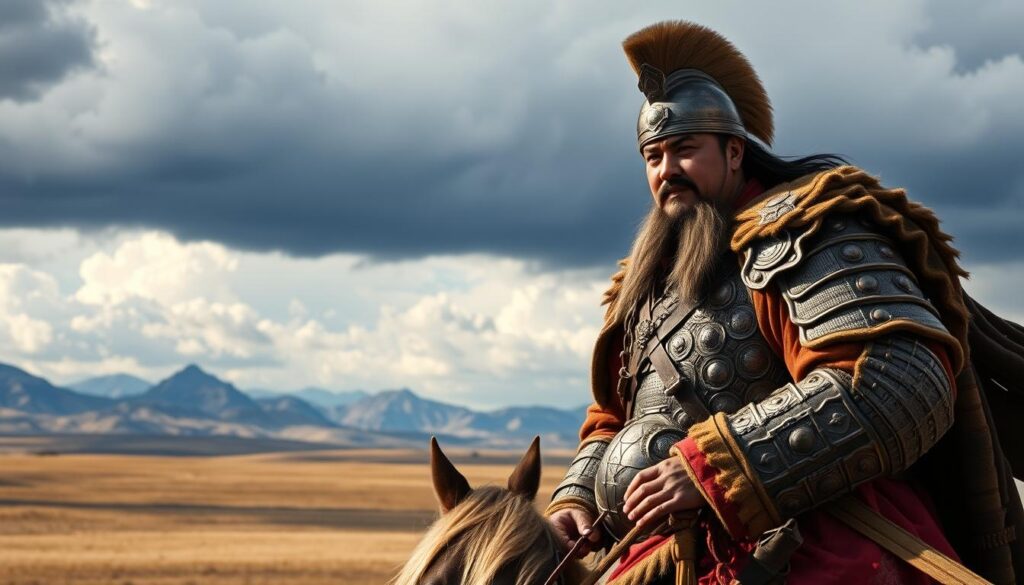
Genghis Khan, the founder of the Mongolian Empire, was born around 1162 near the border of modern Mongolia and Siberia. His birth name was Temüjin1. He came from the Borjigin clan and faced early hardships, including his father’s death and being abandoned by his clan. As the Khagan of the Mongol Empire, Genghis Khan’s life was marked by significant events that shaped his character and the empire he founded. The Mongolian Empire, under his leadership, expanded rapidly, covering a vast territory.
Imagine being a young boy, born in a time of constant tribal conflicts, and rising to become one of history’s most influential figures – this was the life of Temüjin, later known as Genghis Khan. The harsh environment of the Mongolian steppes played a significant role in shaping his early life and the circumstances that led him to become the founder of the largest contiguous empire in history. Genghis Khan’s military conquests transformed the Mongols into a world power, with campaigns against various kingdoms2.
Genghis Khan’s legacy extends beyond his military conquests, as he also embraced religious diversity and passed laws declaring religious freedom for all in his conquered territories1. His impact on world history is felt today, with the Mongolian Empire remaining one of the most fascinating and complex empires in human history. As we explore the life and times of Genghis Khan, we will look at the factors that contributed to his success and the lasting legacy of the Mongolian Empire.
Key Takeaways
- Genghis Khan was born around 1162 and founded the Mongolian Empire, which became the largest contiguous empire in history.
- He faced early hardships, including his father’s death and abandonment by his clan, but rose to become a powerful leader.
- Genghis Khan’s military conquests transformed the Mongols into a world power, with campaigns against various kingdoms.
- He embraced religious diversity and passed laws declaring religious freedom for all in his conquered territories.
- The Mongolian Empire, under his leadership, expanded rapidly, covering a vast territory of over 11 million square miles1.
- Genghis Khan’s legacy extends beyond his military conquests, with a lasting impact on world history and the modern world.
The Early Life of Genghis Khan
Genghis Khan, born Temüjin around 1162 near the modern Mongolia and Siberia border3, was born into the vast steppes of Mongolia. His birth into the royal Borjigin clan marked the start of a life filled with both privilege and hardship.
Birth and Origins
Temüjin’s family had a noble background, but his father’s early death left them poor4. He grew up in a time of turmoil, learning the value of resilience and power.
Early Struggles
Temüjin faced many challenges, including being enslaved and his wife, Börte, being kidnapped. These hardships shaped his determination and strategic thinking, essential for a leader.
Rise to Power
Temüjin formed alliances and showed great leadership, earning a loyal following. By 1206, he united the Mongol tribes, becoming Genghis Khan and starting the Mongol Conquests5.
| Year | Event |
|---|---|
| 1162 | Birth of Temüjin near Lake Baikal4 |
| 1178 | Marriage to Börte3 |
| 1206 | Adopts the title “Genghis Khan”5 |
| 1227 | Death of Genghis Khan4 |
The Conquests of Genghis Khan
Genghis Khan led the Mongol Empire to grow fast across Asia and Europe. His new ways of fighting and never-ending push to expand were key to the empire’s huge size.
Military Strategies
Genghis Khan changed war with fast cavalry and the “feigned retreat” trick. These tactics helped the Mongol Warrior beat bigger armies and win big battles.
- Rapid cavalry movements for swift attacks
- Feigned retreats to draw enemies into traps
- Superior communication systems within the army
Key Battles and Campaigns
He first attacked the Xi Xia kingdom, then the Jin Dynasty in China. In 1209, he invaded to solve a trade problem with the Tanguts, starting his big push6.
By 1215, he took Beijing, showing his power6. The fight against the Khwarezm Empire in 1219 was sparked by the killing of his messengers, leading to big wins6.
The Formation of the Mongol Empire
Genghis Khan united many tribes and lands, making a huge empire from Japan to the Caspian Sea. This vast area helped trade and culture spread across Eurasia7. His skill in keeping power and control over new lands showed his great leadership as a Mongol Leader.
| Battle/Campaign | Year | Outcome |
|---|---|---|
| Invasion of Xi Xia | 1209 | Resolution of trade disputes, initial expansion |
| Campaign against Jin Dynasty | 1215 | Seizure of Beijing, increased territorial control |
| Invasion of Khwarezm Empire | 1219 | Devastating conflict, significant territorial gains |
The Mongol Empire lasted from 1206 to 1368. It covered modern-day Mongolia, China, and more, showing Genghis Khan’s huge impact7.
Legacy and Impact of Genghis Khan
Genghis Khan’s influence goes beyond his lifetime. He shaped history with the vast Mongolian Empire he built.
The Mongol Empire helped in big cultural and economic exchanges across continents.
Cultural Exchange and Development
The Mongol Empire was the biggest ever, covering from the Pacific Ocean to modern-day Hungary8. This huge area allowed for amazing cultural exchanges and the sharing of scientific knowledge across Eurasia8. The Pax Mongolica period brought stability, making trade and ideas flow along the Silk Road, blending Eastern and Western traditions.
Views on Genghis Khan vary a lot.
Historical Perspectives
Many remember Genghis Khan for his brutal conquests. Yet, his role as the Khagan of the Mongol Empire shows his skill in uniting diverse cultures and managing a huge empire well9. He turned the Mongols from nomadic tribes into rulers of cities and states, using systems from conquered lands8.
Today, Genghis Khan is viewed differently around the world.
Modern Interpretations of Genghis Khan
In Mongolia, he is seen as a national hero. His legacy includes a big genetic impact, with studies showing many in former Mongol territories might be his descendants9. Modern views also focus on his administrative innovations and the lasting effect of the Mongolian Empire on world history8.
FAQ
Who was Genghis Khan and what is his significance in history?
A: Genghis Khan, born Temüjin, was the founder of the Mongol Empire. He united Mongolian tribes and created the largest empire in history. His leadership and military skills have greatly influenced the world for centuries.
What were the early challenges faced by Temüjin before becoming Genghis Khan?
Temüjin faced many hardships, like tribal conflicts and slavery. These struggles made him strong and strategic. His ability to overcome these challenges helped him unite the Mongol tribes.
How did Genghis Khan unify the Mongol tribes?
Genghis Khan united the tribes through alliances, military campaigns, and leadership. He promoted loyalty and introduced laws that strengthened his rule. His leadership made the Mongol army strong and united.
What were the key military strategies used by Genghis Khan during the Mongol Conquests?
Genghis Khan used mobile cavalry, feigned retreats, and psychological warfare. His tactics allowed the Mongols to defeat larger forces. This helped the Mongol Empire expand quickly.
What social and administrative reforms did Genghis Khan implement in the Mongol Empire?
Genghis Khan introduced reforms like merit-based leadership and religious tolerance. He also created a unified legal code, the Yassa. These reforms promoted unity and stability in the empire.
How did the Mongol Empire impact cultural exchange and trade across Eurasia?
The Mongol Empire under Genghis Khan led to a period of cultural exchange and trade. The Pax Mongolica allowed the Silk Road to flourish. This transfer of goods and ideas greatly influenced civilizations along these routes.
What is the legacy of Genghis Khan in modern Mongolia and beyond?
In modern Mongolia, Genghis Khan is seen as a national hero. His legacy extends globally, influencing military strategies and genetics. His life continues to fascinate people, showing the complex nature of his impact.
How is Genghis Khan portrayed in different historical perspectives?
Views on Genghis Khan vary. Some see him as a ruthless conqueror, while others view him as a visionary leader. These views reflect the complex nature of his legacy and the diverse impacts of his reign.
What were the major campaigns and battles led by Genghis Khan?
Genghis Khan led campaigns against the Xi Xia kingdom, the Jin Dynasty, and the Khwarezm Empire. His military genius and the Mongol army’s strength greatly expanded the empire.
What is the importance of Genghis Khan’s biography in understanding his leadership?
The Genghis Khan Biography offers insights into his personal struggles and leadership. It helps understand his decisions and the lasting legacy of the Mongol Empire.
How did Genghis Khan influence modern military tactics?
Genghis Khan’s military innovations, like mobile cavalry and feigned retreats, are studied today. His emphasis on speed and psychological warfare has influenced modern warfare.
Source Links
- https://www.history.com/news/10-things-you-may-not-know-about-genghis-khan – 10 Things You May Not Know About Genghis Khan | HISTORY
- https://www.britannica.com/biography/Genghis-Khan/Rise-to-power – Genghis Khan – Mongol Empire, Conqueror, Warrior | Britannica
- https://www.history.com/topics/asian-history/genghis-khan – Genghis Khan ‑ Descendants, Empire & Facts | HISTORY
- https://www.britannica.com/biography/Genghis-Khan – Genghis Khan | Biography, Conquests, Achievements, & Facts | Britannica
- https://en.wikipedia.org/wiki/Genghis_Khan – Genghis Khan
- https://afe.easia.columbia.edu/mongols/conquests/conquests_2c.htm – Mongols in World History | Asia for Educators
- https://en.wikipedia.org/wiki/Mongol_invasions_and_conquests – Mongol invasions and conquests
- https://www.metmuseum.org/toah/hd/khan1/hd_khan1.htm – The Legacy of Genghis Khan | Essay | The Metropolitan Museum of Art | Heilbrunn Timeline of Art History
- https://www.britannica.com/biography/Genghis-Khan/Legacy – Genghis Khan – Mongol Empire, Conquests, Legacy | Britannica