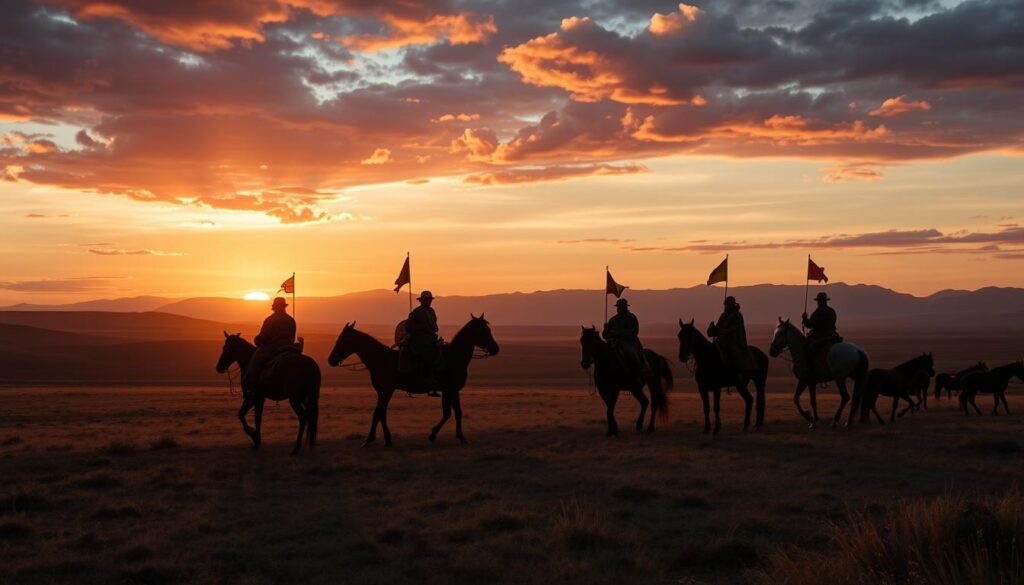
The Mongol Empire was founded by Genghis Khan in 1206. It lasted for 162 years1 and covered about 9 million square miles (23 million square km) at its peak2. It was the largest empire in history during the 13th and 14th centuries3. It started in the Eurasian steppe.
Genghis Khan, the first Great Khan, ruled from 1206 to 12273. He united the Mongol tribes.
The Mongols expanded quickly. They first conquered the Tangut kingdom of Hsi Hsia (Xi Xia) and the Tungusic Jin dynasty in north China2. They reached from the Black Sea to the Korean peninsula in Asia1. They controlled Iran, Russia, Eastern Europe, and China.
Their diet was mostly dairy products like cheese, yogurt, butter, and dried milk curds (kurut)1.
Key Takeaways
- The Mongol Empire was founded by Genghis Khan in 1206 and existed for 162 years1.
- The empire covered approximately 9 million square miles (23 million square km) of territory at its peak2.
- The Mongol Empire was the largest contiguous empire in history during the 13th and 14th centuries3.
- Genghis Khan ruled the empire from 1206 to 12273.
- The empire extended its dominance from the Black Sea to the Korean peninsula in Asia1.
- The Mongol diet mainly included dairy products like cheese, yogurt, butter, and dried milk curds (kurut)1.
Origins and Formation of the Mongol Empire
Temujin’s journey from a young outcast to a great leader shows his strength and strategic thinking. Born around 1162, he faced many challenges. These hardships prepared him for the rise of a powerful empire.
The Rise of Genghis Khan
Temujin united the broken nomadic tribes and became Genghis Khan in 1206. This moment marked the start of Mongolian conquests that changed Eurasia4.
Unification of Mongol Tribes
Genghis Khan used diplomacy and military power to unite the tribes. His leadership built loyalty and unity. This allowed the Mongols to launch big campaigns5.
Early Conquests and Expansion
The Mongols started their conquests by attacking the Jin Empire in 1211. They quickly moved into Central Asia. Temujin’s new tactics and organized army gave the Mongols an edge over their enemies6.
| Year | Event |
|---|---|
| 1206 | Temujin declared Genghis Khan, uniting the Mongol tribes4 |
| 1211 | Invasion of the Jin Empire commences5 |
| 1215 | Fall of the Western Xia Dynasty |
Administration and Governance
The Mongol Empire was huge and needed a strong system to keep things running smoothly. They created Mongol governance to manage their vast lands. This system brought together different cultures and areas under one rule.
Political Structure of the Empire
The empire was split among Genghis Khan’s family, making it easier to manage. Each part was ruled by a khan or royal family member7. This setup helped keep control local while the Great Khan had the final say.
Möngke Khan made these rules even clearer, setting up the Golden Horde and the Ilkhanate8.
Legal Code: Yassa
Genghis Khan introduced the Yassa, a key step in uniting the empire. This law brought order and justice to all, no matter where they were from. It covered everyday life and military rules, making sure everyone followed the same rules.
Taxation and Economic Policies
The Mongols had a smart tax system to help the empire grow and support trade. They made sure taxes were fair and trade flourished. Kublai Khan was key in making these policies work, helping China’s economy grow.
| Aspect | Description | Relevant Khan |
|---|---|---|
| Political Division | Division of empire into ulus territories | Genghis Khan’s Sons |
| Legal Framework | Implementation of Yassa code | Genghis Khan |
| Monetary Policy | Control of paper money issuance | Möngke Khan |
| Trade Enhancement | Support of Silk Road through economic policies | Kublai Khan |
Military Strategies and Tactics
The Mongols’ success in expanding their empire was due to their smart military tactics. They organized their army very well.
Organization of the Mongol Army
The Mongol army had a core of 10,000 elite soldiers called the kesikten. They were Genghis Khan’s personal bodyguards and held important roles in the empire9. They were backed by more troops from Mongol tribes and conquered lands10.
Each soldier had three to four horses. This allowed for quick movement and flexibility in battles9.
- Composite bows with ranges over 200 meters
- Light cavalry skilled in hit-and-run tactics
- Advanced communication systems using signal flags and horns
Use of Psychological Warfare
The Mongols used fear to weaken their enemies. They threatened to kill many to get quick surrenders11. This made battles shorter and easier to win.
Innovative Tactics in Battle
The Mongols were leaders in new battle tactics. They used the composite bow to fire many arrows fast10. They also used tricks like feigned retreats and double envelopment to beat bigger armies11.
| Tactic | Description |
|---|---|
| Arrow Storm | Simultaneous firing of multiple arrows to overwhelm defenders. |
| Double Envelopment | Surrounding the enemy from multiple sides to ensure defeat. |
| Feigned Retreat | Simulating a retreat to lure enemies into a vulnerable position. |
Cultural Impact and Legacy
The Mongol Empire’s influence went beyond its vast lands. It brought about significant cultural exchanges and religious diversity across Eurasia.
Religious Tolerance and Convergence
The Mongols were known for their religious tolerance. They allowed different faiths to thrive within their empire. They even converted to Tibetan Buddhism, which greatly influenced Chinese culture under the Yuan Dynasty12.
This blending of traditions spread Tibetan Buddhism, Islam, and other religions. It created a rich cultural mix.
Influence on Trade and the Silk Road
The Mongols made the Silk Road safe and accessible again. This boosted trade and cultural exchanges between East and West. Goods, ideas, and technologies were exchanged like never before.
Travelers like Marco Polo shared their stories. They showed how the empire connected the world1312.
The Decline and Fragmentation of the Empire
Despite its successes, the Mongol Empire eventually broke into four parts. The Yuan Dynasty in China, the Golden Horde in Russia12, the Chagatai Khanate in Central Asia, and the Ilkhanid dynasty in Greater Iran.
Internal disputes and external pressures weakened these divisions. This led to the empire’s decline. The Mongols were eventually forced out of China in 136813.
FAQ
What factors contributed to the rise of Genghis Khan and the formation of the Mongol Empire?
The harsh conditions of the Eurasian steppe helped shape the Mongols. Genghis Khan’s ambition and leadership united the tribes. His people’s horse-riding and archery skills were key to their success.
How did Genghis Khan manage to unify the Mongol tribes?
Genghis Khan, once named Temujin, used diplomacy and military strategy. He made alliances and enforced loyalty with the Yassa code. This created a strong, unified force.
What were the key strategies in the early conquests and expansion of the Mongol Empire?
The Mongols used light cavalry and archery in their early conquests. They also used fear and propaganda to weaken enemies. Their adaptability allowed them to expand quickly.
How was the Mongol Empire administratively structured to control vast territories?
The Mongols had a balanced system of governance. They had administrators and the Yassa code for laws. This helped them manage their vast empire effectively.
What was the Yassa, and how did it influence Mongol governance?
The Yassa was a legal code by Genghis Khan. It governed warfare, trade, and social life. It helped maintain order across the diverse empire.
How did Mongolian economic policies facilitate trade along the Silk Road?
The Mongols promoted trade on the Silk Road. They offered safe passage and reduced tariffs. This boosted their economy and facilitated cultural exchange.
What military tactics made the Mongol army so effective in battle?
The Mongol army was organized and skilled. They used flexible formations and archery. Their intelligence and planning helped them defeat larger armies.
How did the Mongol Empire approach religious tolerance and cultural convergence?
The Mongols were known for their religious tolerance. This allowed diverse faiths to coexist. It fostered cultural exchange and a cosmopolitan society.
What led to the decline and fragmentation of the Mongol Empire into khanates like the Golden Horde and the Yuan Dynasty?
The Mongol Empire declined due to internal divisions and the challenge of governing vast territories. It split into four khanates. Each faced challenges, leading to fragmentation.
What was the impact of Marco Polo’s travels on Western perceptions of the Mongol Empire?
Marco Polo’s travels introduced Western Europe to the Mongol Empire. His stories sparked interest and imagination. They helped shape Western views of the East.
Source Links
- Mongol Empire – https://www.worldhistory.org/Mongol_Empire/
- Mongol empire | Time Period, Map, Location, & Facts | Britannica – https://www.britannica.com/place/Mongol-empire
- Mongol Empire – https://en.wikipedia.org/wiki/Mongol_Empire
- World History Connected | Vol. 5 No. 2 – https://worldhistoryconnected.press.uillinois.edu/5.2/may.html
- The Mongol Empire – https://pressbooks.pub/abriefhistory1/chapter/chinggis-khan-and-the-early-mongol-empire/
- The Mongol Empire – https://www.oerproject.com/World-History-Origins/Unit-6/The-Mongol-Empire
- Mongol empire – Central Asia, Steppe Warfare, Khanates | Britannica – https://www.britannica.com/place/Mongol-empire/Organization-of-Genghis-Khans-empire
- Administrative Reform in the Mongol Empire – https://courses.lumenlearning.com/suny-hccc-worldcivilization/chapter/administrative-reform-in-the-mongol-empire/
- Military of the Mongol Empire – https://en.wikipedia.org/wiki/Military_of_the_Mongol_Empire
- MONGOL ARMY: TACTICS, WEAPONS, REVENGE AND TERROR – https://factsanddetails.com/asian/cat65/sub423/item2696.html
- World History Connected | Vol. 12 No. 1 – https://worldhistoryconnected.press.uillinois.edu/12.1/forum_may.html
- The Legacy of Genghis Khan | Essay | The Metropolitan Museum of Art | Heilbrunn Timeline of Art History – https://www.metmuseum.org/toah/hd/khan1/hd_khan1.htm
- Mongol empire – Expansion, Trade, Legacy | Britannica – https://www.britannica.com/place/Mongol-empire/Effects-of-Mongol-rule