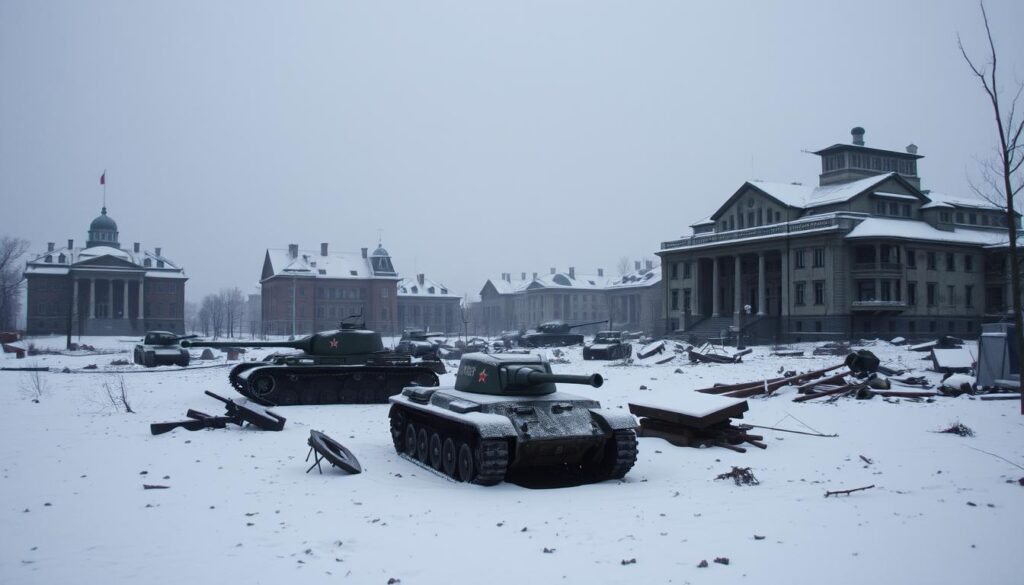
The Siege of Leningrad was a major event in the city’s history. It lasted about 900 days, from September 8, 1941, to January 27, 19441. This siege had a huge impact on the city and its people. The German army’s attack on Leningrad led to a long time of hunger and struggle for its residents.
During the siege, around 2,887,000 people were trapped, including about 400,000 children1. Leningrad, with its deep history, was besieged for almost two and a half years. This resulted in the loss of thousands of lives2. The people of Leningrad showed great strength, enduring extreme hunger and cold.
Key Takeaways
- The Siege of Leningrad lasted for about 900 days, from September 8, 1941, to January 27, 19441.
- Approximately 2,887,000 citizens, including around 400,000 children, were trapped within the circle of German troops during the siege1.
- The siege of Leningrad was a result of the German army’s advance on the city, which led to a prolonged period of starvation and hardship for the residents of Leningrad.
- The city of Leningrad, with its rich Leningrad history, was under siege for almost two and a half years, resulting in the loss of thousands of lives2.
- The siege of Leningrad was a significant event in Leningrad history, and its impact is felt today.
Historical Context of the Siege
The Siege of Leningrad is a key part of Leningrad WW2 history. It was shaped by the chaotic events of Eastern Europe during World War II. Knowing about the wider conflict helps us see why Leningrad was so important in military plans.
Overview of World War II in Eastern Europe
Eastern Europe during World War II saw a lot of fighting and changing alliances. Germany launched Operation Barbarossa against the Soviet Union on June 22, 19413. They used about three million soldiers in a surprise attack. Their goal was to quickly defeat Soviet defenses and take control of important areas.
The Strategic Importance of Leningrad
Leningrad was very important because of its factories and naval role. It had over 600 factories3, making it second only to Moscow in production. It was also the base for Russia’s Baltic Fleet, key for controlling the Baltic Sea and keeping supply lines open.
Prelude to the Siege: Key Events Leading Up
Before the siege started, German forces quickly moved through the Baltic states. They cut off Leningrad by August 313. Soviet troops were able to stop Army Group North’s advance in Leningrad’s suburbs by late September3. These early battles led to the long and harsh blockade that lasted nearly 900 days.
Life During the Siege
The people of Leningrad faced extreme hardships, including food shortages and freezing temperatures. Every day was a fight for survival under the blockade.
Daily Struggles: Food and Resources
Food was scarce, with many getting only 125 grams of bread a day4. People ate strange things like petroleum jelly and wallpaper glue5. They even ate their pets to survive5.
The Resilience of Leningrad’s Citizens
Despite the tough times, Leningrad’s people showed great strength. Nearly half a million kids refused to give up, showing the city’s spirit5. Their stories of survival are a testament to their courage.
“We are together in this storm, and together we will survive.”6
Cultural and Artistic Endeavors Amidst Hardship
Even in the midst of chaos, culture thrived. The performance of Shostakovich’s 7th Symphony in August 1942 gave hope5. These efforts lifted spirits and left a lasting impact. Today, they attract visitors through Leningrad tourism and attractions.
| Aspect | Details | Reference |
|---|---|---|
| Duration of Siege | 30 months from September 8, 1941 | 5 |
| Civilian Deaths | Approximately 800,000 | 6 |
| Daily Bread Ration | 125 grams | 4 |
Military Operations and Tactics
The Siege of Leningrad was a battle of military strategies. Both German and Soviet forces used different tactics. This insight helps us understand the long fight that lasted for years.
The German Offensive: Initial Assaults
Army Group North started the fight, quickly trapping the city. They tried to block all supply paths. But, the cold weather and long supply lines caused many losses7.
Soviet Counteroffensives and Strategies
The Soviet army launched many counterattacks to break the siege. Lt. Gen. Ivan Fedorovich Nikolaev led a key attack near Staro-Panovo in July 1942. Though costly, these battles stopped the Germans from gaining much ground8.
The Role of Supply Routes and the Road of Life
Keeping supply lines open was key for Leningrad’s survival. The “Road of Life” across Lake Ladoga was the main supply route. It was under constant attack but kept the city and its people alive7.
| Aspect | Details |
|---|---|
| Duration of Siege | 872 days (2 years, 4 months, 2 weeks, 5 days) |
| Axis Casualties | 579,985 total; 117,407 killed in action7 |
| Soviet Civilian Deaths | 642,000 during siege |
| Defensive Fortifications | 306 km timber barricades, 635 km wire entanglements |
| Road of Life | Vital supply route across Lake Ladoga |
Aftermath and Legacy of the Siege
The Siege of Leningrad left a lasting impact on the city and its people. The immense suffering during those dark months has shaped Russian history. It tells a story of resilience and endurance.
Human Cost and Casualties
Estimates of deaths during the siege vary, with some saying up to 1.5 million. The Soviet government reported about 670,000 deaths from 1941 to 19449. Independent studies suggest civilian losses could be 1.1 to 1.3 million9.
By the time of liberation, only 600,000 out of 2.5 million inhabitants remained10.
Impact on Soviet Military Tactics and Strategy
The siege’s harsh experiences changed Soviet military strategies. It showed the importance of keeping supply routes open. It also highlighted the value of urban warfare tactics in future plans.
Remembering the Siege: Commemorations and Memorials
Today, Leningrad tourism includes many memorials and museums. They honor those who suffered and died. Annual events in modern-day St. Petersburg reflect on the city’s strength and its people’s legacy.
The Order of Lenin and the title Hero City of the Soviet Union were given to Leningrad9. It solidified its place in history.
Leningrad today is a symbol of human resilience. It attracts visitors who want to learn about its deep history. Tourism here focuses on both the tragedies and triumphs of the past.
FAQ
What was the Siege of Leningrad?
The Siege of Leningrad was a long military blockade by Nazi Germany against the Soviet city of Leningrad (now St. Petersburg) during World War II. It lasted from September 1941 to January 1944. It was one of the longest and most devastating sieges in history, causing about 1.5 million deaths due to starvation, bombardment, and harsh winters.
Why was Leningrad strategically important during World War II?
Leningrad was very important for both the Soviet Union and Nazi Germany. It was a major industrial center, key for the Soviet war effort, producing weapons and supplies. It was also the birthplace of the Russian Revolution, making it a prime target for Hitler to weaken the Soviet people and disrupt their military.
How did the citizens of Leningrad survive during the siege?
The people of Leningrad showed incredible resilience during the siege. With severe food shortages, they relied on limited rations, grew rooftop gardens, and used everyday items to survive. Cultural events, like Shostakovich’s 7th Symphony, brought hope and unity amidst the hardships.
What was the “Road of Life” and its significance?
The “Road of Life” was a vital supply route across Lake Ladoga that connected Leningrad to the Soviet Union. Trucks brought essential supplies in summer, and in winter, the frozen lake was a path for vehicles and pedestrians. This route was essential for keeping the city’s population and war efforts alive during the siege.
How is the Siege of Leningrad remembered in modern-day St. Petersburg?
The Siege of Leningrad’s legacy is deeply rooted in St. Petersburg’s history and culture. Many memorials and museums remember the suffering and resilience of its people. Annual events and exhibitions honor the victims and survivors, keeping the memory of this difficult time alive in the city’s identity and a key part of Leningrad tourism.
What were the key factors that led to the end of the Siege of Leningrad?
The siege ended in January 1944 due to Soviet military offensives, better supply routes, and German forces being diverted to other fronts. The city’s defenders’ resilience and the Soviet leadership’s strategic focus on breaking the blockade were key to ending the siege.
How did the Siege of Leningrad impact Soviet military strategies in World War II?
The Siege of Leningrad taught the Soviets the importance of securing supply lines and strengthening urban defenses. These lessons helped shape future Soviet strategies, leading to more effective coordination and resilience in subsequent military operations on the Eastern Front.
What attractions related to the Siege of Leningrad can tourists visit today?
Today, St. Petersburg offers several attractions related to the Siege of Leningrad. Key sites include the Siege of Leningrad Museum, memorials for the victims, and preserved areas like the Admiralty building, which survived intense bombardment. These attractions give visitors a deep understanding of the city’s history and the enduring spirit of its people.
Source Links
- The Siege of Leningrad – https://www.expresstorussia.com/guide/petersburg-history_leningrad.html
- The Siege of Leningrad, 1941 – http://www.eyewitnesstohistory.com/leningrad.htm
- The Siege of Leningrad: When Hitler Used Starvation as a Weapon | HISTORY – https://www.history.com/news/the-siege-of-leningrad
- “Bread in those days was like gold!” A survivor’s account of the Siege of Leningrad – https://www.historyworkshop.org.uk/communism-socialism/bread-in-those-days-was-like-gold-a-survivors-account-of-the-siege-of-leningrad/
- Leningrad: A Survivor’s Story – https://warfarehistorynetwork.com/article/leningrad-a-survivors-story/
- Leningrad: What was it like to live through history’s deadliest siege? – https://bigthink.com/the-past/leningrad-siege-germany-russia-blockade/
- Siege of Leningrad – https://en.wikipedia.org/wiki/Siege_of_Leningrad
- Wehrmacht Operation to Take Leningrad Aborted – https://warfarehistorynetwork.com/article/wehrmacht-operation-to-take-leningrad-aborted/
- Effects of the siege of Leningrad – https://en.wikipedia.org/wiki/Effects_of_the_siege_of_Leningrad
- Siege of Leningrad (1941-1944) (The) – https://ehne.fr/en/encyclopedia/themes/wars-and-memories/war-fronts/siege-leningrad-1941-1944