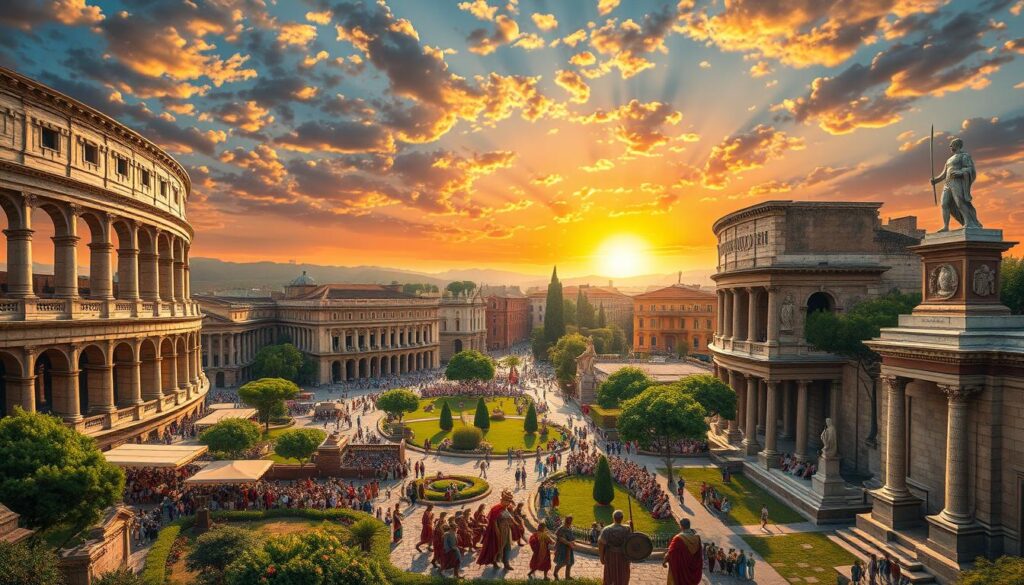
The Roman Empire was a huge and powerful state in Ancient Rome. It covered a lot of Europe, Western Asia, and North Africa1. Its history is filled with conquests, cultural achievements, and political changes. Let’s explore the Roman Empire’s governance, daily life, and its impact on Western civilization.
At its peak, the Roman Empire was a cultural, political, and economic giant. It had a population of about 56,800,000 in 25 BC1. Its area was huge, covering around 2,750,000 km2 in 25 BC, growing to 5,000,000 km2 in AD 117, and then shrinking to 3,400,000 km2 in AD 3901. The Roman Empire lasted from 27 BCE to 476 CE2, with emperors like Augustus and Constantine making a big impact2.
The Roman Empire’s story is one of greatness and decline. It had times of peace, like the Pax Romana, and times of crisis, like the 49-year crisis in the 3rd century1. We’ll look at key events, like the Battle of Milvian Bridge2, and the High Empire era, from 31 BC to 305 AD3.
Key Takeaways
- The Roman Empire was a vast and influential state in Ancient Rome, covering much of Europe, Western Asia, and North Africa.
- The Roman Empire’s history spans from 27 BCE to 476 CE, with notable emperors like Augustus and Constantine.
- The Roman Empire’s territorial expanse and population were significant, with a population of around 56,800,000 in 25 BC.
- The Roman Empire experienced periods of stability and prosperity, like the Pax Romana, and times of crisis, like the 49-year crisis in the 3rd century.
- The Roman Empire’s legacy continues to shape Western civilization, with its cultural, political, and economic achievements remaining relevant today.
Overview of the Roman Empire
The Roman Empire was a key part of Roman civilization. It grew from a small city-state to a major power in the Mediterranean.
Rome started in 753 B.C. with the twins Romulus and Remus4. Over time, Rome grew by conquering and forming alliances.
Foundation and Early History
Rome was first ruled by a king. Then, it became a republic in 509 B.C., ending the monarchy4. The Senate, made up of rich families, held power by 300 B.C4.
Key Dates and Events
- Julius Caesar crosses the Rubicon in 49 B.C., starting a civil war and becoming dictator for life4.
- Caesar’s death in 44 B.C. leads to the Second Triumvirate4.
- Octavian becomes the first emperor in 27 B.C., named Augustus, starting the Pax Romana4.
Geography and Territorial Expansion
Rome was built on seven hills, key for defense and growth4. Under Trajan, the empire reached its peak, covering from Britain to Mesopotamia5. Keeping such a large area needed great military and administrative skills.
| Emperor | Reign | Territorial Expansion |
|---|---|---|
| Augustus | 27 B.C. – 14 A.D. | Established Pax Romana |
| Trajan | 98–117 A.D. | Greatest territorial extent |
| Constantine | 306–337 A.D. | Reunited the empire, founded Constantinople |
Political Structure and Governance
Rome’s shift from a Republic to an Empire was a big change. In the Republic, power was shared among elected officials and the Senate had a lot of say6. This system tried to balance power, but the elite often had more control.
The Republic vs. The Empire
The Roman Republic started in 509 BCE and had a system of checks and balances6. The Empire, on the other hand, gave all power to an emperor, making the Senate less important. Emperor Augustus found a way to keep the old system while having all the power, making the Empire stable67.
Notable Emperors and Their Impact
Emperor Augustus was Rome’s first emperor and made big changes to keep the Empire strong6. His leadership helped set the stage for emperors like Trajan and Marcus Aurelius. They grew Rome’s lands and made its government stronger6.
Administrative Divisions
The Roman Empire was split into provinces, each run by officials to keep things running smoothly6. Even though the Senate’s power was less, it helped with money and foreign affairs8. Here’s a table showing the main parts of the Empire:
| Division | Role | Governing Official |
|---|---|---|
| Provinces | Regional governance and tax collection | Proconsul or Governor |
| Prefectures | Military and administrative oversight | Prefect |
| Senate | Advising on foreign policy and finances | Senators |
Culture and Society in the Roman Empire
Life in Ancient Rome was a mix of different social classes and rich cultural practices. The Roman civilization was built on a society where wealth and property showed status9.
Daily Life and Social Classes
Every class had its own way of living. Only the emperor could wear a purple toga, showing he was in charge9. Senators wore white togas with a wide purple stripe, setting them apart from equestrians with a narrower stripe9. Getting rich was a way to move up in society, with Augustus adding more people to the equestrian order9.
By the first century, equestrians were in the Senate, and even non-Italians could join9.
Religion and Mythology
The Ancient Rome religion changed a lot over time. It started as polytheistic but then Christianity became popular, leading to medieval Christendom. Festivals and rituals were key in daily life, showing how religion was tied to society and politics.
Contributions to Art and Architecture
Roman civilization made huge contributions to art and architecture. The Colosseum and Pantheon show their engineering and beauty skills. Roman art influenced the Italian Renaissance, and their architecture shaped many styles, including Romanesque and Renaissance.
The legacy of Ancient Rome inspires architecture and art today.
| Iconic Structures | Description | Influence |
|---|---|---|
| Colosseum | Large amphitheater used for gladiatorial contests and public spectacles. | Inspired modern stadium designs. |
| Pantheon | Temple with a massive domed roof and oculus. | Influenced Renaissance and Neoclassical architecture. |
| Aqueducts | Engineered structures to transport water from distant sources. | Set standards for urban infrastructure. |
Decline and Legacy of the Roman Empire
The Roman Empire’s decline ended a great era in history. Many factors led to this downfall, changing Western civilization forever.
Causes of Decline
Political instability weakened the empire. Economic troubles also strained its resources. External threats from invading tribes further weakened Roman control10.
Fall of Rome: Key Events
The sack of Rome in 410 AD by the Visigoths was a major event. The Western Roman Empire fell in 476 AD, showing its weakness1110. The Eastern Roman Empire, or Byzantine Empire, lasted until Constantinople fell in 145311.
Lasting Influence on Modern Society
The Roman Empire’s legacy lives on in law, language, and architecture. Constantine the Great’s rule had a big impact. Many democratic systems come from Roman ideals12. Roman law shaped the Napoleonic Code, and Latin is key in science12.
FAQ
What was the Roman Empire?
The Roman Empire was a powerful civilization that lasted over 500 years. It covered vast areas in Europe, Africa, and Asia. It left a big mark on Western culture through law, architecture, and governance.
How did the Roman Empire originate?
The Roman Empire started in a small city-state in Ancient Rome. It grew from a monarchy to a republic and then to an empire. Leaders like Julius Caesar and Emperor Augustus led this change. This marked Rome’s rise in the Mediterranean.
What were the key events in Roman history?
Important events in Roman history include the founding of Rome by Romulus and Remus. The shift from Republic to Empire with Julius Caesar and Emperor Augustus was key. The Pax Romana, the reign of emperors like Trajan and Constantine the Great, and the empire’s decline and fall are also major events.
How did the Roman Empire expand its territory?
The Roman Empire grew through military victories, alliances, and provinces. Its strong military and efficient rule let Rome control vast areas. This spread Roman culture and infrastructure from the British Isles to the Middle East.
How was the Roman Republic different from the Roman Empire?
The Roman Republic had elected officials and a Senate, focusing on shared power. The Roman Empire, under an emperor like Emperor Augustus, had more centralized power. This allowed for easier decision-making and control over its vast territories.
Who were some notable Roman emperors and their impact?
Important Roman emperors include Emperor Augustus, who started the empire and brought peace. Trajan expanded territories, and Marcus Aurelius was a philosopher-king who wrote “Meditations”. Constantine the Great made big reforms and accepted Christianity, shaping the empire’s future.
How was the Roman Empire administratively divided?
The Roman Empire was split into provinces and prefectures, each with its own leaders. The Senate was key in administration. This structure helped Rome govern its vast and diverse territories efficiently.
What was daily life like in Ancient Rome?
Life in Ancient Rome varied by social class. Patricians lived luxuriously, while slaves faced harsh conditions. Citizens enjoyed baths, public forums, gladiatorial games, and commerce, showing a lively society.
How did religion and mythology influence Roman society?
Religion and mythology were central to Roman civilization. They shaped social norms, politics, and daily life. The Romans worshipped many gods and goddesses, celebrated festivals, and later adopted Christianity, influencing the empire’s culture and politics.
What are some significant contributions of the Roman Empire to art and architecture?
The Roman Empire made lasting impacts on art and architecture. Iconic structures like the Colosseum and the Pantheon stand as testaments. Roman innovations in engineering, like concrete and the arch, changed construction. Their sculptures, mosaics, and literature continue to inspire today.
What led to the decline and fall of the Roman Empire?
The Roman Empire declined due to internal problems, economic issues, military setbacks, and external threats. Events like the sack of Rome in 410 AD and the fall of the Eastern Roman Empire in 1453 marked its end.
What is the legacy of the Roman Empire in modern society?
The Roman Empire left a lasting impact on modern society. Its influence is seen in law, language, architecture, and political thought. Latin is used in science, Roman law shapes many legal systems, and architectural principles are seen in buildings worldwide.
Source Links
- Roman Empire – https://en.wikipedia.org/wiki/Roman_Empire
- Roman Empire | Definition, History, Time Period, Map, & Facts | Britannica – https://www.britannica.com/place/Roman-Empire
- Roman Empire (27 BC – 476 AD) – History of Rome – https://www.rome.net/roman-empire
- Ancient Rome ‑ Facts, Location, & Timeline | HISTORY – https://www.history.com/topics/ancient-rome/ancient-rome
- The Roman Empire (27 B.C.–393 A.D.) | Essay | The Metropolitan Museum of Art | Heilbrunn Timeline of Art History – https://www.metmuseum.org/toah/hd/roem/hd_roem.htm
- Roman Republic | Definition, Dates, History, Government, Map, & Facts | Britannica – https://www.britannica.com/place/Roman-Republic
- Rome’s Transition from Republic to Empire – https://education.nationalgeographic.org/resource/romes-transition-republic-empire/
- Roman Government – https://www.worldhistory.org/Roman_Government/
- The Roman Empire: in the First Century. The Roman Empire. Social Order – https://www.pbs.org/empires/romans/empire/order.html
- The Decline and Fall of the Roman Empire – https://courses.lumenlearning.com/atd-herkimer-westerncivilization/chapter/the-decline-and-fall-of-the-roman-empire/
- Roman Empire – Expansion, Decline, Legacy | Britannica – https://www.britannica.com/place/Roman-Empire/Height-and-decline-of-imperial-Rome
- The History of the Decline and Fall of the Roman Empire – https://en.wikipedia.org/wiki/The_History_of_the_Decline_and_Fall_of_the_Roman_Empire