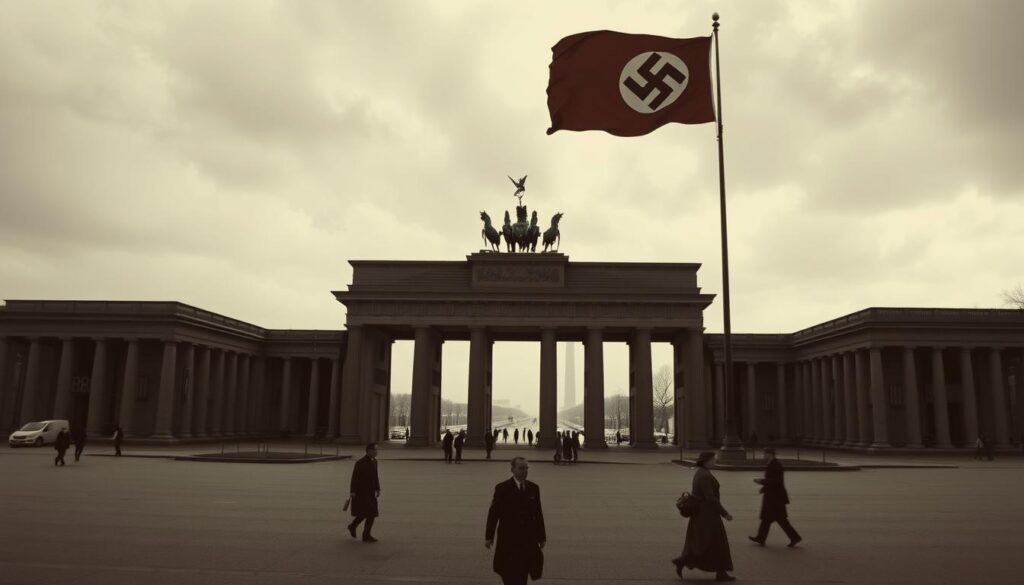
Nazi Germany, also known as the Third Reich, was a dictatorship led by Adolf Hitler. He turned the country into a regime of terror and oppression. The official language was German1.
In 1939, Nazi Germany covered 633,786 km2 and had 79,375,281 people1. The Nazi Party quickly gained power, getting 18.3% of the vote and 107 seats in the 1930 elections2.
Berlin, the capital, was at 52°30′40″N 13°22′47″E1. By 1940, the population was 109,518,183. The religious breakdown was 54% Protestant, 40% Catholic, 3.5% Gottgläubige, 1.5% irreligious, and 1% other1.
In the 1928 Reichstag elections, the Nazi Party got only 2.6% of the votes and 12 seats2.
Introduction to the Third Reich
Adolf Hitler and the Nazi Party controlled Nazi Germany, making it a significant part of world history. The Third Reich had a profound impact on the world, and understanding its rise to power is key.
Key Takeaways
- Nazi Germany was a totalitarian dictatorship led by Adolf Hitler.
- The official language of Nazi Germany was German.
- The Nazi Party’s support surged in the 1930 elections.
- The population of Nazi Germany in 1939 was 79,375,281.
- The coordinates of Berlin, the capital of Nazi Germany, were 52°30′40″N 13°22′47″E.
- The Nazi Party won only 2.6% of the votes and 12 seats in the 1928 Reichstag elections2.
Overview of Nazi Germany’s Rise to Power
The Nazi Party’s rise was fueled by strategic moves during the Weimar Republic’s turmoil. Germany’s economic woes made it a breeding ground for extremist views.
Economic Conditions in Weimar Germany
The Weimar economy faced hyperinflation and high unemployment. This led to widespread discontent. The economic troubles weakened democracy, making radical solutions more appealing3.
Propaganda and the Use of Symbolism
Nazi propaganda was key in gaining power. The manifesto Mein Kampf outlined the party’s beliefs and goals. It united and mobilized supporters. Symbolic images and mass rallies made the Nazi message hit home with the German people4.
Key Figures: Hitler and the Nazi Leadership
Adolf Hitler’s leadership was essential to the Nazi’s success. He was joined by Joseph Goebbels and Heinrich Himmler. Together, they formed a strict regime. The Gestapo was created to silence opposition, solidifying the party’s control34.
Social Policies and Impact of Nazi Ideology
The Nazi regime carefully planned social policies to match their main beliefs. These policies deeply changed German society and the world.
Anti-Semitic Policies and the Holocaust
Under Nazi rule, laws against Jews got worse, leading to the Holocaust. The Nuremberg Laws of 1935 took away Jews’ citizenship and banned Jewish-German marriages5. Kristallnacht in 1938 was a big step up, with about 7,500 Jewish shops destroyed and around 100 Jews killed5. By World War II, killing Jews was a main goal, leading to the deaths of six million Jews6.
Youth Education and the Hitler Youth
The Nazi regime spent a lot on teaching youth Nazi beliefs through education and the Hitler Youth. Kids learned about Nazi ideology, getting ready for military and state jobs. This made sure the next generation was loyal to Hitler’s plans, helping the regime during World War II.
Role of Women in Nazi Society
Women were pushed to focus on being mothers and homemakers, fitting the Aryan ideal. But when World War II started, they also helped with the war. Even so, their main role was seen as traditional, showing the regime’s mixed views on women.
| Aspect | Details |
|---|---|
| Anti-Semitic Legislation | Nuremberg Laws, Kristallnacht damages |
| Holocaust | Six million Jews killed |
| Youth Indoctrination | Hitler Youth programs |
| Women’s Roles | Motherhood emphasis, war effort involvement |
The Downfall of Nazi Germany
The collapse of Nazi Germany was caused by many factors. These factors together led to the end of the Third Reich.
Military Defeats and Resistance Movements
The Axis Powers faced big military losses as the Allies moved in from both sides. By late 1944, over a million German soldiers were dead, wounded, or captured in the West7. On the Eastern Front, more than 800,000 German troops surrendered in the last months8.
Internal resistance movements also grew stronger. They challenged the Nazi regime from inside.
Post-War Consequences and Nuremberg Trials
After Germany surrendered on May 8, 1945, the Allies started the Nuremberg Trials. They aimed to hold Nazi leaders accountable for their crimes9. These trials were a key moment in international law, setting new standards for dealing with atrocities.
The process of denazification followed. It aimed to remove Nazi beliefs from German society.
Lessons Learned and Historical Reflection
The fall of Nazi Germany teaches us about the dangers of totalitarianism. It shows why we must protect our democratic systems. Looking back at this time reminds us to always watch out for our rights and prevent oppressive regimes.
Learning from these events helps us stay committed to peace and justice97.
FAQ
What factors contributed to the rise of the Nazi Party in Germany?
The Nazi Party rose due to economic troubles and social unrest in the Weimar Republic. Adolf Hitler’s leadership was key. The aftermath of World War I and the Great Depression helped the Nazis gain support.
How did propaganda and symbolism play a role in Nazi Germany’s consolidation of power?
Propaganda and symbols were vital for the Nazis. Joseph Goebbels led powerful campaigns. Symbols like the swastika unified the people. Hitler’s Mein Kampf spread Nazi beliefs.
Who were some key figures in the Nazi leadership beside Adolf Hitler?
Joseph Goebbels and Heinrich Himmler were important. Goebbels handled propaganda, and Himmler led the Gestapo and SS. They helped enforce Nazi policies.
What were the main social policies implemented by the Nazi regime?
The Nazis targeted many groups with their policies. They had anti-Semitic laws and indoctrinated youth. Women were expected to follow traditional roles but also helped in the war.
How did the Nazi ideology influence Germany’s actions in World War II?
Nazi beliefs drove aggressive policies and World War II. Their racism and anti-Semitism led to the Holocaust. These beliefs justified invading other countries.
What led to the downfall of Nazi Germany?
Military defeats and resistance led to the Nazis’ downfall. Battles like Stalingrad were turning points. The Allies’ pressure eventually collapsed the Third Reich.
What were the post-war consequences for Nazi leaders and Germany?
Nazi leaders faced trials for war crimes. The Nuremberg Trials held them accountable. Germany worked to remove Nazi influence and rebuild democracy.
What lessons can be learned from the history of Nazi Germany?
Nazi Germany’s history warns us about totalitarianism and the need to protect democracy. It shows the importance of education and remembering history to prevent similar regimes. It also highlights the importance of human rights and dignity.
Source Links
- Nazi Germany – https://en.wikipedia.org/wiki/Nazi_Germany
- The Nazi Party – https://encyclopedia.ushmm.org/content/en/article/the-nazi-party-1
- The Nazi Rise to Power – https://encyclopedia.ushmm.org/content/en/article/the-nazi-rise-to-power
- Nazi Party – Rise to Power, Ideology, Germany | Britannica – https://www.britannica.com/topic/Nazi-Party/The-Nazi-Party-and-Hitlers-rise-to-power
- Social policies – Why the Nazis were able to stay in power – Higher History Revision – BBC Bitesize – https://www.bbc.co.uk/bitesize/guides/zgtyvcw/revision/8
- How did different goals and political systems shape racism in Nazi Germany and the United States? – https://encyclopedia.ushmm.org/content/en/question/how-did-different-goals-and-political-systems-shape-racism-in-nazi-germany-and-the-united-states
- Third Reich – Defeat, Nazi Germany, Holocaust | Britannica – https://www.britannica.com/place/Third-Reich/The-beginning-of-defeat
- End of World War II in Europe – https://en.wikipedia.org/wiki/End_of_World_War_II_in_Europe
- The collapse of Nazi Germany – https://www.holocaust.cz/en/history/final-solution/general-2/the-collapse-of-nazi-germany/