The Ottoman Empire, also known as Osmanlı İmparatorluğu, was a vast and influential state from about 1299 to 19221. It played a big role in history. Osman I started it, and it lasted over 600 years, affecting politics, culture, and religion worldwide. Its history is complex, with growth, reforms, and decline, making it interesting to study.
The Ottoman Empire covered a lot of land, including southeastern Europe, the Balkans, and parts of North Africa2. It was known for its art and architecture, seen in cities like Istanbul. Istanbul was a center of artistic expression3.
Key Takeaways
- The Ottoman Empire started with Osman I around 12991 and3, beginning a new chapter in history.
- It grew to cover most of southeastern Europe, the Balkans, and parts of North Africa2, showing its growing power.
- In the 19th century, the empire went through reforms and modernization, known as the Tanzimat1, to improve its institutions and economy.
- Istanbul and other major cities in the Ottoman Empire were known for their art and architecture, showing the empire’s love for culture3.
- The empire started to decline in the 1600s, due to competition from the Americas and India3, leading to its end.
- The Ottoman Empire officially ended in 1922, when the title of Ottoman Sultan was removed, and Turkey became a republic1 and3, ending an era.
Overview of the Ottoman Empire
The Ottoman Empire grew from a small principality to a powerful empire. This was thanks to the Ottoman sultans, who led the empire through growth and cultural achievements.
Historical Background
The empire started around 1299 with Osman I in northwestern Anatolia. It quickly grew, taking Bursa in 1326 and reducing Byzantine power4. The key conquest of Constantinople in 1453 by Sultan Mehmet II ended the Byzantine Empire. It made Istanbul the empire’s heart54.
Founding and Expansion
Suleiman the Magnificent led the empire to its peak in the 16th century. It then covered three continents6. The empire’s military won many Ottoman conquests, expanding its lands in Europe, Africa, and Asia5.
Cultural Significance
The Ottoman civilization mixed Turkish, Islamic, and Byzantine traditions. This created a rich culture known for art, architecture, and governance. This mix strengthened the empire and left a lasting impact on modern societies56.
The Ottoman sultans’ strategies and cultural efforts helped the empire last over six centuries4.
Government and Administration
The Ottoman Empire’s governance was a testament to its enduring power and organizational prowess. Central to this was the role of the Ottoman sultans, who held supreme authority over the vast territories of the empire.
Sultans of the Ottoman Empire
The Ottoman sultans were the linchpins of Ottoman civilization, ruling as absolute monarchs in a centralized government7. With 36 sultans from 1299 to 1922, each monarch played a key role in shaping the empire’s destiny7. Sultan Mehmed II transformed Istanbul into a cultural hub with a strong Turkish-Islamic identity, marking a significant milestone in the city’s development8. Sultan Suleyman I further enhanced Istanbul’s infrastructure by implementing significant water supply projects, ensuring the city’s needs were met8.
Legal and Taxation Systems
The legal framework of the Ottoman Empire was a blend of Islamic law and sultanic decrees, creating a sophisticated judiciary system. Taxes were meticulously collected to fund the empire’s ambitious projects and military endeavors, ensuring the state’s longevity and prosperity.
Provinces and Local Governance
The empire was divided into vilayets, each governed by appointed officials, allowing for effective local administration while maintaining centralized control. This structure facilitated the management of diverse regions, ensuring stability across the vast Ottoman history.
Military Organization
The military was the backbone of Ottoman power, with the Janissary corps standing out as a formidable force. The dual system of military and civil administration allowed for a balanced distribution of power, reinforcing the empire’s strength and resilience7.
| Administrative Division | Governing Body |
|---|---|
| Central Government | Sultan, Divan, Askeri, Ulema7 |
| Provinces (Vilayets) | Appointed Governors7 |
| Judicial System | Kazas, Nahiyas, Qadis7 |
| Education | Medrasa and Enderun Schools7 |
Cultural Achievements
The Ottoman civilization was known for its Ottoman architecture, rich literary traditions, and groundbreaking scientific discoveries91011.
Art and Architecture
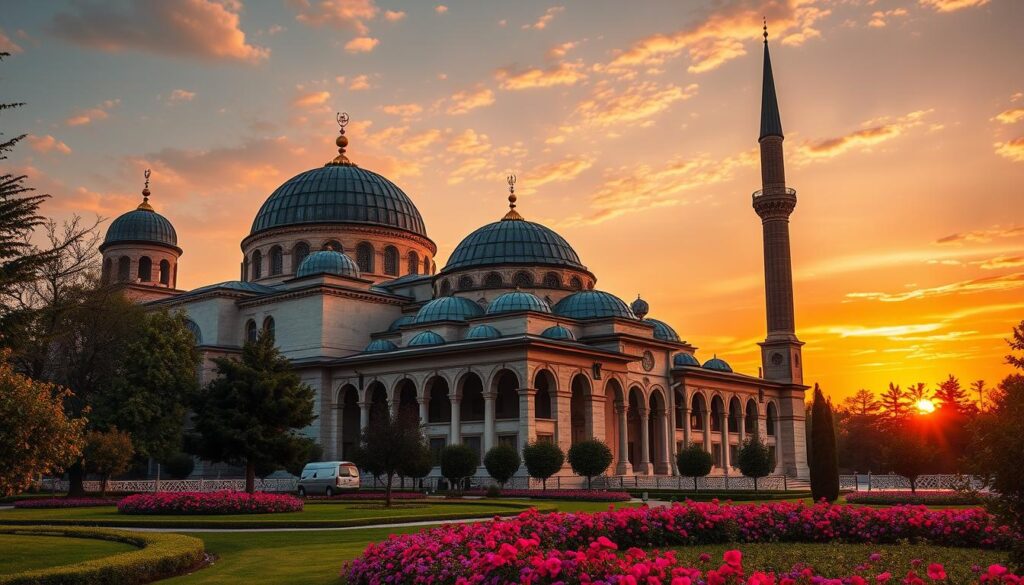
Buildings like the Blue Mosque and Topkapi Palace show the empire’s skill in architecture. Ottoman buildings, influenced by Byzantine and Persian styles, feature grand domes and detailed designs910.
- Transformation of Hagia Sophia into an imperial mosque
- Sinan’s design of 312 public buildings
- Specialized cities for arts like Iznik for ceramics
Literature and Music
Ottoman literature flourished with Diwan poetry, mixing Turkish, Arabic, and Persian styles. Music also showed the empire’s wide range of cultures.
Scientific Contributions
Scholars like Taqi al-Din made big steps in astronomy and engineering. They introduced the early steam turbine and mechanical clocks, showing the empire’s drive for science11. The empire also made progress in medicine and mathematics, leaving a lasting impact.
| Field | Notable Contributions |
|---|---|
| Architecture | Blue Mosque, Topkapi Palace, Sinan’s public buildings |
| Literature | Diwan poetry, blending multiple cultural influences |
| Music | Diverse musical traditions reflecting empire’s diversity |
| Science | Taqi al-Din’s steam turbine, mechanical clocks, advancements in medicine |
Decline and Legacy
The Ottoman Empire’s decline was caused by many factors. Economic troubles, military losses, and growing nationalism weakened it12.
Factors Leading to Decline
Economic issues arose as trade routes changed, hurting the Middle Eastern provinces’ wealth12. The arrival of precious metals from the Americas caused inflation. This led the government to devalue currency and raise taxes, making things worse12.
Also, the population grew, causing social problems. Peasants left due to high taxes, and rebel groups challenged the government1213.
The Fall of Constantinople
The fall of Constantinople was a key moment in Ottoman history. It showed the empire’s power at first but later its weakness12. This loss showed the empire’s struggle to keep its vast lands and influence.
Influence on Modern Nation-States
The Ottoman Empire’s end led to the birth of many modern countries. Turkey, Syria, and Greece are examples, each with Ottoman roots12. The Ottoman legacy affects today’s politics, culture, and identities, showing its lasting impact.
FAQ
What was the Ottoman Empire?
The Ottoman Empire, also known as the Osmanlı İmparatorluğu, was a powerful Islamic state. It lasted for over six centuries. Starting as a small Turkish principality, it grew to dominate Southeast Europe, Western Asia, and North Africa.
How did the Ottoman Empire achieve its rapid expansion?
The Ottomans expanded through smart military strategies and strong leadership. Early sultans led the way, and a well-organized system helped them. Key victories, like the fall of Constantinople in 1453, helped them grow even more.
Who were some of the most influential Ottoman sultans?
Important Ottoman sultans include Suleiman the Magnificent and Mehmed II. Suleiman led the empire to its peak, while Mehmed II conquered Constantinople. They shaped the empire’s politics, military, and culture.
What are the key features of Ottoman architecture?
Ottoman architecture is famous for its grand mosques and detailed tile work. Buildings like the Blue Mosque and Topkapi Palace show the empire’s style. They mix Turkish, Islamic, and Byzantine elements, showing the empire’s skill in design and engineering.
What factors contributed to the decline of the Ottoman Empire?
The Ottoman decline was caused by several factors. These include economic slowdown, military losses, poor administration, and rising nationalism. These issues weakened the empire, leading to its end in the early 20th century.
What was the significance of the fall of Constantinople?
The fall of Constantinople in 1453 was a major event. It ended the Byzantine Empire and made the Ottomans a global power. This victory expanded Ottoman lands and boosted trade and cultural exchange between East and West.
How did the Ottoman Empire influence modern nation-states?
The Ottoman Empire’s breakup led to many modern nation-states. Its legacy can be seen in the Balkans, Middle East, and North Africa. The empire’s ways of governing, cultural diversity, and borders have shaped these regions today.
What are some of the scientific and medical contributions of the Ottoman Empire?
The Ottoman Empire made big strides in math, astronomy, and surgery. Scholars and doctors developed new ideas and techniques. Their work helped both Islamic and European science, showing the empire’s intellectual depth.
What is the legacy of the Ottoman Empire in contemporary Turkey?
The Ottoman Empire’s legacy is strong in Turkey today. It’s seen in architecture, food, language, and identity. Many Ottoman traditions and sites are kept alive, showing the empire’s lasting impact on Turkey.
Source Links
- Ottoman Empire – https://en.wikipedia.org/wiki/Ottoman_Empire
- Ottoman Empire | Facts, History, & Map | Britannica – https://www.britannica.com/place/Ottoman-Empire
- Ottoman Empire ‑ WWI, Decline & Definition | HISTORY – https://www.history.com/topics/middle-east/ottoman-empire
- History of the Ottoman Empire – https://en.wikipedia.org/wiki/History_of_the_Ottoman_Empire
- BBC – Religions – Islam: Ottoman Empire (1301-1922) – https://www.bbc.co.uk/religion/religions/islam/history/ottomanempire_1.shtml
- Ottoman Empire – https://www.worldhistory.org/Ottoman_Empire/
- Government of the classical Ottoman Empire – https://en.wikipedia.org/wiki/Government_of_the_classical_Ottoman_Empire
- ADMINISTRATION OF THE OTTOMAN CAPITAL – https://istanbultarihi.ist/442-administration-of-the-ottoman-capital
- The Art of the Ottomans before 1600 | Essay | The Metropolitan Museum of Art | Heilbrunn Timeline of Art History – https://www.metmuseum.org/toah/hd/otto1/hd_otto1.htm
- History, Facts and Major Accomplishments of the Ottoman Empire, an Islamic Superpower – World History Edu – https://worldhistoryedu.com/history-facts-and-major-accomplishments-of-the-ottoman-empire/
- The cultural and scientific achievements of the Ottoman Empire – International Baccalaureate History – Marked by Teachers.com – https://www.markedbyteachers.com/international-baccalaureate/history/the-cultural-and-scientific-achievements-of-the-ottoman-empire.html
- Ottoman Empire – Decline, Reforms, Fall | Britannica – https://www.britannica.com/place/Ottoman-Empire/The-decline-of-the-Ottoman-Empire-1566-1807
- Ottoman Empire – Resistance, Reforms, Decline | Britannica – https://www.britannica.com/place/Ottoman-Empire/Resistance-to-change