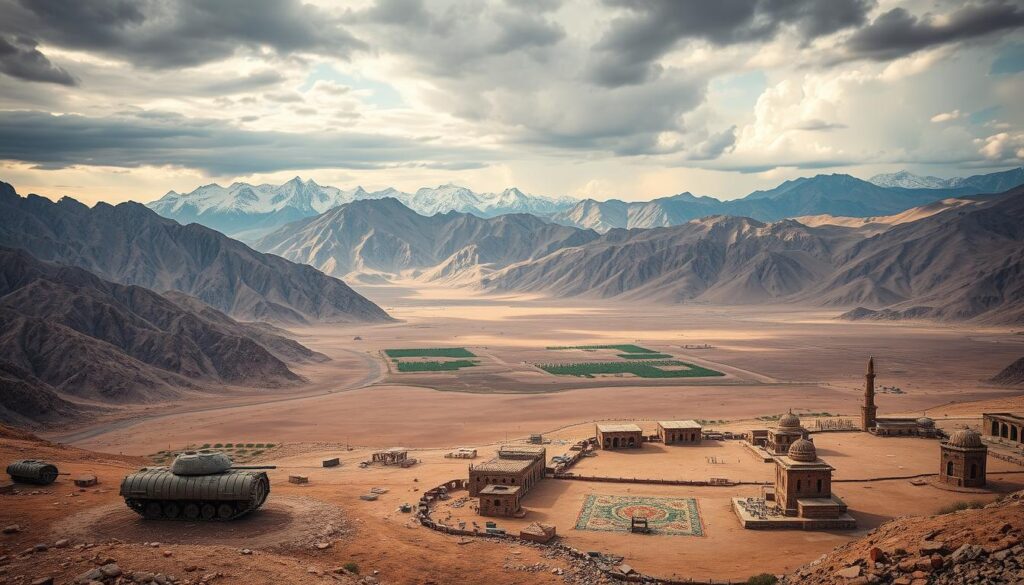
The War in Afghanistan started on October 7, 2001, after the September 11 attacks. It lasted for 20 years, until 20211. The U.S. and its allies fought against the Taliban and al-Qaeda. Kabul was a major battleground.
This war has caused a huge humanitarian crisis. By February 2024, 23.7 million Afghans needed aid2.
The war deeply affected Afghan society. In 2018, the United Nations reported 10,993 civilian casualties2. The conflict lasted 20 years, from 2001 to 20211.
Understanding the War in Afghanistan is key to knowing the current state of the country.
Key Takeaways
- The War in Afghanistan began on October 7, 2001, and lasted for 20 years, from 2001 to 20211.
- The conflict involved the United States and its allies against the Taliban regime and al-Qaeda.
- An estimated 23.7 million Afghans required humanitarian aid as of February 20242.
- The United Nations documented a then-record high of 10,993 civilian casualties in 20182.
- The war has had a profound impact on Afghan society, with the city of Kabul being a key location in the war.
- The conflict in Afghanistan lasted for 20 years, from 2001 to 2021, and at the peak of the conflict, there were more than 130,000 NATO troops on the ground1.
Overview of the War in Afghanistan
The Afghan conflict started in 2001 when the U.S. invaded to take down the Taliban and stop al-Qaeda. This long fight changed the Afghan government and economy over 20 years3.
Key Events Leading to the Conflict
In the summer of 2001, the Taliban controlled most of Afghanistan3. The 9/11 attacks led to U.S. military action, quickly removing the Taliban in two months3. Then, efforts to rebuild Afghanistan’s institutions began, but challenges remained.
Major Players Involved
International forces, like NATO allies, and local Afghan groups played big roles. Important figures like Dr. Dov S. Zakheim and David Kilcullen made key decisions. Critics like Greg Mills pointed out economic and political problems4.
Objectives of the War
The main goals were to create a stable Afghan government, stop terrorist threats, and help the Afghan economy. But, problems like corruption and not using resources well made it hard to succeed43.
Knowing these points gives a full picture of the Afghan conflict. It helps us see how it deeply affected society and the area.
| Aspect | Details |
|---|---|
| Duration of War | December 2001 – 2021 |
| U.S. Military Casualties | ~2,400 killed, ~20,700 wounded3 |
| Financial Assistance (2001-2009) | Over $38 billion allocated3 |
| Taliban Control in 2001 | Over 90% of Afghanistan3 |
Impact on Afghan Society
The war has changed Afghan society a lot. It has affected daily life in many ways. From people being displaced to changes in social norms, the war’s impact is clear.
Humanitarian Crisis and Displacement
Millions had to leave their homes to find safety5. Between August 2021 and May 2023, there were 3,774 civilian casualties5. Also, over half of media outlets closed, making it hard to stay connected5.
Changes in Gender Dynamics
Women’s roles have changed a lot, sometimes for the better, sometimes not6. More than 80% of women journalists stopped working because of restrictions6. But Afghan women keep fighting for their rights and voices in society6.
Economic Consequences
The Afghan economy is facing big challenges7. The World Bank has given over $1.7 billion to help, but growth is hard to achieve7. Projects like CASA-1000 try to help, but there are many hurdles7.
| Impact Area | Key Statistics |
|---|---|
| Humanitarian Crisis | 3,774 civilian casualties (1,095 killed, 2,679 wounded)5 |
| Gender Dynamics | 80% of women journalists stopped working6 |
| Economic Support | $1.7 billion from the World Bank7 |
International Response and Involvement
The world came together to face the Afghan conflict’s challenges. They helped in many ways, from military actions to giving aid. This helped shape the news from Afghanistan and guided the Afghan government’s plans.
Role of NATO and Allied Forces
NATO and its allies played a key role in the Afghan conflict. They led military efforts to make the area safer. The U.S. had fewer troops in Afghanistan, going from about 15,500 to 2,500 during the Trump era8.
This move was part of a plan to let Afghan forces handle security. These forces, around 300,000 strong, got U.S. support8.
The United Nations’ Efforts
The United Nations worked hard to keep the peace and help people. By July 2022, the U.S. had given $775 million to help Afghans9. This made the U.S. the biggest donor in the area.
Their goal was to help those who had to leave their homes and keep important services running. This was all while violence was happening.
Diplomatic Initiatives and Challenges
There were always efforts to find peace, but it was tough. The U.S. closed its embassy in Kabul on August 31, 20219. Now, the U.S. works with Qatar to help with diplomatic tasks and help U.S. citizens9.
Also, efforts like Operation Allies Refugee helped move 2,000 Afghans to the U.S. for special visas8.
The Withdrawal and Aftermath
The end of the two-decade-long conflict marked a significant turning point for Afghanistan. The coordinated exit of U.S. and NATO forces reshaped the nation’s landscape. It left lasting impacts on its government, society, and economy.
Timeline of U.S. Withdrawal
The withdrawal process began in spring 2021. It ended on August 30, 2021, when the last U.S. military aircraft departed Afghanistan10. The chaotic evacuation saw tragic events, including a terrorist attack on August 26, 2021.
This attack killed 13 U.S. servicemembers and over 170 Afghan civilians10. The rapid departure undermined the stability of the Afghan government. It led to the swift takeover by Taliban forces11.
Immediate Consequences for Afghanistan
The sudden change in power triggered a humanitarian crisis and severe economic downturn. Sanctions and frozen assets plunged the Afghan economy into turmoil, with billions of dollars immobilized12. Women faced increased restrictions, including bans on secondary education and limited public participation12.
Civil society organizations struggled under new constraints, and journalists encountered heightened dangers12. The collapse of infrastructure left many Afghans displaced and in urgent need of support11.
Future Prospects and Challenges
Looking ahead, Afghanistan faces numerous challenges in rebuilding its governance and economy. The Afghan government must navigate international sanctions and internal instability to restore economic growth12. Efforts to process Special Immigrant Visas remain sluggish, affecting thousands awaiting evacuation12.
Security concerns persist with the presence of extremist groups, and regional tensions continue to influence Afghanistan’s future10. Addressing these issues will be key for the nation’s recovery and the well-being of its people11.
FAQ
What were the main triggers of the War in Afghanistan?
The War in Afghanistan started with the September 11, 2001 attacks by Al-Qaeda. The U.S. and its allies invaded to take down the Taliban, who harbored terrorists. This began a long conflict, fueled by politics and history.
Who were the major players involved in the Afghan conflict?
Many groups were involved, like the U.S. and NATO, the Taliban, and Afghan factions. Each had their own goals, making the war complex and long.
How did the War in Afghanistan impact Afghan society and culture?
The war caused a big humanitarian crisis, displacing millions. It also changed gender roles, with both progress and setbacks for women. The war affected Afghan culture, including food and travel, changing the country’s social fabric.
What role did NATO and allied forces play in the Afghanistan conflict?
NATO and allies were key in the start and later efforts to stabilize Afghanistan. They moved from fighting to training Afghan forces. Their actions were like a chess game, with big impacts on the war’s path.
What were the economic consequences of the War in Afghanistan?
The war hit the Afghan economy hard, like a ship in rough seas. Foreign aid helped, but corruption and destroyed infrastructure limited growth. This made lasting development hard.
How did the international community respond to the War in Afghanistan?
The world responded with military action, aid, and diplomacy. Groups like the U.N. worked for peace, aid, and political solutions. But, they faced big challenges.
What were the key objectives of the U.S.-led invasion of Afghanistan?
The U.S. aimed to stop terrorists, remove the Taliban, and build a stable Afghan government. Goals later included building the country and boosting its economy.
What were the immediate consequences of the U.S. withdrawal from Afghanistan?
The U.S. leaving led to the Taliban taking over, causing big changes. There was political instability, humanitarian crises, and economic problems. The shift also made governance, recovery, and development hard.
What are the future prospects and challenges for Afghanistan post-war?
Afghanistan has chances for stability, economic growth, and social progress with good governance and support. But, it faces ongoing conflict, economic struggles, and rebuilding challenges.
How has the war influenced Afghanistan’s position in global news and politics?
The War in Afghanistan has kept Afghanistan in the news for over 20 years. The Taliban’s comeback and U.S. withdrawal continue to shape its global image. This affects international relations and policies about the area.
Source Links
- Afghanistan War: How did 9/11 lead to a 20-year war? – https://www.iwm.org.uk/history/afghanistan-war-how-did-911-lead-to-a-20-year-war
- Instability in Afghanistan | Global Conflict Tracker – https://www.cfr.org/global-conflict-tracker/conflict/war-afghanistan
- Afghanistan War | History, Combatants, Facts, & Timeline | Britannica – https://www.britannica.com/event/Afghanistan-War
- The Ledger and The American War in Afghanistan – https://ndupress.ndu.edu/Media/News/News-Article-View/Article/3175546/the-ledger-and-the-american-war-in-afghanistan/
- Human rights in Afghanistan – https://www.amnesty.org/en/location/asia-and-the-pacific/south-asia/afghanistan/report-afghanistan/
- Three years of Taliban rule and international inaction for Afghans – https://www.amnesty.org/en/latest/news/2024/08/afghanistan-three-years-of-taliban-rule-and-international-inaction-have-left-afghan-community-with-little-hope/
- Overview – https://www.worldbank.org/en/country/afghanistan/overview
- Remarks by President Biden on Afghanistan | The White House – https://www.whitehouse.gov/briefing-room/speeches-remarks/2021/08/16/remarks-by-president-biden-on-afghanistan/
- U.S. Relations With Afghanistan – United States Department of State – https://www.state.gov/u-s-relations-with-afghanistan/
- Getting Answers on the Afghanistan Withdrawal – Committee on Foreign Affairs – https://foreignaffairs.house.gov/getting-answers-on-afghanistan-withdrawal/
- Microsoft Word – Final Report Compiled – https://www.state.gov/wp-content/uploads/2023/06/State-AAR-AFG.pdf
- What’s happening in Afghanistan one year after the U.S. withdrawal? – https://www.brookings.edu/articles/whats-happening-in-afghanistan-one-year-after-the-u-s-withdrawal/