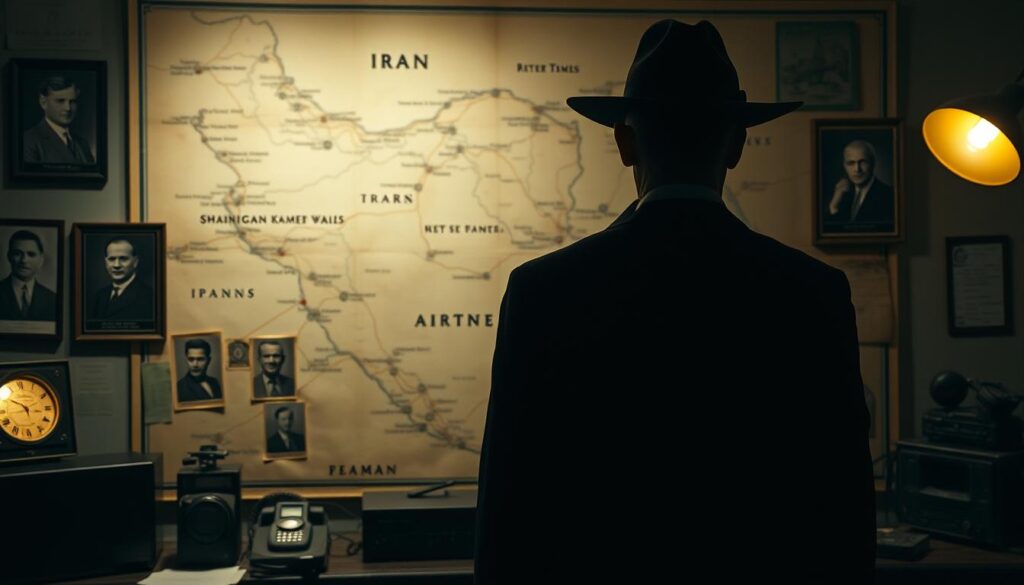
The CIA worked with the Pahlavi dynasty to overthrow Iran’s elected government. They aimed to remove Prime Minister Mohammed Mossadegh and strengthen Shah Mohammed Reza Pahlavi’s power1. This move was a key event in the Cold War, as the U.S. wanted to keep control over Iran’s oil2. It was the CIA’s first attempt to topple a democratically elected government1. The success of Operation Ajax led the CIA to plan similar actions in other countries, like Guatemala1.
Kermit Roosevelt, Jr., a senior CIA agent and Theodore Roosevelt’s grandson, led the operation1. The U.S. saw Iran’s border with the Soviet Union as critical during the Cold War1. With annual oil revenues of $500 million in the early 1950s, equivalent to $4.5 billion today3, the CIA was given a million dollars to help bring down Mossadegh3.
Key Takeaways
- The CIA conducted Operation Ajax to overthrow the elected government of Iran and Prime Minister Mohammed Mossadegh.
- The operation was led by Kermit Roosevelt, Jr., a senior CIA agent and grandson of the former U.S. President Theodore Roosevelt1.
- The U.S. saw Iran’s border with the Soviet Union as strategically significant during the Cold War era1.
- Annual oil revenues in the early 1950s were around $500 million, equivalent to $4.5 billion today3.
- The CIA had green-lit an initial million dollars to “be used by the Tehran Station in any way that would bring about the fall of Mossadegh”3.
- The operation marked the first time the CIA had orchestrated a plot to overthrow a democratically elected government1.
Background of Operation Ajax
The Cold War era was filled with tension between the U.S. and the Soviet Union. Iran’s location, bordering the USSR, made it critical for both countries. This led to a focus on Iran by American and British interests.
The Anglo-Iranian Oil Company was key to Iran’s economy. When Prime Minister Mossadegh pushed for nationalization, it threatened the company’s and British Petroleum‘s power in the area.
Context of the Cold War Era
The U.S. was worried about Soviet expansion. They wanted to have allies in the Middle East. Creating a pro-American government in Iran was seen as a way to fight Soviet influence4.
Key Players Involved
The CIA and British intelligence worked together on the operation. Iranian politicians, like the Tudeh Party, played a big role in the events5.
The Role of Iran’s Nationalization of Oil
Mossadegh’s move to nationalize oil without paying the company raised tensions. This move upset Iran’s relations with Western powers6.
Execution of Operation Ajax
Kermit Roosevelt Jr., a senior CIA agent and grandson of President Theodore Roosevelt, led the planning of the coup d’état against Iran’s Prime Minister, Mohammed Mossadegh. He worked closely with British intelligence and pro-Shah Iranian factions to take down Mossadegh’s government6.
Planning and Coordination by the CIA
The CIA set up a guerrilla force. They made alliances with Qashqai tribal leaders in southern Iran. This was key in setting up the operation6.
Tactics Utilized During the Operation
Propaganda was a big part of the plan. The CIA created “rented” crowds to show wide support. They staged street protests to hide the real goal of the operation7.
Outcomes and Immediate Effects
The coup d’état happened on August 19, 1953. It brought back the monarchy under Shah Mohammad Reza Pahlavi. Mossadegh was arrested, showing the CIA’s strong influence in Iranian politics8.
Long-term Implications of Operation Ajax
Operation Ajax has had a lasting impact on U.S.-Iran relations and the Middle East.
Impact on U.S.-Iran Relations
The fall of Prime Minister Mossadegh created deep distrust between the U.S. and Iran. This distrust grew and led to the Iranian Revolution in 1979. The U.S. embassy takeover was a result of this shift9.
Influence on Middle Eastern Politics
Operation Ajax showed the dangers of foreign intervention in the Middle East. It made the region less stable. The Shah’s return led to authoritarian rule, sparking anti-Western sentiment in Iran and beyond. This hurt efforts for Middle East stability10.
Legacy of Operation Ajax in Modern Context
Today, Operation Ajax’s legacy is clear. Newly released CIA declassified documents have sparked debates on foreign policy and sovereignty. The mistrust from then continues to shape current alliances and strategies in the region.
FAQ
What was Operation Ajax?
Operation Ajax was a secret CIA plan in 1953. It aimed to remove Iran’s elected leader, Mohammed Mossadegh. The goal was to bring back the Shah, Mohammed Reza Pahlavi. This event was a key moment in the Cold War, driven by a desire to control Iran’s oil.
Who were the key players involved in Operation Ajax?
The CIA, led by Kermit Roosevelt Jr. and Donald Wilber, played a big role. British intelligence and pro-Shah groups also helped. On the Iranian side, Prime Minister Mossadegh and Shah Pahlavi were key figures.
What was the primary objective of Operation Ajax?
The main goal was to remove Mossadegh’s government and put the Shah back in power. This was to keep Western control over Iran’s oil and stop Soviet influence during the Cold War.
How did the Cold War context influence Operation Ajax?
The Cold War made the U.S. and its allies worry about Soviet expansion. They feared Mossadegh might turn to the Soviets. So, they planned a coup to protect their interests, mainly oil.
What were the methods used to execute Operation Ajax?
The CIA, British intelligence, and pro-Shah groups worked together. They used propaganda and street protests to make it seem like Mossadegh was unpopular. This helped them stage a successful coup.
What were the immediate outcomes of Operation Ajax?
Mossadegh was overthrown, and the Shah was put back in power. This led to a pro-Western government in Iran. It also gave the West access to Iranian oil and strengthened the Shah’s rule.
How did Operation Ajax affect U.S.-Iran relations?
Operation Ajax created lasting distrust in Iran towards the U.S. The U.S. backing the Shah’s regime and interfering in Iran’s democracy fueled anti-Western feelings. These feelings played a big role in the 1979 Islamic Revolution.
What is the legacy of Operation Ajax in modern Middle Eastern politics?
Operation Ajax left a mark on U.S.-Iran relations, causing ongoing distrust. It set a bad precedent for foreign intervention in the Middle East. This has led to ongoing conflicts and instability in the region.
Source Links
- Operation Ajax (1953) – https://www.thelatinlibrary.com/imperialism/notes/operationajax.html
- Aug. 19, 1953: Operation Ajax – Priya Satia | Department of History – https://history.stanford.edu/news/aug-19-1953-operation-ajax-priya-satia
- Operation Ajax | Bridey Heing – https://www.laphamsquarterly.org/roundtable/operation-ajax
- History Research Paper Sample: Operation Ajax and The United States: Incentives, Actors, and Anti-Communist Foreign Policy – https://www.commschool.org/news/news-post/~board/inside-commonwealth/post/history-research-paper-sample-operation-ajax-and-the-united-states-incentives-actors-and-anti-communist-foreign-policy
- PDF – https://saberandscroll.scholasticahq.com/api/v1/articles/28521-operation-ajax-roots-of-a-tree-grown-in-distrust.pdf
- 1953 Iranian coup d’état – https://en.wikipedia.org/wiki/1953_Iranian_coup_d’état
- 64 Years Later, CIA Finally Releases Details of Iranian Coup – https://foreignpolicy.com/2017/06/20/64-years-later-cia-finally-releases-details-of-iranian-coup-iran-tehran-oil/
- Operation Ajax – (US History – 1945 to Present) – Vocab, Definition, Explanations | Fiveable – https://library.fiveable.me/key-terms/united-states-history-since-1945/operation-ajax
- Operation Ajax Was Always An Open Secret | A Timeline – https://www.mohammadmossadegh.com/1953/operation-ajax/an-open-secret/
- The Coup Against Iran’s Mohammad Mossadegh – Association for Diplomatic Studies & Training – https://adst.org/2015/07/the-coup-against-irans-mohammad-mossadegh/