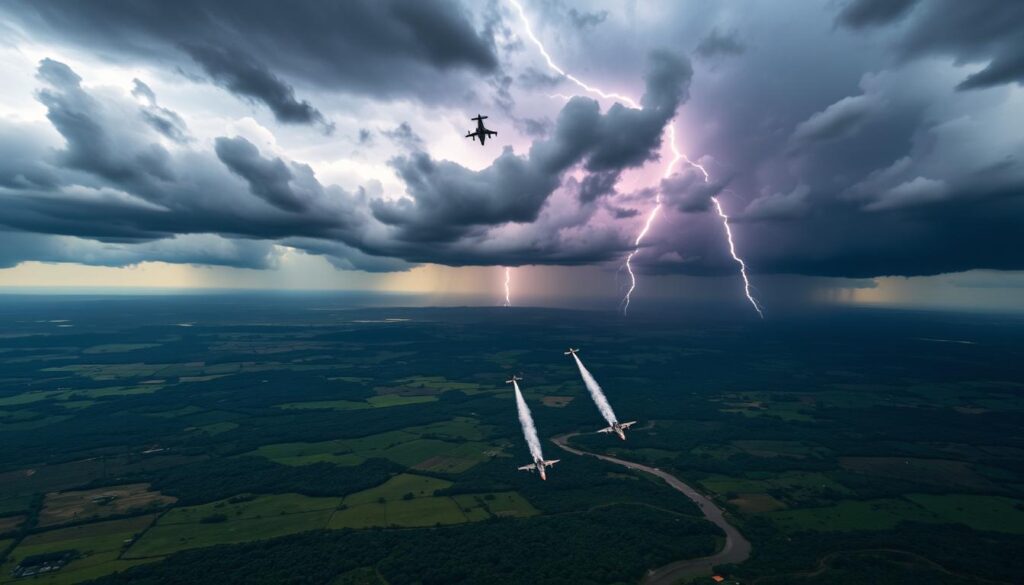
Operation Rolling Thunder was a key part of the Vietnam War. It involved the U.S. and its allies bombing North Vietnam for years1. The goal was to help the Saigon regime and stop North Vietnam’s support for the South1.
This campaign lasted from 1965 to 1968. It was a major part of the war. The Rolling Thunder air campaign was the longest and most debated in U.S. history2.
The U.S. dropped a lot of bombs, like in World War II1. The first bombing started on 2 March 1965. During this time, Navy pilots shot down 29 enemy planes while losing eight to MiGs3.
The Vietnam War was tough, and Operation Rolling Thunder was a big part of the U.S. strategy. The goal was to win the war with air power and ground forces3.
Key Takeaways
- Operation Rolling Thunder was a significant military campaign during the Vietnam War.
- The campaign involved a gradual and sustained aerial bombardment of North Vietnam.
- The goal of the operation was to boost the morale of the Saigon regime and disrupt North Vietnam’s support for the Communist insurgency.
- The campaign lasted from 1965 to 1968 and was a critical part of the war.
- The operation involved a series of bombing raids against North Vietnamese targets, with a high volume of bombs being dropped.
- The Rolling Thunder air campaign was considered the longest, most controversial, and most restrictive air war in American history2.
Overview of Operation Rolling Thunder
Operation Rolling Thunder was a bombing campaign by the United States during the Vietnam War. It aimed to weaken North Vietnam’s support for the South while showing American commitment4.
Purpose and Objectives
The operation had four main goals:
- Boost the morale of South Vietnam.
- Persuade North Vietnam to stop supporting the communist insurgency without using ground forces.
- Destroy North Vietnam’s transportation, industrial base, and air defenses.
- Stop the flow of men and supplies into South Vietnam.
These goals changed over time, becoming more aggressive as the campaign went on4.
Timeline and Duration
Operation Rolling Thunder started on March 2, 1965, and ended on November 2, 1968. It lasted over three years5. During this time, the U.S. military changed its strategies due to new challenges and peace talks.
| Phase | Milestones |
|---|---|
| Initiation | March 2, 1965 – Campaign begins |
| Expansion | August 1964 – Air operations expanded by President Johnson |
| Scaling Back | March 1968 – Operations limited due to effectiveness and peace talks |
| Conclusion | November 2, 1968 – Operation officially ended |
Key Participants
U.S. Air Force and Navy units, along with the Republic of Vietnam Air Force, were key players. General Curtis LeMay and Secretary of Defense Robert McNamara were important in planning. The operation also affected veterans and raised POW/MIA concerns, as many American pilots were captured or went missing45.
Strategies and Tactics Employed
The Operation Rolling Thunder showed a mix of bold moves and careful steps. It aimed to push forward without starting a big war.
Air Power Utilization
On March 2, 1965, the U.S. Air Force and South Vietnamese Air Force started “Rolling Thunder.” This was the start of a big air attack on North Vietnam6. Over 43 months, they kept hitting military and industrial spots to cut off North Vietnam’s supplies67.
The B-52 bombers were key, dropping huge amounts of bombs to weaken the enemy’s bases7. But, they didn’t quite reach their main goals of breaking North Vietnam’s will and stopping their supplies7.
Ground Forces Involvement
Ground troops helped by defending air bases and joining fights to help the air attacks6. Their plan was like the motorcycle rides to Washington D.C., where everyone comes together7. This shows how important it is to work together and plan well, whether in war or in rallies.
| Strategy | Objective | Outcome |
|---|---|---|
| Extensive Bombing Campaign | Disrupt supply lines and weaken infrastructure | Limited success; North Vietnam endured significant destruction |
| Deployment of B-52 Bombers | Maximize bombing efficiency | Millions of tons of bombs dropped, minimal strategic impact |
| Ground Force Support | Protect air bases and engage combat roles | Enhanced defense capabilities, gradual combat escalation |
| Strategic Restraint | Avoid provoking China and the Soviet Union | Maintained diplomatic balance but limited campaign effectiveness |
Impact and Consequences
Operation Rolling Thunder had a big impact on Vietnam and the United States. It caused a lot of destruction and loss of life right away.
Short-Term Outcomes
The campaign dropped over 643,000 tonnes of bombs. This was more than in World War II and the Korean War combined8. Despite all the effort, it didn’t really hurt North Vietnam’s infrastructure9.
It cost about 300 million dollars and almost 900 American planes were lost8.
Long-Term Effects on U.S. Military Strategy
The limited success of Rolling Thunder changed how the U.S. uses air power. It taught them to be more precise and sustainable in future wars9.
Civilian Impact and Ethical Considerations
The bombing hurt Vietnamese civilians a lot. About 30,000 were killed and many buildings were destroyed8. Chemical agents like Agent Orange also harmed the environment and people’s health for years8.
This raised big questions about war and protecting people who aren’t fighting.
The war also hurt American veterans a lot. They faced physical and mental challenges. Groups like Rolling Thunder Inc. help them, fighting for their rights and remembering their sacrifices8.
FAQ
What was Operation Rolling Thunder?
Operation Rolling Thunder was a bombing campaign by the U.S. against North Vietnam from 1965 to 1968. It aimed to weaken North Vietnam’s military and demoralize its people during the Vietnam War.
What were the primary objectives of Operation Rolling Thunder?
The main goals were to show American strength, boost South Vietnamese morale, and disrupt North Vietnamese supply lines. It also aimed to pressure North Vietnam to stop supporting the Viet Cong in the South.
Who were the key participants in Operation Rolling Thunder?
Key players included President Lyndon B. Johnson and his team, military leaders like General Curtis LeMay, and Secretary of Defense Robert McNamara. The U.S. Air Force and Navy worked with the Republic of Vietnam Air Force.
How did Operation Rolling Thunder impact the Vietnam War?
It made the Vietnam War much more intense, one of the biggest air campaigns of the Cold War. Though it didn’t meet its main goals, it changed U.S. military strategy. It also had big effects on Vietnamese civilians and American veterans.
What strategies and tactics were employed during Operation Rolling Thunder?
The operation used a lot of air power, bombing military and industrial targets. It introduced new tech like advanced planes and weapons. Ground forces defended air bases and supported the air campaign.
How did Operation Rolling Thunder influence U.S. military strategy?
It showed air power’s limits in achieving goals. This led to better air-ground operations and new doctrines on limited warfare and air superiority.
What were the short-term outcomes of Operation Rolling Thunder?
Short-term, it didn’t really disrupt North Vietnamese supply lines or break their will. It showed U.S. military strength but didn’t win a decisive victory. It also raised tensions in the area.
What ethical considerations arose from Operation Rolling Thunder?
It raised questions about the impact of bombing on civilians. The destruction of infrastructure and loss of lives were big concerns. These issues highlighted the moral challenges of using force in war.
How has Operation Rolling Thunder affected veterans and POW/MIA issues?
Many pilots were captured, leading to ongoing POW/MIA concerns. The experience had a big impact on veterans. It led to advocacy efforts to support them and remember their sacrifices.
What is Rolling Thunder Inc. and its role in veteran advocacy?
Rolling Thunder Inc. is a group supporting Vietnam War veterans and POW/MIA issues. They organize motorcycle rides to Washington D.C. to honor veterans and fight for their rights.
How are motorcycle rallies connected to Operation Rolling Thunder?
Motorcycle rallies, like those by Rolling Thunder Inc., remember Operation Rolling Thunder. They bring veterans and supporters together to honor those who served and advocate for POW/MIA issues.
How did Operation Rolling Thunder compare to other aerial campaigns in history?
It’s often compared to bombing Germany in World War II for its scale and intensity. But unlike World War II, Rolling Thunder had limited success. It showed the challenges of air campaigns in achieving goals.
Source Links
- Behind the Fog of War – Association for Diplomatic Studies & Training – https://adst.org/2015/07/rolling-thunder-behind-the-fog-of-war/
- THE RULES OF DEFEAT: THE IMPACT OF AERIAL RULES OF ENGAGEMENT ON USAF OPERATIONS IN NORTH VIETNAM, 1965-1968 – https://media.defense.gov/2017/Dec/28/2001861735/-1/-1/0/T_DRAKE_RULES_OF_DEFEAT.PDF
- H-017-2: Operation Rolling Thunder Overview – https://www.history.navy.mil/about-us/leadership/director/directors-corner/h-grams/h-gram-017/h-017-2.html
- Operation Rolling Thunder – https://en.wikipedia.org/wiki/Operation_Rolling_Thunder
- Operation Rolling Thunder ‑ Definition, Vietnam War & Timeline – https://www.history.com/topics/vietnam-war/operation-rolling-thunder
- Rolling Thunder and the Law of War – https://biotech.law.lsu.edu/cases/nat-sec/Vietnam/Rolling-Thunder-and-the-Law-of-War.html
- Operation Rolling Thunder – (AP World History: Modern) – Vocab, Definition, Explanations | Fiveable – https://library.fiveable.me/key-terms/ap-world/operation-rolling-thunder
- Operation Rolling Thunder: Summary & Facts – https://www.vaia.com/en-us/explanations/history/cold-war/operation-rolling-thunder/
- Rolling Thunder – (Honors World History) – Vocab, Definition, Explanations | Fiveable – https://library.fiveable.me/key-terms/hs-honors-world-history/rolling-thunder