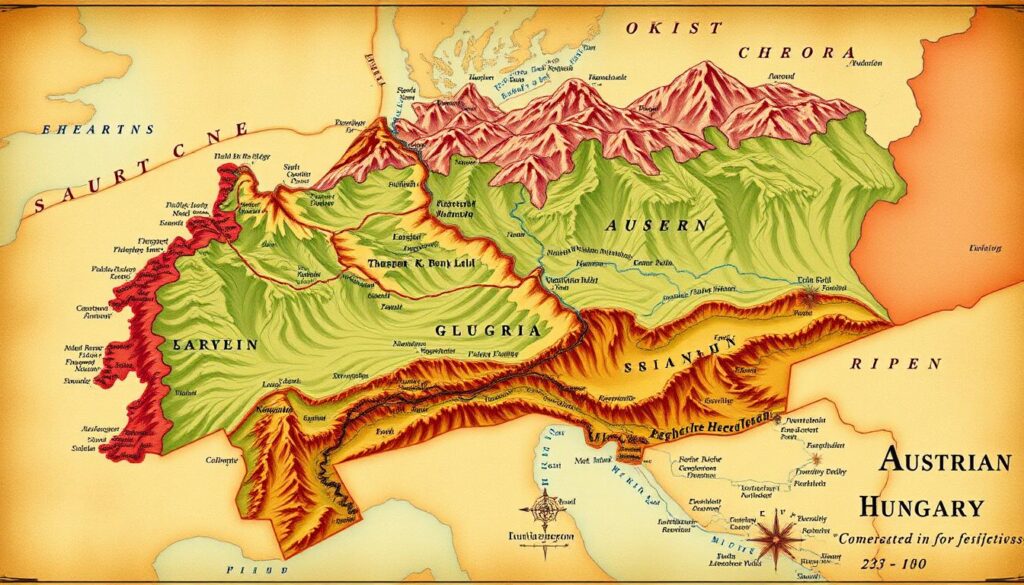
Austria-Hungary, also known as the Austro-Hungarian Empire, was a dual monarchy from 1867 to 1918. It played a big role in Central Europe’s history. The Habsburg dynasty ruled it, thanks to the Austro-Hungarian Compromise1.
The empire was huge, the second-largest in Europe, and had a lot of people. It had a special setup that let Hungary have a lot of freedom, thanks to the Ausgleich of 18671. It was made up of many ethnic groups. Its legacy affects the region’s politics and culture today. For example, the border between Austria and Hungary is open, thanks to the Schengen Agreement2.
The Austro-Hungarian Empire was a big power in Europe, with Vienna as its capital. It was famous for its culture, including music, art, and literature. Famous composers like Joseph Haydn lived and worked there2.
The empire’s history includes big events like World War I. This led to its end. The Treaty of Trianon also had a big impact, making Hungary lose a lot of land and people1.
Key Takeaways
- Austria-Hungary was a dual monarchy that existed from 1867 to 1918.
- The empire was the second-largest country in Europe by area and the third most populous.
- The Habsburg dynasty played a significant role in shaping the empire’s history.
- Austria-Hungary was a complex entity, comprising various ethnic groups.
- The empire’s legacy continues to shape the region’s politics and culture.
- The shared border between Austria and Hungary can be crossed without control due to the Schengen Agreement2.
- Hungary lost significant territory and population following the Treaty of Trianon1.
Historical Overview of Austria-Hungary
The Austro-Hungarian Compromise of 1867 created a dual monarchy. It gave Hungary full control over its internal affairs3. This deal helped balance the power between Austria and Hungary, allowing them to govern themselves while sharing some institutions.
Formation and Early Years
The Austro-Hungarian Compromise of 1867 was a key moment. It was passed as a law by the Hungarian parliament3. This agreement let two states exist together under one emperor, creating a unique political system.
Key Figures and Leaders
Emperor Franz Joseph I ruled from 1867 to 19164. He played a vital role in keeping the balance between Austria and Hungary. His leadership helped the empire through good times and bad, shaping its policies and actions.
Major Conflicts and Wars
Austria-Hungary was a key member of the Central Powers in World War I3. Its involvement in the war led to its downfall in 1918. Managing a diverse empire during war showed the deep internal problems that weakened it.
Cultural Contributions of Austria-Hungary
Austria-Hungary was a beacon of Habsburg culture. It fostered a vibrant environment for artistic and intellectual growth.
Literature and Philosophy
Franz Kafka became a key figure in literature. He explored complex themes within the empire’s diverse society.
Music and Art Movements
The Vienna Secession movement changed art, led by Gustav Klimt. His works were full of symbols. In music, Bela Bartok used folk traditions, adding to the empire’s rich musical heritage.
Architectural Innovations
The architecture of Austria-Hungary showed its cultural diversity and modern dreams. It featured grand imperial buildings and new urban plans.
| Field | Key Figures | Contributions |
|---|---|---|
| Literature | Franz Kafka | Explored existential themes and modernist narratives |
| Art | Gustav Klimt | Leading figure in the Vienna Secession movement |
| Music | Bela Bartok | Incorporated folk traditions into classical compositions |
Political Structure of Austria-Hungary
The Austro-Hungarian Empire was a complex system designed to manage a vast, multiethnic empire. It was shaped by the Austro-Hungarian Compromise of 1867. This compromise created a dual monarchy system.
Dual Monarchy Explained
The empire was divided into two regions: Cisleithania (Austria) and Transleithania (Hungary). At first, 70% of common expenses went to Austria, and 30% to Hungary5. By 1907, Hungary’s share rose to 36.4%, showing a shift in economic focus5.
Each region had its own parliament. The Imperial Council governed Cisleithania, and the Diet of Hungary managed Transleithania. This ensured each region could govern itself within the empire56.
Ethnic Diversity and Tensions
The empire’s strength came from its diversity, but it also faced big challenges. Managing the hopes of different ethnic groups was a delicate task. The Fundamental Laws of 1867 aimed to protect minority rights and ensure equality, promoting a sense of belonging in the empire6.
Reforms and Governance
Governance reforms were key to adapting to the empire’s changing social and economic scene. Separate governments and parliaments allowed for region-specific policies. Yet, financial cooperation through a customs union and shared accounts needed regular updates, sometimes causing disagreements between Austrian and Hungarian leaders6.
The End of Austria-Hungary
The collapse of Austria-Hungary was a big change in Central European history. The war put a lot of stress on the empire, leading to its fall.
World War I and its Impact
World War I was very hard on Austria-Hungary. It made the economy worse and damaged the country’s buildings. By 1918, people were facing a lot of hardship and hunger7.
The 1918 flu pandemic also made things worse. It added to the empire’s problems7. Groups wanting their own countries grew stronger, making the empire weaker8.
Treaty of Saint-Germain
The Treaty of Saint-Germain-en-Laye in September 1919 ended Austria-Hungary. It created new countries and set their borders7. The Treaty of Trianon in June 1920 changed Hungary’s borders even more7.
These treaties ended the Austro-Hungarian monarchy. They changed the map of Europe7.
Legacy and Remnants of the Empire
The legacy of Austria-Hungary is seen in today’s countries. Places like Austria, Hungary, Czechoslovakia, and Yugoslavia were shaped by the empire7. The empire’s art and buildings are part of Central Europe’s culture.
The borders and ethnic groups set by the empire’s fall are important today8.
FAQ
What was the dual monarchy system in Austria-Hungary?
The dual monarchy system was set up in 1867. It made Austria and Hungary two separate places under one king. This system let each part handle its own business but they worked together on big issues like foreign policy.
Who was Emperor Franz Joseph I and what was his role in Austria-Hungary?
Emperor Franz Joseph I ruled Austria-Hungary from 1848 until 1916. He kept the peace between Austria and Hungary, dealing with many problems. He was important in both the country’s inside and outside affairs, leading through changes and wars, including World War I.
How did Austria-Hungary contribute to European culture?
Austria-Hungary was a place of new ideas in culture. It helped shape European writing, music, and art. Famous people like Franz Kafka and Bela Bartok came from there. The Vienna Secession movement and Gustav Klimt changed art. The empire’s buildings also showed its rich culture and new ideas.
What were the main factors that led to the dissolution of Austria-Hungary?
World War I was the main reason Austria-Hungary fell apart. The war made old problems worse and caused more. The war effort made people want their own countries, leading to trouble. Losing the war and the treaties that followed ended the empire and started new countries.
What was the Austro-Hungarian Compromise of 1867?
The Austro-Hungarian Compromise of 1867 was a big deal. It made Austria and Hungary work together but also gave Hungary a lot of power. This helped keep the empire stable by balancing the needs of both sides.
How did ethnic diversity impact the political structure of Austria-Hungary?
The many ethnic groups in Austria-Hungary were both a blessing and a curse. They brought rich culture but also caused problems. The dual monarchy tried to solve these by giving Hungary a lot of freedom. But, the differences between groups kept causing trouble and led to the empire’s fall.
What was the role of Austria-Hungary in World War I?
Austria-Hungary was a key player in World War I. It fought against the Allies with Germany and others. The war started with the death of Archduke Franz Ferdinand in 1914. It drained the empire’s resources, made divisions worse, and led to its downfall.
What legacy did Austria-Hungary leave on Central Europe?
Austria-Hungary’s impact is seen in Central Europe’s culture, politics, and buildings. It influenced literature, music, and art. Its politics and borders helped shape today’s countries. The empire’s architecture and city planning, like in Vienna and Budapest, show its lasting influence.
Source Links
- Hungary – Countries – Office of the Historian – https://history.state.gov/countries/hungary
- Austria–Hungary relations – https://en.wikipedia.org/wiki/Austria–Hungary_relations
- Austria-Hungary | History, Definition, Map, & Facts | Britannica – https://www.britannica.com/place/Austria-Hungary
- Austria-Hungary – https://en.wikipedia.org/wiki/Austria-Hungary
- Government of Austria-Hungary – https://en.wikipedia.org/wiki/Government_of_Austria-Hungary
- Austria – Habsburg Empire, Dual Monarchy, WWI | Britannica – https://www.britannica.com/place/Austria/Austria-Hungary-1867-1918
- Dissolution of Austria-Hungary – https://en.wikipedia.org/wiki/Dissolution_of_Austria-Hungary
- World War I – Austria-Hungary, Collapse, Causes | Britannica – https://www.britannica.com/event/World-War-I/The-collapse-of-Austria-Hungary