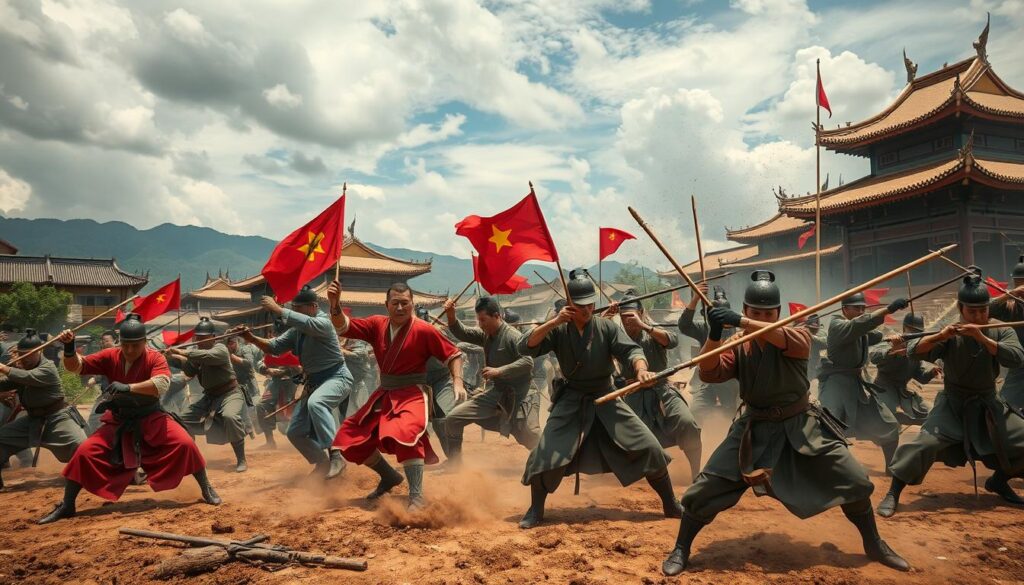
The Boxer Rebellion was a key event in Chinese history. It was a fight against foreign influence and imperialism. The Boxer Rebellion in China led to the deaths of 32,000 Chinese Christians and 200 Western missionaries in northern China1.
This rebellion, also known as the China Boxer Rebellion, happened in North China from 1899 to 1901. It was against foreign, imperialist, and Christian influence. The Boxer Rebellion summary shows the main events and outcomes of this uprising. It was started by the Society of Righteous and Harmonious Fists, known as the “Boxers” in English, in the northern coastal province of Shandong1.
The Boxer Rebellion was a major event in Chinese history. It targeted Chinese Christians and foreigners, starting in Shandong Province2. To understand the Boxer Rebellion, we need to look at the origins of the “Boxers,” their reasons, and the political and social climate that led to their uprising. The Boxers had between 100,000 to 300,000 fighters1.
By studying this period, we learn about the cultural, economic, and political factors that influenced China at the start of the 20th century. The Boxer Rebellion led to the Boxer Protocol, which required China to pay 450 million taels of silver as indemnity over 39 years to the Eight-Nation Alliance1.
Key Takeaways
- The Boxer Rebellion was an anti-foreign, anti-imperialist, and anti-Christian uprising in North China between 1899 and 1901.
- The rebellion resulted in significant losses, including 32,000 Chinese Christians and 200 Western missionaries killed in northern China1.
- The Boxer Rebellion was initiated by the Society of Righteous and Harmonious Fists, known as the “Boxers” in English, with the movement starting in the northern coastal province of Shandong1.
- The rebellion targeted Chinese Christians and foreigners, originating in Shandong Province2.
- The estimated strength of the Boxers was between 100,000 to 300,000 fighters1.
- The Boxer Rebellion resulted in the signing of the Boxer Protocol, which required the payment of 450 million taels of silver as indemnity over 39 years to the Eight-Nation Alliance1.
Historical Context of the Boxer Rebellion
In the late 19th century, China faced huge challenges. Economic troubles were common, with many areas struggling with poverty and instability3. Natural disasters like floods and droughts made things worse, weakening the government’s power to act4.
Background of China in the Late 19th Century
The Qing Dynasty was dealing with internal conflicts and outside pressures. Trade was mostly in Guangzhou until the early 1800s3. The First Opium War in 1839 changed things, letting British forces into more Chinese ports3.
Rise of Anti-Foreign Sentiment
As more foreigners came in, Chinese people grew angrier. Opium addiction, caused by British trade, added to the unrest3. Christian missionaries also threatened traditional beliefs, making things even more tense4.
Influence of Western Powers in China
By the late 19th century, Western powers and Japan had big roles in China. They controlled key economic areas4. The Sino-Japanese War of 1894-95 made China lose territory, raising national pride3.
| Event | Year | Impact |
|---|---|---|
| First Opium War | 1839 | British access to Chinese ports3 |
| Second Opium War | 1856 | Defeat of China by British and French forces3 |
| Sino-Japanese War | 1894-95 | Territorial gains by Japan3 |
| Boxer Rebellion | 1899-1901 | Destruction of infrastructure and increased anti-foreign sentiment3 |
Key Events During the Boxer Rebellion
The Boxer Rebellion had many important events that shaped its outcome. This timeline shows the key moments that defined the uprising.
Initial Uprisings and Key Locations
The Boxer Uprising started in northern China’s rural areas. Secret societies and anti-foreign feelings sparked the first rebellions. Shandong and Hebei provinces were key, where Boxers attacked foreign missionaries and Chinese Christians5.
The Siege of Beijing
In June 1900, Boxers attacked Beijing, starting the famous Siege of the Legation Quarter. This siege lasted 55 days. It trapped 473 foreign civilians, 400 soldiers, and 3,000 Chinese Christians5.
The siege showed the intense conflict and the desperation of those inside.
International Response and Intervention
The Boxer Rebellion’s severity led to an international response. Eight nations, including the U.S. and Japan, sent about 19,000 troops5. The American Marines, led by Captain John T. Myers, were key. They had 50 Marines, 5 sailors, and a doctor6.
Their help was vital in ending the siege and restoring order in Beijing6.
Consequences of the Boxer Rebellion
The Boxer Rebellion changed China a lot, affecting its future inside and outside the country. It’s important to understand these Boxer Rebellion consequences to see its significance in history.
Treaty of Boxer Protocol
The Boxer Protocol was signed on September 7, 1901, ending the fighting7. China had to pay about 450 million silver taels, over US$330 million then7. The U.S. got a deal to pay less, $10.6 million, for Chinese students in American schools7
Impact on China’s Sovereignty
The treaty made China lose a lot of control to foreign powers8. The big payments hurt the economy and made people unhappy with the Qing7. Foreign powers kept coming in, making China hard to govern on its own8.
Long-term Effects on Chinese Society
The Boxer Rebellion made the Qing Dynasty weaker, leading to its fall in 19117. China then made big changes, like updating the military and schools, and changing taxes7. These steps helped China move forward, leading to the rise of nationalism and the warlord era7.
| Consequence | Description |
|---|---|
| Boxer Protocol | Ended hostilities and imposed hefty indemnities on China7 |
| Economic Impact | Indemnity payments drained the treasury, causing economic distress7 |
| Sovereignty | Increased foreign control and diminished Qing authority8 |
| Political Reforms | Modernization of military, education, and taxation systems7 |
| Fall of Qing Dynasty | Rebellion weakened the dynasty, leading to its demise in 19117 |
| Rise of Nationalism | Accelerated anti-Qing sentiment and unified efforts towards modernization7 |
Legacy of the Boxer Rebellion
The Boxer Rebellion is a key moment in Chinese history. It has shaped China’s identity and its relations with the world.
Cultural Representation in Modern Media
Books and films often tell the story of the Boxer Rebellion. They show the struggles and strength of those who lived through it. These stories give us a glimpse into a difficult time.
Lessons Learned from Historical Events
Looking at the Boxer Rebellion teaches us about foreign intervention and national sovereignty9. These lessons help us understand today’s global relations and how to solve conflicts.
The Rebellion’s Role in China’s Nationalism
The Boxer Rebellion sparked a strong sense of national pride10. It brought the Chinese people together, creating a shared identity. This movement was key to the fall of the Qing dynasty and the rise of the Republic of China9.
FAQ
What was the Boxer Rebellion?
The Boxer Rebellion, also known as the Boxer Uprising, was a big anti-foreign and anti-imperialist movement in China. It happened from 1899 to 1901. The Boxers, a militant group, wanted to get rid of foreign influence and bring back Chinese traditions.
What were the main causes of the Boxer Rebellion?
The Boxer Rebellion causes were many. People were very poor, had suffered from natural disasters, and were angry at foreign powers and Christian missionaries. These issues made the Boxers’ anger grow, leading to the rebellion.
What were the key events in the Boxer Rebellion timeline?
The Boxer Rebellion timeline shows key events. These include the start of uprisings in northern China, the siege of Beijing’s Legation Quarter, and the help from the Eight-Nation Alliance. These events led to the fall of the Qing Dynasty and big changes in China’s politics.
How did the international community respond to the Boxer Uprising?
The international response to the Boxer Uprising was quick and strong. Eight nations, like Japan, Russia, and the U.S., joined forces as the Eight-Nation Alliance. They helped end the siege on Beijing and made the Boxer Protocol.
What were the consequences of the Boxer Rebellion for China?
The Boxer Rebellion consequences were huge. China had to sign the Treaty of Boxer Protocol, which made it pay heavy fines and lost some of its freedom. The rebellion also made the Qing Dynasty weaker and helped start Chinese nationalism.
Why is the Boxer Rebellion significant in Chinese history?
The Boxer Rebellion significance is huge. It was a big push for change in China. It showed the fight between old Chinese ways and new foreign influences. This fight helped bring down the Qing Dynasty and start modern Chinese nationalism.
What is the legacy of the Boxer Rebellion in today’s world?
The Boxer Rebellion legacy is seen in China’s story and how it deals with other countries. The rebellion is seen as a fight against imperialism. Its lessons help China today as it modernizes and deals with the world.
How did the Boxer Rebellion impact China’s sovereignty?
The Boxer Rebellion impact on China’s sovereignty was big. The fines and lost land made the Qing government weaker. This weakness let foreign powers and internal problems grow, leading to big changes and reforms.
Can you provide a summary of the Boxer Rebellion?
The Boxer Rebellion summary is about a violent fight in China. It aimed to get rid of foreign influence and bring back old values. It lasted from 1899 to 1901, involved a siege of Beijing, and many foreign powers. It had big effects on China’s politics and society.
Source Links
- Boxer Rebellion – https://en.wikipedia.org/wiki/Boxer_Rebellion
- The Boxer Rebellion: Bluejackets and Marines in China, 1900-1901 – https://www.history.navy.mil/browse-by-topic/wars-conflicts-and-operations/early-20th-century-conflicts/boxer-rebellion.html
- The Boxer Rebellion Explained: Uprising in China – https://www.thecollector.com/boxer-rebellion-in-china/
- Boxer Rebellion – https://www.historycrunch.com/boxer-rebellion.html
- What Happened in the Boxer Rebellion? – https://www.thoughtco.com/timeline-of-the-boxer-rebellion-195604
- PDF – https://www.usmcu.edu/Portals/218/HD/Brief Histories/Boxer Rebellion Lecture Notes.pdf?ver=2019-05-23-084222-070
- Consequences of the Boxer Rebellion – China Insight – https://chinainsight.info/history/1177-consequences-of-the-boxer-rebellion.html
- Boxer Rebellion: Causes & Effects – https://www.vaia.com/en-us/explanations/chinese/chinese-social-issues/boxer-rebellion/
- Boxer Rebellion: China, Definition & Cause | HISTORY – https://www.history.com/topics/asian-history/boxer-rebellion
- The Boxer Rebellion | National Army Museum – https://www.nam.ac.uk/explore/boxer-rebellion