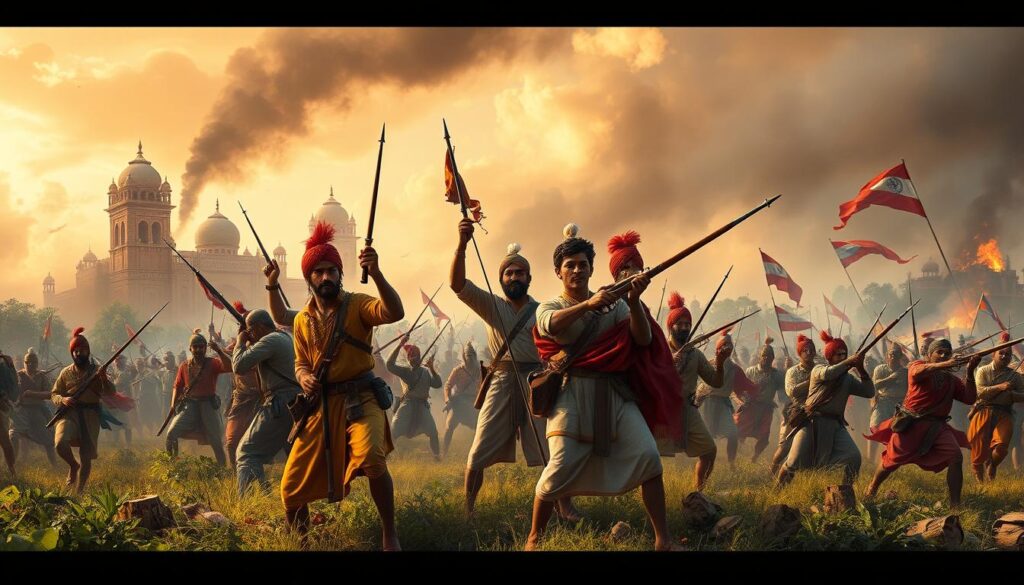
The Indian Rebellion of 1857 was a key event in British India’s history. It challenged British rule and changed the political landscape of the subcontinent under the British Raj1. This uprising started on May 10, 1857, with a mutiny in Meerut, a key town in the rebellion2.
The British East India Company controlled most of India at the time. The Bengal Army had 159,000 soldiers, with 24,000 Europeans and 135,000 Indians3.
The rebellion was a complex uprising across India. It mainly happened in the upper Gangetic plain and central India. It spread to Delhi, North-Western Provinces, and Awadh, earning it the names “Sepoy Mutiny” and “First War of Independence”2.
The rebellion led to the East India Company’s end. India was then directly ruled by the British government through the Government of India Act 18581. About 800,000 Indians died in the rebellion and its aftermath, including famine and disease. British losses were around 6,000, including civilians1.
Key Takeaways
- The Indian Rebellion of 1857 was a key moment in British India’s history, challenging British rule under the British Raj.
- The rebellion started on May 10, 1857, with a mutiny in Meerut.
- The British East India Company controlled two-thirds of India, with the Bengal Army having 159,000 soldiers.
- Estimates suggest that around 800,000 Indians died in the rebellion and its aftermath.
- The rebellion led to the East India Company’s end and direct British rule through the Government of India Act 1858.
- The Indian Rebellion of 1857 was also known as the “Sepoy Mutiny” or the “First War of Independence” and involved various regions of India.
Historical Context of the Indian Rebellion
The Indian Rebellion of 1857 was sparked by decades of British colonialism. This period reshaped the subcontinent. The East India Company had become a dominant force, controlling vast areas of India and affecting every part of life.
British Colonial Rule in India
The East India Company started in 1612. It grew from a trading company to a major ruler, controlling two-thirds of India by the mid-19th century. Despite a huge native population of about 250 million, only 125,000 British civilians lived in India4.
Early Signs of Dissent
As British colonialism grew, it often ignored and belittled Indian culture and religion. This caused a lot of anger. The introduction of Western education and laws also alienated many, leading to organized resistance.
Key Socioeconomic Factors
The East India Company’s economic policies hurt traditional industries and farming. This caused a lot of trouble for the local people. High taxes and taking land away added to the economic problems, leading to growing unrest. This unrest would later fuel the Indian Independence Movement.
| Factor | Impact |
|---|---|
| East India Company Governance | Controlled large territories, marginalized local leaders |
| Economic Policies | Disrupted traditional industries, increased taxes |
| Cultural Suppression | Undermined religious and social practices |
| Population Disparity | 250 million natives vs. 125,000 British |
Major Events During the Rebellion
The 1857 Rebellion marked a turning point in India’s history. It started in Meerut and quickly spread across northern India. People from different areas joined the cause.
The Revolt Begins: March 1857
Tensions had been building before the May 10, 1857, mutiny. On February 26, sepoys at Berhampore refused to practice with rifles5. Mangal Pandey’s actions on March 29 at Barrackpore also sparked dissent5.
Notable Battles and Leaders
The sieges of Delhi and Lucknow were intense battles. Leaders like Nana Sahib and Tantia Tope fought for the rebels. British forces, led by General Anson and Major-General Sir Henry Bernard, fought to keep control5.
Role of Indian Soldiers
Indian soldiers, or sepoys, played a key role in the Sepoy Mutiny. Their involvement showed widespread discontent with British rule. The rebellion highlighted the strategic value and weaknesses of the sepoy ranks6.
| Date | Event | Reference |
|---|---|---|
| May 10, 1857 | Mutiny at Meerut | 5 |
| June 5, 1857 | Siege of Cawnpore begins | 5 |
| July 31, 1857 | ‘Clemency’ resolution issued by Lord Canning | 5 |
| September 5, 1857 | Rebellion suppression begins | 6 |
| July 8, 1858 | Peace treaty signed, rebellion officially ends | 6 |
Impact and Consequences of the Rebellion
The Indian Rebellion of 1857 was a major turning point. It led to big changes in how the subcontinent was governed and in society.
Immediate Aftermath
The British faced heavy losses after the rebellion. About 2,000 soldiers were killed7. The chaos spread to Delhi, Cawnpore, and Lucknow, causing a lot of trouble8.
Changes in British Policy
The uprising led to the end of the East India Company. In 1858, the British government took over, starting the British Raj7. This change made the administration, military, and finances in India more centralized7.
Long-Term Effects on Indian Society
The rebellion sparked the Indian Independence Movement. It made Indians more aware of politics and fueled their desire for freedom7. It also started to change social structures as people began to resist British rule more openly.
Legacy of the Indian Rebellion
The Indian Rebellion of 1857 was a key moment in the fight for India’s freedom. Its impact is felt today in India and around the world.
Remembrance and Commemoration
In India, the 1857 Revolt is seen as the First War of Independence. Many memorials and events honor those who fought against the British. In Britain, it’s studied as a major event that changed colonial policies9.
Influence on Future Independence Movements
The rebellion inspired many Indian leaders to fight for freedom. Mahatma Gandhi, for example, learned from the 1857 Revolt. He used its lessons to lead India to independence in 194710.
The Rebellion in Popular Culture
The 1857 events have been shown in books, movies, and TV shows. These stories keep the rebellion’s memory alive. They show its importance in India’s battle against colonialism910.
FAQ
What was the Indian Rebellion of 1857?
The Indian Rebellion of 1857, also known as the Sepoy Mutiny or the First War of Indian Independence, was a big uprising against British rule in India. It was a key moment in the history of the British Raj. It challenged the East India Company’s authority and paved the way for India’s fight for freedom.
What were the main causes of the Sepoy Mutiny?
The Sepoy Mutiny was caused by many things. People were upset with British rules, cultural and religious issues, and economic problems. The new rifle cartridges were also a big issue because they were greased with animal fat, upsetting both Hindus and Muslims.
How did British colonial rule contribute to the Revolt of 1857?
British rule played a big part in the Revolt of 1857. They changed Indian society and economy in ways that upset people. They ignored local customs and rules, leading to anger. Economic issues like heavy taxes and land reforms also made Indians unhappy, creating a perfect storm for rebellion.
Who were the key leaders during the First War of Indian Independence?
The First War of Indian Independence had many leaders. Mangal Pandey, Rani Lakshmibai of Jhansi, Bahadur Shah Zafar, and Tantia Tope were among them. They played big roles in leading the fight against the British, inspiring many across India.
What were the major battles of the Indian Mutiny?
The Indian Mutiny saw many big battles. The Siege of Delhi, the Siege of Lucknow, the Battle of Kanpur, and the Battle of Gwalior were some of them. These battles were fierce, with rebels and British troops fighting hard, changing the course of the rebellion.
What were the immediate consequences of the 1857 Rebellion?
After the 1857 Rebellion, the British took harsh actions. They executed many and punished civilians. The East India Company was shut down, and the British Crown took over India. This marked a big change in how India was governed.
How did the British Raj change after the Revolt of 1857?
After the Revolt of 1857, the British Raj made some big changes. They changed the military to have fewer Indian soldiers and more British officers. They also tried to respect Indian culture and religion more. They made some administrative changes to better fit India into the British Empire.
What is the legacy of the Indian Rebellion of 1857 on the Indian Independence Movement?
The Indian Rebellion of 1857 had a huge impact on India’s fight for freedom. It made Indians more aware of their unity and desire for self-rule. It was a key step towards India’s freedom in 1947.
How is the Revolt of 1857 remembered in modern India and Britain?
In modern India, the Revolt of 1857 is celebrated as a fight for freedom. It is honored through monuments, books, and events. In Britain, it is seen as a significant event, but not as widely remembered. This shows the complex views of the British Raj in both countries.
What role did Indian soldiers play in the 1857 Rebellion?
Indian soldiers, or sepoys, were key in the 1857 Rebellion. They were upset with British rules and cultural insensitivity. Their mutiny was a big part of the rebellion’s early success, as they fought hard against the British.
Source Links
- Indian Rebellion of 1857 – https://en.wikipedia.org/wiki/Indian_Rebellion_of_1857
- Indian Rebellion of 1857 | History, Causes, Effects, Summary, & Facts | Britannica – https://www.britannica.com/event/Indian-Rebellion-of-1857
- Why did the Indian Mutiny happen? – https://www.nam.ac.uk/explore/why-did-indian-mutiny-happen
- Indian Rebellion of 1857: Two Years of Massacre and Reprisal – https://warfarehistorynetwork.com/article/indian-rebellion-of-1857-two-years-of-massacre-and-reprisal/
- Timeline of the Indian Rebellion of 1857 – https://en.wikipedia.org/wiki/Timeline_of_the_Indian_Rebellion_of_1857
- The 37th and the Indian Mutiny – The Royal Hampshire Regiment Museum – https://www.royalhampshireregiment.org/about-the-museum/timeline/37th-indian-mutiny-1857-1859/
- The Indian Rebellion of 1857 – https://scholarworks.harding.edu/cgi/viewcontent.cgi?article=1052&context=tenor
- Decisive events of the Indian Mutiny – https://www.nam.ac.uk/explore/decisive-events-indian-mutiny
- The Indian Uprising of 1857 and its aftermath – https://www.lhistoire.fr/english-version/the-indian-uprising-of-1857-and-its-aftermath
- Causes and legacy of the Sepoy Rebellion in India – https://www.enotes.com/topics/history/questions/causes-and-legacy-of-the-sepoy-rebellion-in-india-3122692