
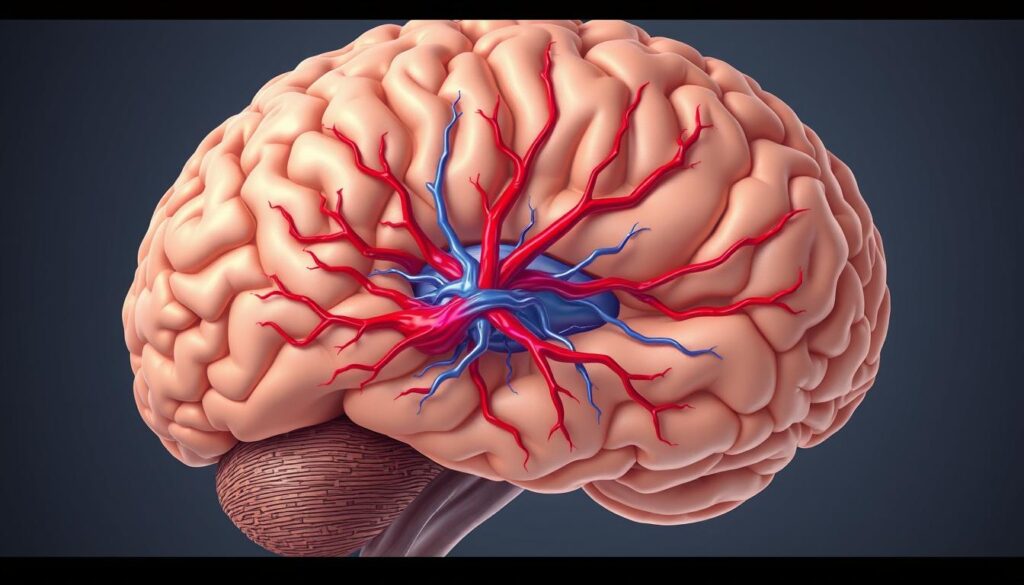
Brain arteriovenous malformation (AVM) is a rare neurovascular disorder affecting brain health. It creates abnormal connections between arteries and veins, disrupting blood flow. This can lead to serious complications in the brain and spinal cord1.
An intracranial AVM forms a tangled web of blood vessels. This bypasses normal capillary connections, reducing oxygen to brain tissues. It also increases the risk of dangerous bleeding2. Men are more likely to develop these complex vascular structures1.
Brain AVMs cause about 2% of all hemorrhagic strokes annually. The yearly bleeding risk is 2% to 3%, varying by AVM type1. People can be born with these malformations or develop them later in life.
Key Takeaways
- Brain AVMs are rare neurovascular disorders affecting blood vessel connections
- They can disrupt normal blood flow and oxygen delivery to brain tissues
- Most common in the brain and spinal cord
- Men have a higher likelihood of developing brain AVMs
- Annual bleeding risk is approximately 2-3%
Understanding Brain AVM (Arteriovenous Malformation)
Brain arteriovenous malformation (AVM) is a rare vascular lesion. It disrupts normal blood flow in the brain. This condition affects less than 1% of the population3.
AVM creates an abnormal connection between arteries and veins. It bypasses the crucial capillary network. About 10 in 100,000 people have this unique brain abnormality3.
How Blood Flow Works in Brain AVM
In AVM, blood moves directly from arteries to veins. This happens at high speed and pressure. It skips the normal capillary filtering system4.
This unusual blood flow pattern increases hemorrhagic stroke risk. Blood vessels become vulnerable to rupture. This can lead to dangerous brain bleeding5.
Common Locations and Occurrence Rates
- Cerebral AVMs occur equally among men and women3
- Can develop anywhere in the brain or spinal cord
- Approximately 300,000 Americans are affected by neurological AVMs3
Risk Factors and Genetic Predisposition
The exact cause of AVM remains uncertain. Genetic factors likely play a significant role. It involves a mix of genetic mutation and an angiogenic event3.
Pregnancy can trigger or worsen AVM symptoms. This is due to cardiovascular changes3.
The annual hemorrhage rate for AVMs is estimated at 4%, highlighting the importance of careful monitoring and potential intervention5.
Assessing your personal risk requires medical imaging. Consult with neurological specialists for a thorough evaluation. Early detection can make a critical difference in managing this complex vascular condition.
Signs and Warning Signals of Brain AVMs
Brain arteriovenous malformations (AVMs) are complex disorders with various warning signs. Early detection is crucial for managing this brain abnormality6.
About 12 percent of people with AVMs have noticeable symptoms requiring medical attention7. These signs range from mild to severe.
- Unexpected seizures
- Severe headaches
- Muscle weakness or numbness
- Vision disturbances
- Speech difficulties
Untreated brain AVMs raise your risk of hemorrhagic stroke. Unruptured AVMs have a 2-4% yearly chance of bleeding6.
Pregnant individuals should be extra careful. Their risk of hemorrhagic stroke may be higher6.
- Sudden, intense headaches
- Unexplained neurological changes
- Persistent dizziness
- Cognitive impairment
“Early recognition of AVM symptoms can be life-saving and prevent potential neurological complications.”
Untreated brain AVMs can lead to serious problems. These include stroke and reduced oxygen to the brain7.
Less than 4 percent of AVMs cause bleeding. However, when they do, the results can be severe7.
Remember, not all AVMs cause immediate symptoms, making regular neurological check-ups essential for those at risk.
Treatment Options and Medical Interventions
Brain arteriovenous malformations (AVMs) have several advanced treatment options. Your specific condition, AVM features, and overall health determine the best approach8.
Doctors use multiple strategies to manage brain AVMs. They focus on interventional neuroradiology techniques to minimize risks and improve outcomes9.
Surgical Removal Techniques
Surgical resection is a key treatment for brain AVMs. It involves removing the abnormal blood vessel cluster while protecting surrounding brain tissue8.
Microsurgery can often fully cure surgically accessible AVMs9.
Endovascular Embolization Procedures
Endovascular embolization is a sophisticated interventional approach. Specialists use special catheters to place blocking agents into the AVM.
This technique seals off abnormal blood vessel connections. It helps reduce potential bleeding risks8.
- Liquid embolic agents are frequently used
- Targets challenging cerebral AVMs
- Minimally invasive procedure
Radiation Therapy Approaches
Stereotactic radiosurgery is a non-invasive treatment option. Doctors use precise radiation beams to damage blood vessel walls.
This causes the vessels to close over 1-3 years8.
“Advances in imaging technology continue to enhance our ability to treat complex brain AVMs with greater precision and safety.” – Neurovascular Research Team
Your medical team will create a custom treatment plan. They’ll consider your unique medical profile and AVM characteristics9.
Conclusion
Brain AVMs are complex neurovascular disorders that require careful management. Research has revealed important insights into these cerebral vascular malformations. Hemorrhagic lesions have a four times higher risk compared to unruptured ones10.
Dealing with a brain AVM doesn’t have to be overwhelming. Medical research has uncovered key factors influencing vascular development. Over half of brain AVM lesions can change size without intervention11.
These findings stress the need for personalized care and regular monitoring. Doctors now know that treatment for brain AVMs must be tailored to each patient.
The Randomized trial of Unruptured Brain Arteriovenous Malformations showed different outcomes across treatment groups10. This highlights the importance of individualized care and expert advice.
Living with a neurovascular disorder can be challenging. However, many patients lead fulfilling lives with proper medical guidance. Stay informed and work closely with your healthcare team.
Remember, ongoing research continues to improve our understanding of brain AVMs. This research also leads to better treatment options for patients.
FAQ
What is a Brain AVM?
A brain arteriovenous malformation (AVM) is a rare tangle of blood vessels. It connects arteries to veins without capillaries. This disrupts normal blood flow and can deprive brain tissues of oxygen.
Are Brain AVMs Dangerous?
Brain AVMs can be dangerous with a 2-3% annual bleeding risk. A ruptured vessel can cause a hemorrhagic stroke, leading to severe neurological damage. However, many people with AVMs lead normal lives with proper medical care.
What Causes Brain AVMs?
The exact cause of brain AVMs is unknown, but they’re typically congenital. Genetic factors may play a role, especially in conditions like hereditary hemorrhagic telangiectasia (HHT). They can develop anywhere in the brain or spinal cord.
What Are Common Symptoms of Brain AVMs?
Symptoms vary widely and can include seizures, headaches, and muscle weakness. Some people may experience numbness, vision problems, and speech difficulties. A sudden, severe headache could indicate a hemorrhage and requires immediate medical attention.
How Are Brain AVMs Diagnosed?
Brain AVMs are diagnosed using advanced imaging techniques like MRI, CT scans, and cerebral angiography. These methods help visualize the AVM’s size, location, and blood flow patterns. This information is crucial for determining the most appropriate treatment strategy.
What Treatment Options Exist for Brain AVMs?
Treatment depends on the AVM’s characteristics and can include surgical removal and endovascular embolization. Radiation therapy is another option. Some low-risk AVMs might be monitored without immediate intervention.
Your medical team will recommend the best approach based on your individual case.
Can Brain AVMs Be Prevented?
Since the cause of brain AVMs is largely unknown, they cannot be definitively prevented. Regular medical check-ups can help with early detection and management. This can reduce the risk of serious complications.
Are Brain AVMs Hereditary?
Brain AVMs are not always hereditary. Some genetic conditions like hereditary hemorrhagic telangiectasia (HHT) can increase their likelihood. If you have a family history of AVMs, consult a genetic counselor or neurologist.
Source Links
- Brain AVM (arteriovenous malformation) – Symptoms and causes – https://www.mayoclinic.org/diseases-conditions/brain-avm/symptoms-causes/syc-20350260
- Arteriovenous Malformations (AVMs) – https://www.ninds.nih.gov/health-information/disorders/arteriovenous-malformations-avms
- Brain Arteriovenous Malformation (AVM) – https://www.barrowneuro.org/condition/arteriovenous-malformation-avm/
- Cerebral arteriovenous malformation: MedlinePlus Medical Encyclopedia – https://medlineplus.gov/ency/article/000779.htm
- Arteriovenous Malformations – Neurosurgery – https://lsom.uthscsa.edu/neurosurgery/clinical-practice/arteriovenous-malformations/
- Arteriovenous Malformation (AVM) – https://my.clevelandclinic.org/health/diseases/16755-arteriovenous-malformation-avm
- Arteriovenous Malformations – https://www.hopkinsmedicine.org/health/conditions-and-diseases/arteriovenous-malformations
- Brain AVM (arteriovenous malformation) – Diagnosis and treatment – https://www.mayoclinic.org/diseases-conditions/brain-avm/diagnosis-treatment/drc-20350265
- Arteriovenous Malformations Treatments | Mount Sinai – https://www.mountsinai.org/locations/cerebrovascular-center/conditions/vascular-malformations/brain
- Updates in arteriovenous malformation management: the post-ARUBA era – https://svn.bmj.com/content/5/1/34
- No title found – https://thejns.org/focus/view/journals/neurosurg-focus/26/5/article-pE10.xml

