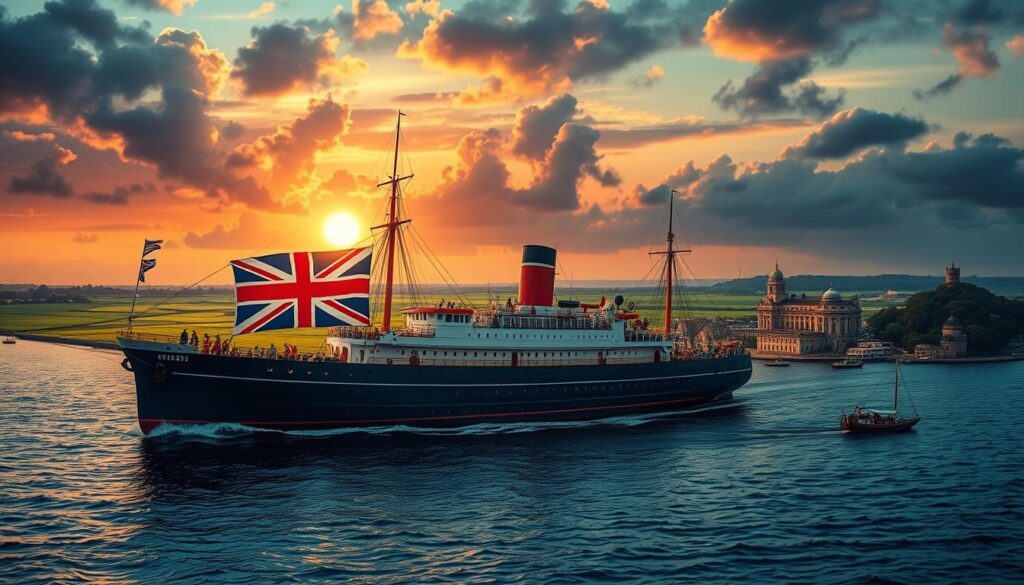
The British Empire started in the late 1500s under Queen Elizabeth I. By 1913, it had grown to rule over 400 million people, making it the largest empire in history1. This vast empire spanned the globe, showing the power of colonialism. The British Empire’s impact on history is huge, and its legacy is felt today.
The British Empire’s role in history is huge. It influenced culture, economy, and politics, all key parts of colonialism. Exploring the British Empire’s history reveals the complex nature of colonialism. It’s a rich and complex topic that offers many lessons.
Key Takeaways
- The British Empire began in the late 1500s under Queen Elizabeth I and grew to rule over 400 million people by 19131.
- The British Empire was a prime example of colonialism, with its impact on world history and culture.
- The British Empire’s legacy is complex, with both good and bad effects, important for understanding colonialism.
- The British Empire’s influence reached many areas of society, including culture, economy, and politics, all key to colonialism.
- Understanding the British Empire’s history is key to grasping the complexities of colonialism and its lasting effects.
Overview of the British Empire
The British Empire lasted nearly four centuries. It was one of the biggest empires in history. It covered areas from the Americas to Africa, Asia, and Australasia. It changed the world through imperial expansion and colonization.
Definition and Scope
The British Empire had many British colonies and territories. It had a system that gave local areas some freedom but also kept the empire in control. By 1670, it included places like New England, Virginia, and Barbados2. It grew to cover many different areas.
Historical Timeline
The British Empire’s history is filled with important moments:
- 1600: The East India Company was founded2
- 1655: Jamaica was taken by force2
- 1763: The Treaty of Paris made Britain strong in Canada2
- 1788: Australia was first settled2
- 1807: The slave trade was banned in British colonies2
Key Features
The empire’s way of governing, its economy, and culture were key to its success. Its military and navy helped it get places like India and Canada2. Its economic plans encouraged trade and getting resources, building a huge network of British colonies.
Major Colonies and Territories
The British Empire stretched across continents, leaving a mark through imperialism. It touched North America, India, Africa, and the Caribbean. Each place played a key role in the empire’s history.
North America
In North America, the British set up 13 colonies. These colonies grew through trade and farming, challenging British control. Their fight for freedom was a major shift in British history, showing the hard task of ruling far-off lands3.
India
India was seen as the “jewel in the crown” of the British Empire. The British East India Company took control from 1757, changing India’s economy and society. This period showed how deeply British rule affected India’s place in the world4.
Africa and the Caribbean
In Africa and the Caribbean, Britain’s role was complex. The slave trade hurt African communities, while the “Scramble for Africa” in the 1880s saw Britain control about 30% of Africa. In the Caribbean, sugar estates used enslaved labor, shaping the area’s economy and society4.
Impact and Legacy of the British Empire
The British Empire’s influence is vast, shaping many parts of today’s world.
Cultural Influences
English is now a global language, helping people talk and do business across borders. British schools and books have taught values like democracy and freedom in many places. Christianity, brought by the British, has become a part of many cultures.
Economic Consequences
The Empire made Britain rich by using resources and trade from colonies. But, this wealth hurt local economies, causing lasting economic gaps. Today, the Commonwealth affects economic policies and trade.
Political Ramifications
Many colonies adopted British-style governments and laws. This helped create stable political systems in some areas. Yet, others faced problems due to these imposed systems.
Decolonization and Its Effects
Decolonization led to new, independent countries and the Commonwealth. It brought cooperation and cultural sharing. But, it also meant dealing with old colonial policies and finding new national identities. This legacy shapes today’s politics and society56.
FAQ
What defined the British Empire and what was its global scope?
The British Empire was huge, covering every continent with its colonies. At its peak, it controlled a quarter of the Earth and had 400 million people under its rule. This made it the biggest empire in history.
How did the British Empire expand and what were some key moments in its growth?
The empire grew through sea exploration, trade, and strategic moves. Key moments include setting up colonies in North America and getting India. The Scramble for Africa was also a big deal. These events helped shape the empire’s size and influence.
What were the unique features of the British Empire’s governance and economic policies?
The empire had a centralized system of rule, using local structures to keep control. It focused on extracting resources and trade, building strong infrastructure in colonies. This helped Britain’s economy grow while exploiting local resources.
Which were the most significant colonies of the British Empire, and how did they influence its development?
Colonies like North America, India, Africa, and the Caribbean were key. The loss of the 13 American colonies was a big turning point. India was a major economic and strategic asset. Africa and the Caribbean were marked by the slave trade and intense imperialism, shaping their futures.
What is the lasting cultural impact of the British Empire on former colonies?
The empire left a lasting cultural mark. It introduced English, education, laws, and religions. These influences are seen in former colonies, creating a shared heritage in the Commonwealth.
How did the process of decolonization unfold, and what were its effects on the British Empire’s legacy?
Decolonization started after World War II, with colonies wanting independence. This led to the end of the British Empire and the start of the Commonwealth. The transition to independence changed global power and brought ongoing challenges to former colonies.
Source Links
- What was the British Empire? – BBC Bitesize – https://www.bbc.co.uk/bitesize/articles/zpjv3j6
- British Empire | History, Countries, Map, Size, & Facts | Britannica – https://www.britannica.com/place/British-Empire
- British Empire | Timeline | Britannica – https://www.britannica.com/summary/British-Empire-Timeline
- Territorial evolution of the British Empire – https://en.wikipedia.org/wiki/Territorial_evolution_of_the_British_Empire
- What was the legacy of the British Empire? – https://www.britishempire.me.uk/legacyofempire.html
- What are the British Empire’s “Legacies”? – https://blogs.sussex.ac.uk/snapshotsofempire/2022/10/10/what-are-the-british-empires-legacies/